🦔⚡ THE BLUE BLUR IN A WORLD THAT DOESN’T CARE
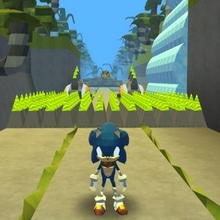
Kogama: Sonic Dash 2 has that “okay, one quick run” energy that turns into “why am I sweating over a browser game” five minutes later. You spawn in, the map looks bright and friendly, and then the first set of jumps politely introduces you to the truth: this is a 3D parkour platformer where the floor is basically a suggestion. You’re not strolling through a level, you’re sprinting through a community-built obstacle course that wants to catch you slipping. And because you’re playing on Kiz10, it’s instant. No warm-up, no long intro, just go. The kind of go where you feel your fingers tighten up like you’re trying to grip the air. 😅
The Sonic theme matters here, not because the game needs a big story, but because it sets the mood. You’re supposed to move fast. You’re supposed to be fearless. You’re supposed to bounce from platform to platform like gravity is a rumor. Of course, reality shows up quickly: you still have to land. You still have to line up jumps. You still have to respect the spacing, the corners, and the little “gotcha” traps that appear right when you start getting confident.
🏁🌀 PARKOUR THAT FEELS LIKE A RACE AGAINST YOUR OWN IMPATIENCE
What makes this kind of Kogama-style runner work is the rhythm. There’s a flow to a good run: jump, land, adjust, jump again, keep momentum. When you’re locked in, you glide. When you’re not, you bonk into edges, slide off platforms, and fall in the most dramatic way possible, like you’re reenacting a cartoon “Welp!” moment. The game doesn’t need to be cruel to be challenging. The challenge comes from speed plus precision, and that combo is always spicy.
You’ll notice the way the map pushes you to commit. Some jumps are easy and safe, the kind that lull you into tapping forward without thinking. Then you hit a section that’s tighter. Maybe the platforms are smaller. Maybe the gaps are longer. Maybe there’s a narrow bridge that turns your run into a balancing act. The game quietly asks: are you actually in control, or are you just holding forward and hoping? That question hits hard when your Sonic character skids off a ledge because you turned half a second too late. 😭🦔
🧱🎯 CHECKPOINTS, SHORTCUTS, AND THE “DO I RISK IT?” BRAIN VOICE
A big part of the fun in obstacle course platformers is the constant risk math. Do you take the safe route that’s longer, or do you gamble on a faster line that could save time but also destroy your run? Kogama: Sonic Dash 2 shines when it puts you in that decision loop again and again. You start recognizing patterns: a jump pad that can boost you forward, a ramp that launches you into a cleaner angle, a tricky corner that’s faster if you cut it tight… and dangerous if you cut it wrong.
This creates those tiny gamer monologues. “I can make that.” “I made it last time.” “Okay but I’m better now.” And then you miss, and you instantly become humble for exactly three seconds. The best part is that the game encourages retrying without making it feel like punishment. Failing is quick. Resetting is quick. The only thing that lingers is your pride, which is, honestly, the real currency in a speedrun-style platform game. 😤⏱️
🚧🔥 TRAPS THAT FEEL LIKE JOKES UNTIL THEY AREN’T
The obstacle course design in games like this usually mixes pure platform skill with little surprise moments. It might be a sudden drop, a slippery surface, a narrow ledge, or a jump that looks normal until you realize you need a better angle to stick the landing. The trap isn’t always a literal spike or a laser. Sometimes the trap is your own autopilot. You see a straight path, you assume it’s safe, and then the map hits you with a twist, a gap, or a bend that punishes lazy movement.
That’s where the game feels fun instead of just difficult. It’s not asking you to memorize complicated rules. It’s asking you to pay attention. And the second you start paying attention, you begin to feel improvement. Your jumps get cleaner. Your turns get tighter. You stop overcorrecting midair like you’re swatting invisible flies. You start landing centered instead of barely clipping the edge. Those small upgrades in skill feel huge because the game is fast. Your progress shows up immediately.
🌈🎮 KOGAMA VIBES: COMMUNITY CHAOS WITH A SONIC SKIN
There’s a specific vibe to Kogama-style experiences: they feel like playgrounds built by players who want you to have fun and suffer a little. The environments are usually colorful and bold, with simple shapes that make the challenges readable. That readability matters when you’re moving quickly. You don’t want to be confused about where to go; you want to be challenged by whether you can get there.
Sonic as the theme adds extra “go, go, go” pressure. Even if you’re not officially timed in every moment, you feel timed. You want to keep momentum. You want to chain jumps smoothly. You want to finish the run with that satisfying sense of flow, like you didn’t just survive the level, you dominated it. And when you do finish, it feels like a little victory lap. Then you replay because now you want to finish faster, cleaner, with fewer mistakes… and you remember one section that still annoys you, so you go back like it’s personal. 😈🏁
🧠⚡ HOW TO GET BETTER WITHOUT TURNING IT INTO HOMEWORK
If you keep falling, it’s usually one of three things: you’re rushing the approach, you’re turning too late, or you’re jumping while off-center. The quickest improvement comes from slowing down in the right places. Not everywhere, just in the tricky sections. Take a half-second to line up. Make sure your character is straight. Then commit. It’s weird, but “slowing down” often makes you faster overall because it reduces resets.
Also, learn which parts deserve patience. A long safe run-up is a gift, use it to set your angle. A narrow ledge is not the place for dramatic steering. Small corrections win. Big corrections throw you into the void. And if there’s a jump that keeps ruining you, don’t keep attacking it the same way. Change your approach angle slightly. Start your jump earlier or later. Treat it like a puzzle for your hands, not a wall you headbutt forever. 🧩🦔
🏆✨ WHY IT’S SO EASY TO GET ADDICTED ON KIZ10
Kogama: Sonic Dash 2 is the perfect mix of quick sessions and deep replay. You can hop in for a few minutes, finish a run, feel good, leave. Or you can get stuck chasing that “perfect” run where everything flows, where you don’t stumble, where you don’t hesitate, where you hit the jumps like you’re on rails. That chase is addictive because it feels achievable. The game is simple enough to understand instantly, but precise enough that mastery takes real practice.
And when you finally nail a clean sequence that used to ruin you? That’s the good stuff. That’s the moment you lean back and do the tiny silent celebration like “yep, I’m him.” Then you immediately fall in the next section and you’re humbled again. Balanced. Fair. Slightly rude. Very fun. 🦔⚡🎮





 Share
Share
 Embed
Embed


