🚗🅿️ Small parking lot, enormous ego damage
Park It! is one of those games that looks simple from a distance and then immediately starts disrespecting your confidence. The mission sounds harmless enough. Drive the car. Reach the space. Park cleanly. Do it fast. Avoid smashing into everything like a confused shopping cart with an engine. Easy, right? Well… not exactly. That is the trick with parking games. They take something ordinary, almost boring in real life, and turn it into a tiny pressure chamber where every turn matters and every bad angle follows you like a personal insult.
On Kiz10, Park It! works as a precision parking game with a timer, obstacles, and that tense little balance between speed and control that makes the whole thing weirdly addictive. It is not about racing in the classic sense. You are not drifting through neon streets or flying off ramps like gravity is optional. This is a different kind of challenge. Slower, tighter, meaner. The chaos is smaller, but somehow more humiliating. Because when you fail in a parking game, you usually know exactly why. You turned too early. Too late. Too hard. Too confident. The game does not need to shout at you. Your own brain handles that part just fine.
And that is exactly why Park It! is fun. It turns careful driving into a battle of patience, geometry, and mild emotional collapse.
⏱️🛞 Fast is good, clean is better
The clever thing about Park It! is that it does not let you choose between speed and precision. It wants both. That is where the tension lives. If the game were only about careful movement, it could become calm and methodical. If it were only about speed, it would be just another racing challenge in disguise. But this game puts you in that uncomfortable middle zone where rushing is dangerous and overthinking is also dangerous. Lovely.
You start each level with a clear goal, get to the marked parking space as quickly as possible without clipping obstacles or losing control. Sounds reasonable. Then you begin moving and the level reminds you that narrow lanes, awkward corners, and little hazards have no sympathy at all. Every route becomes a puzzle. Every turn asks a question. Can you brake at the right time? Can you line up the car before the final entry? Can you stop treating the accelerator like an argument you are trying to win?
That last part matters more than people expect. Parking games reward restraint. They reward the player who understands that smooth movement beats dramatic correction almost every time. Park It! has that nice skill-based feel where the challenge is not random nonsense. Improvement actually happens. You begin to read angles better. You start noticing where your setup goes wrong. You realize the cleanest parking jobs are usually decided a few seconds before the parking spot, not at the spot itself.
Which is frustrating at first. Then very satisfying.
🚧😅 Obstacles exist mostly to embarrass you
A parking game without obstacles would barely be a game. It would just be a polite errand. Park It! understands that the real fun comes from forcing you to work around annoying little problems. Barriers, tight spaces, tricky turns, maybe speed bumps or awkward lane placement, all of it turns the parking lot into a miniature obstacle course disguised as something civilized. It is not civilized. It is a trap with painted lines.
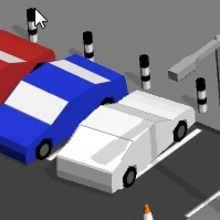
What makes this fun is how ordinary the danger looks. In a shooter, danger explodes. In a horror game, danger chases you. In Park It!, danger is a curb. A cone. A badly placed divider. A bend in the lane that suddenly feels one inch too narrow for your current level of competence. The stakes are smaller, but the pressure is real because everything feels avoidable until the moment you hit it. Then it feels personal.
There is also a funny little psychological shift that happens when you play long enough. At first, the parking space is the goal and the obstacles are the problem. Later, the obstacles become the real focus and the parking space turns into a kind of finish line for your own self-control. You stop asking, “Can I park?” and start asking, “Can I reach that spot without doing something embarrassingly preventable?” That is a very different energy, and it gives the game its bite.
🧠📐 Every level is basically a geometry exam with tires
Park It! may look like a casual driving game, but underneath the hood it is really a game about spacing. Distance. Angle. Timing. Tiny corrections. It teaches you to think about movement in a very practical way. Not glamorous driving, not cinematic driving, just efficient driving. The kind where the car needs to be in the right place before the turn, not halfway through regretting it.
That is where the satisfaction comes from. You approach a nasty corner, brake early, swing just wide enough, straighten out, and slide into the spot cleanly. No crunch. No awkward backup panic. No desperate wheel wiggling at the end. Just a smooth finish. Those moments feel great because they look simple and secretly are not. A clean parking move in a game like this has the energy of a magician making something difficult seem obvious.
And of course the reverse is also true. One messy approach can wreck the whole level. That is the beauty of it. Park It! constantly reminds you that control is built in advance. The final seconds only reveal whether you earned it.
This is why parking games are sneakily addictive. Improvement is visible. Tangible. You can feel your hands getting calmer, your timing getting sharper, your terrible habit of oversteering slowly fading into memory. Or not fading at all, depending on the day. We are all human.
🔥🚦 The lot gets louder the moment you get impatient
Impatience is the secret villain in Park It!. Not the timer. Not the barriers. Not the awkward route. You. Specifically the version of you that says, “I can probably squeeze through there,” right before the car kisses a wall and ruins everything. The game is excellent at exposing that part of the player. It waits quietly, lets you build a little confidence, and then hands you a corner that punishes every reckless instinct you have.
That is why the pace works so well. The timer creates urgency, but not enough to turn the game into nonsense. It simply pressures your decisions. You can still be careful, but you cannot drift into endless hesitation either. The sweet spot is calm speed. Smooth speed. The kind that looks easy once you have earned it and absolutely does not feel easy while you are learning.
There is a nice dramatic rhythm to that loop. Accelerate, brake, line up, breathe, commit, stop. It is almost elegant when it goes well. And when it goes badly, it becomes slapstick with a steering wheel. Also fun, in a different way.
🎮🅿️ Why Park It! works so well on Kiz10
Park It! succeeds because it understands the weird magic of parking games. It takes a basic idea, place the car in the right spot, and wraps it in just enough time pressure, obstacle placement, and route tension to make every level feel like a compact skill challenge. No wasted motion. No unnecessary systems. Just you, the car, the lot, and a very fragile relationship with accuracy.
On Kiz10, it is a great fit for players who enjoy driving games, precision challenges, car control, and those browser games that seem simple until they completely take over your focus. It is approachable in seconds, but the actual rhythm of mastering it takes more than luck. You need patience. Spatial awareness. A bit of nerve. And maybe the humility to admit that the last crash was not the game’s fault.
So yes, Park It! turns parking into a dramatic little sport. Tight turns become boss fights. Painted lines become judgment. The final stop becomes a tiny moment of glory. Or disaster. Sometimes both in the same level. That is exactly why it works.









 3.6 (10 votes)
 Share
Share
 Embed
Embed


