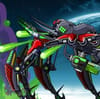
A metal spider wakes up 🕷️⚙️
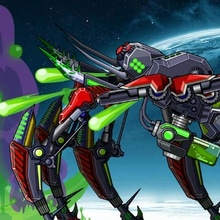
The first thing you see is not a friendly robot dog or a clunky training drone. It is a tarantula made of steel and sparks, eight legs folded under a heavy armored core, eyes glowing like tiny red suns. In Robot Tarantula you are not just pressing start on a level, you are hitting the power switch on a combat machine that really should come with more warning labels. The workshop lights flicker, servos whine, and your brand new mech lifts its head as if it already knows there is work to do.
That moment in the hangar is strangely quiet. Tools are still scattered across the workbench. Cables snake across the floor. Diagnostic screens scroll numbers you pretend to understand. Then one leg takes a careful step, claws scraping metal, and you realize how different this robot feels from any biped mech. Eight contact points, eight ways to move, eight opportunities to mess up or look incredibly cool.
Eight legs, eight problems 🕸️🔧
Controlling a spider shaped robot is not just a visual gimmick. It changes the way you see the map. Instead of thinking in simple left and right, you start thinking in arcs and diagonals. Your tarantula can hug walls, creep along narrow beams and pivot around its center like a living compass made of titanium. Every leg has a purpose. When you push forward, the front limbs hunt for stability while the rear ones shove you into motion with more force than you expected.
The game does not lecture you with long tutorials. It just drops you into a test zone and lets you feel what the mech can do. Take a sharp turn and the outer legs stretch out, gripping the ground so the whole body slides in a strange, satisfying way. Climb a steep ramp and you can almost sense the weight distribution shifting as the spider mech presses down with every limb to avoid slipping. If you rush, you will stumble. If you treat the machine like something alive, you will handle it much better.
From workshop bench to battlefield 🔋🚀
The heart of Robot Tarantula is that loop from building bay to combat zone. You start each run in the workshop, staring at a chassis that looks bare and full of potential. Empty sockets wait for armor plates, weapon systems, sensor pods and strange experimental gadgets you probably should not trust yet. You drag on new leg segments that change your speed and stability. You attach different cannons to the front and rear, wondering which combination will keep you alive longest.
Every part has a personality. Heavy armored legs make you slower but let you shrug off explosions that would flip a lighter build. Sleek, jointed limbs give you crazy speed and terrifyingly fragile ankles. One turret might fire fast but weak pulses, another launches slow plasma orbs that wipe out clusters of enemies at once. You begin to see your tarantula as more than a single robot. It becomes a collection of choices, a walking summary of every upgrade you decided to risk.
When you deploy into a mission, the tone shifts fast. The hangar hum fades and you are suddenly crawling across ruined industrial yards, abandoned research labs and dusty canyon bases. Drones dart between rocks. Defense turrets wake up like angry eyes. Mines glint under the sand. You move your spider mech forward, legs ticking, guns tracking, and the first volley of shots cuts through the air with a sound that instantly tells you this is not a gentle puzzle.
Enemies that really hate arachnids 🤖💥
The opposition in Robot Tarantula feels like it was built by someone who saw your mech and said absolutely not. Tiny scout bots zip across the map, firing quick bursts and then hiding behind cover. Heavier walkers stomp into view, their armor thick enough that you cannot just spray and pray. Overhead, hovering sentries drift in slow circles, raining down energy beams if you linger in the open for too long.
The best fights are the ones where the battlefield itself joins the argument. Conveyor belts tug at your legs while you are trying to line up a shot. Laser fences force you to plan a careful path instead of charging straight ahead. Tight corridors make your eight legged body feel a little too big, so you end up backing out in a clumsy shuffle while enemies try to box you in. All of it combines into this feeling that the world is not just scenery. It is a puzzle you must solve while someone throws explosives at you.
Boss encounters push that feeling even harder. A massive tank spider with rotating cannons crawls over the side of a cliff, every step shaking the ground. A segmented worm robot bursts from vents in the floor, forcing you to track its position and strike only when a weak point appears. Those fights demand patience and pattern reading. Your tarantula might look terrifying, but if you charge blindly, you will watch it fall apart piece by piece.
Upgrades, experiments and weird builds 🧠💡
Between missions, the workshop becomes your second home. This is where you decide what kind of player you want to be today. Do you build a slow, unkillable fortress spider with heavy armor and short range cannons Or do you assemble a quick, glassy assassin that sprints along walls, dodges everything and lands precise hits before dancing away
You experiment with leg layouts. Longer front limbs for easier climbing. Reinforced rear legs for speed bursts. Maybe you bolt on shock pads that damage enemies with every stomp. On top of that, you tweak your weapons loadout. Front mounted rifles for direct fire, side mounted rocket pods for splash damage, or a weird experimental laser that gets stronger the longer you keep it on target.
Every small change shows up immediately in your next mission. That new armor plate might save you from a mine that used to destroy you. That extra booster on the back might push you just far enough to cross a gap you could never reach before. Sometimes your ideas fall flat and you come back from a mission in pieces, laughing at your own bad decisions. Sometimes you stumble on a build that just clicks and makes the next few levels feel like you cheated, even though you earned every part.
Controls that feel like piloting a real mech 🎮🕷️
Despite the complexity of the machine, the controls stay comfortably intuitive. On keyboard you move with familiar directional keys or WASD, aim with the mouse and fire with simple clicks or key presses. On touch devices, virtual sticks and buttons take over, giving your thumbs direct control over crawling, aiming and shooting. You are never wrestling with the interface. Instead, you are wrestling with your own greed and timing.
There is a tiny pleasure in learning how the spider’s body reacts to your inputs. Tap forward and you get a careful step. Hold the key down and you break into a skittering run that feels dangerously fast. Swing the turret while moving and you see the whole chassis lean into the turn. If you stop abruptly on a slope, the rear legs dig in automatically, claws scratching at the surface in a way that makes the whole thing feel heavier and more physical.
The more time you spend with the robot, the more it stops feeling like a collection of parts and starts feeling like an extension of your hands. When that happens, missions stop being scary and start being satisfying. You no longer think “I hope my tarantula survives this.” You think “Let’s see how badly we can scare these factory guards today.”
Why you keep coming back to the nest 🔁🔥
What makes Robot Tarantula so sticky is not just the metal spider fantasy, although that alone is pretty wild. It is the loop of planning, testing, failing and improving that sits underneath the explosions. You open the game for a quick mission, tweak one part, and suddenly you are three missions in, still telling yourself just one more.
You remember specific runs. The mission where you pushed too far into enemy territory, lost three legs to mines and still somehow crawled to the extraction point with your cannons blazing. The time you tried a ridiculous glass cannon build, got deleted in the first minute, and laughed so hard you immediately rebuilt it with one extra layer of armor just to see if that would fix everything. The boss battle where you finally learned to use vertical walls to your advantage, circling the arena like a real spider while the enemy tried and failed to track you.
Under all the chaos there is a subtle sense of progress. Your parts collection grows. Your understanding of each enemy type deepens. Your hands stop panicking and start reacting with confidence when a new threat shows up. Day by day, mission by mission, your tarantula becomes more than just a robot. It becomes your strange eight legged signature in a world of generic mechs. And every time the hangar doors open and your steel spider steps out onto the battlefield again, you feel that little spark of excitement that says all right, let’s crawl back into the chaos one more time 🕷️✨





 Share
Share
 Embed
Embed