🪨 Prehistoric panic with a rolling attitude
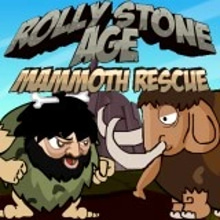
Rolly Stone Age Mammoth Rescue is the kind of puzzle adventure that looks simple for about five seconds, and then suddenly you are staring at a rock, a caveman, a trapped mammoth, and a disaster-shaped plan forming in your head. It drops you into a rough, primitive world where the rules are clear enough to understand but messy enough to stay interesting: the mammoths need saving, hostile humans are in the way, and your best argument is usually a well-placed stone. It is a prehistoric rescue game with a playful streak, built around timing, environmental interaction, and that deeply satisfying feeling of causing chaos for a good reason. On Kiz10, the game is presented as a puzzle-adventure where you become the savior of these animals and use different objects and stones to defeat the men and rescue the mammoths. That setup says everything it needs to say. Rescue mission, yes. But also: welcome to the Stone Age, please solve your problems by making gravity do the ugly work.
There is something immediately fun about that premise. You are not some armored war hero with a dramatic soundtrack and a suspicious number of weapons. You are dealing with a raw, scrappy prehistoric mess where survival and rescue depend on observation, quick thinking, and occasionally dropping the right object on the wrong person. Elegant? Not really. Effective? Absolutely.
🐘 The mammoths are counting on you, which is stressful actually
The heart of the game is the rescue itself. That matters, because Rolly Stone Age Mammoth Rescue does not feel like a cold mechanical puzzle game where you are just clearing levels for points. There is a mission behind the madness. The mammoths are trapped, threatened, or blocked by cavemen, and every level becomes a small rescue operation disguised as a slapstick problem-solving challenge. It gives the action a weirdly noble core. You are not just knocking things around because destruction is fun, even though, yes, destruction is very fun. You are doing it to free these giant shaggy creatures from a very bad day.
That rescue angle changes the mood. It makes the puzzles feel more urgent, more personal. A rolling boulder is not just a boulder. It is a plan. A suspended object is not decoration. It is potential justice. You look at each scene and start asking the real prehistoric questions. What can move? What can fall? What can crush that guy before he causes more trouble? Very educational stuff.
And the mammoths themselves give the game charm. They are not just targets or props. They are the reason the level exists. Their presence makes the world feel a little wilder, a little softer, and a lot more memorable. Saving a mammoth feels better than opening a random exit door. There is purpose in it. Big fuzzy purpose 🐾
🔥 Every level feels like a small stone-powered conspiracy
What keeps the game entertaining is the structure of the puzzles. These are not giant sprawling logic mazes. They are compact little scenarios where a few objects, a few enemies, and a few interactive pieces create a surprising number of possibilities. You study the setup, start imagining cause and effect, and then try to trigger the chain reaction that clears the path. Sometimes the answer is immediate. Sometimes it is hidden in one tiny detail you almost ignored because your brain was too busy admiring how suspiciously crushable everyone looks.
That is where the game becomes addictive. It teaches you to think in motion. Not just what object matters, but when it matters. Not just where the stone should go, but what should happen first so the whole plan works cleanly. A good solution in Rolly Stone Age Mammoth Rescue feels like a primitive domino effect. One click, one release, one drop, one panic-filled second, and then the level opens up like it was waiting for you to stop guessing and start seeing.
The game also understands something very important about browser puzzle games: failure should be funny. If your plan goes wrong, it usually goes wrong in a way that still teaches you something. Maybe the rock drops too early. Maybe the wrong caveman survives. Maybe you solve half the problem and accidentally create a new one, which is honestly the most Stone Age thing imaginable. But those failures are part of the rhythm. You are not punished with boredom. You are nudged toward a better idea.
🌋 Cavemen, traps, and the beauty of controlled chaos
There is a lovely roughness to the whole experience. The setting is prehistoric, so everything feels physical. Heavy objects. natural hazards. crude obstacles. danger that looks like it was assembled by accident and left there by history. That gives the puzzle design a tactile quality. You do not feel like you are navigating abstract symbols. You feel like you are dealing with stuff. Stone, wood, platforms, enemies, mammoths, and all the messy consequences that come from putting them in the same level.
That physicality makes every success more satisfying. When something rolls exactly where you hoped, when a trap finally triggers the way you predicted, when the path opens and the mammoth is safe, it feels earned. Not because the puzzle is impossibly hard, but because you had to understand the scene instead of just reacting to it. That is a big difference. The game respects your ability to observe.
And then there is the comic energy. Rolly Stone Age Mammoth Rescue never feels grim, even when it is built around danger. There is a cartoonish bounce to the levels, a lightness to the violence, a sense that this entire prehistoric rescue operation exists in a universe where giant rocks are both tools and punchlines. That tone helps a lot. It keeps the game lively. It lets you enjoy the trial-and-error process instead of treating every failed attempt like a tragedy carved into a cave wall.
🧠 Small puzzles, sharp instincts
What I like most about this game is that it rewards a very human kind of thinking. Not textbook logic. Not sterile optimization. More like instinct sharpened by observation. You look at the level and get a feeling. You test the feeling. Sometimes it works. Sometimes it explodes in your face in a spiritually educational way. Then you adjust. That loop feels natural, and it makes the game easy to sink into.
Because the levels are compact, the pacing stays clean. You are never wandering around lost in some oversized map wondering what the actual puzzle is. The puzzle is right there, staring at you with dirt on its face. That focus makes the game ideal for quick sessions, but it also makes it dangerously easy to keep playing. One more level turns into three. Three turns into “wait, why am I so invested in these mammoths now?”
That is the hidden strength of Rolly Stone Age Mammoth Rescue. It looks like a casual prehistoric puzzle game, and it is accessible enough to be one, but underneath that simplicity is a satisfying little machine of timing, chain reactions, rescue goals, and environmental problem-solving. It has enough structure to feel smart and enough chaos to feel alive.
🌿 Why this prehistoric rescue game still works on Kiz10
On Kiz10, the game fits perfectly for players who enjoy puzzle games, animal rescue games, prehistoric adventures, and physics-style challenges that are easy to understand but fun to master. The official Kiz10 page places it between Puzzle and Adventure categories, which makes sense because it is not only about solving each level but also about progressing through a themed rescue journey with a clear objective and a playful world.
If you like browser games where each stage feels like a miniature trap room waiting to be unraveled, this one has real charm. If you enjoy caveman settings, mammoth themes, rolling-object puzzles, and rescue mechanics with a bit of cartoon mayhem, it hits that sweet spot beautifully. It is clever without showing off, funny without trying too hard, and satisfying in that old-school way where one good idea can change the whole screen.
Rolly Stone Age Mammoth Rescue is basically prehistoric problem-solving at its best. Save the mammoths. Outwit the cavemen. Trust the rock. Maybe not emotionally, but definitely strategically.





 Share
Share
 Embed
Embed


