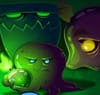
🌊💣 Welcome to the Ocean, Please Don’t Drop That
Sea Boom has the kind of concept that sounds simple right up until you actually play it. You’re deep underwater, everything looks calm in that “aquarium at night” way, and then the game hands you a bomb and says, gently, politely, almost sweetly: move this to the evil jellyfish and collect all three stars while you’re at it. On Kiz10.com it feels like a classic puzzle challenge with a mischievous grin, the type of game that looks small and ends up living in your head because you keep replaying the same level thinking, I can do it cleaner. I can do it faster. I can do it without that one embarrassing bump into the wall that makes everything spiral. 😅
The magic is that it’s not a complicated control scheme. It’s movement. It’s positioning. It’s planning a route in a little underwater maze where every push matters, because once you start sliding that bomb around, you’re basically negotiating with physics, corners, and your own impatience. And impatience, in Sea Boom, is expensive.
🪼😈 The Jellyfish Isn’t Just a Target, It’s a Mood
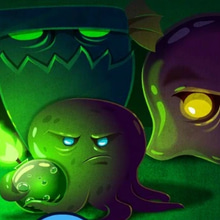
The evil jellyfish at the end of each stage isn’t there to tell a story. It’s there to give you direction, a final destination with a smug aura. It’s the kind of enemy that doesn’t chase you, doesn’t shout, doesn’t need to. It just waits, like a boss who knows you’ll mess up before you reach it. That’s why it’s satisfying when you finally line up the bomb correctly and boom, level cleared, jellyfish deleted, your ego patched back together. 💥🪼
But the jellyfish is also what makes the puzzle feel like a mission instead of a wandering maze. You aren’t moving randomly. You’re threading a path from where you start, through the star placements, toward that final “end this” moment. It’s a neat loop: chase perfection, then deliver destruction.
⭐🧭 Three Stars, Infinite Bad Decisions
The star collection is where Sea Boom stops being a casual stroll and becomes a little tactical obsession. Grabbing one star is easy. Grabbing two is usually doable. Grabbing all three without wasting moves or trapping yourself in a stupid corner you created with your own hands? That’s where the game starts whispering in your ear. The stars are placed to tempt you into detours, into risky angles, into “I’ll just push it a tiny bit more” choices that turn into “why is it stuck there now?” moments. 😭
You’ll notice how the stage design plays with your confidence. It gives you a straight path to the goal, then places a star slightly off-route, like a shiny lie. And you take the bait because your brain doesn’t like leaving stars behind. It feels incomplete. It feels wrong. So you commit, you go after that star, and suddenly you’re doing careful micro-movements to avoid overshooting, because overshooting underwater corridors is how disasters begin.
There’s a fun tension here: the game rewards patience, but it also rewards boldness at the right time. Sometimes the cleanest solution is a smooth, efficient route that feels obvious in hindsight. Sometimes it’s a weird zigzag that looks wrong until it clicks. Sea Boom is basically a puzzle about accepting that “weird” can still be correct.
🧠🫧 Sliding Physics and the Art of Not Panicking
Sea Boom’s movement feels like you’re guiding something heavy through water. The bomb doesn’t behave like a feather. It has momentum. It slides. It bumps. It behaves like an object with consequences. That’s why it’s so easy to mess up when you rush. You push too far, it glides too long, and now you’re out of alignment and the whole plan collapses like a sandwich dropped on the floor. 😩
So you learn to play with restraint. Small nudges. Thoughtful pushes. Setting up angles before you commit. It’s not flashy skill, but it’s real skill, the kind that makes you better at puzzle games in general. You start seeing the board as a set of lanes and stopping points. You stop thinking “go there” and start thinking “if I push from here, what happens next?” That’s the moment you’re not reacting anymore, you’re controlling.
And when you finally get into that calm rhythm, it feels oddly satisfying. The ocean might be quiet, but your brain is loud with calculations, tiny predictions, and that little internal coach voice saying, slow down, don’t throw it away.
🐠⚠️ Traps, Tight Passages, and the Level That Humiliates You
Every good puzzle game has that one stage that teaches you humility. Sea Boom does it with tight corridors and hazards that punish sloppy movement. You’ll have a level where everything seems fine, you’re cruising, and then one wrong push puts the bomb in a position that’s technically not impossible… but it’s annoying. Like, genuinely annoying. And then you realize the game is training you. It’s training you to avoid getting into that position in the first place. 😤
That’s the fun kind of difficulty. Not random chaos, but “consequences exist” difficulty. You begin to appreciate safe positioning. You begin to respect corners. You begin to understand that sometimes you should take a longer route because it keeps you in control. The sea is patient. It will wait for you to make one greedy move and then it will punish you with a reset.
Still, those hard stages are the reason the game sticks. When you beat them, it doesn’t feel like you got lucky. It feels like you figured something out, like you solved a tiny underwater riddle that was designed specifically to mess with you.
🎬🌊 Little Underwater Heists, One Perfect Route at a Time
The best way to describe Sea Boom’s vibe is “mini heist puzzles.” You start a level, you scan the room like a thief casing a vault. Where are the stars? Where’s the jellyfish? What are the choke points? What’s the one push that would ruin everything? Then you start moving with intention, stealing stars in the cleanest order you can manage, and sliding toward the final target like you’re trying not to wake the entire ocean. 🫣⭐
When it goes well, it feels cinematic in a goofy way. You collect the last star, line up the approach, and deliver the bomb to the jellyfish with that satisfying finality. When it goes badly, it feels like you tripped the alarm and now you’re sprinting in circles trying to recover, except your sprinting is actually slow bomb nudges and quiet frustration. Sea Boom is gentle chaos, the kind that makes you laugh at yourself while still taking it seriously.
🏁💥 Why Sea Boom on Kiz10 Feels So Replayable
Sea Boom is easy to start and hard to finish perfectly, which is basically the perfect recipe for a browser puzzle game. You can jump in for a few levels, get a quick win, and leave. Or you can get trapped in that beautiful loop of “just one more try,” chasing three stars with the stubborn energy of someone who refuses to be outsmarted by a corridor. 😅
It’s also a great kind of difficulty because it’s clean. If you fail, it’s usually on you. Not in a mean way, more like in a motivating way. You know what you did. You know what you should do differently. You restart and apply the lesson instantly. That immediate feedback is why it works so well on Kiz10.com, especially if you like puzzle games that reward careful thinking without drowning you in complicated systems.
So yes, it’s a simple premise. Bomb plus stars plus jellyfish. But the way the levels twist thats premise into small, clever challenges makes it surprisingly addictive. You’ll play one stage, beat it, and then immediately want to beat it better. Cleaner route. Fewer awkward bumps. Smoother star order. Bigger boom at the end. 💣🪼✨








 4.1 (20 votes)
 Share
Share
 Embed
Embed