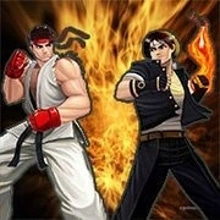
The screen fades in on a crowded stage and you can almost hear an arena that exists somewhere outside your headphones. Lights flash, pixels crackle, and two legends step forward from opposite corners. On one side an SNK veteran tightens his gloves. On the other a Capcom icon rolls their shoulders like this is just another day in the office. The announcer calls the round and suddenly SNK vs Capcom SVC Chaos Super Plus stops being a name and becomes a promise. This is a retro fighting game where two universes collide and the only thing that matters is who presses their advantages better. 🔥
What hits you first is how alive the sprites feel. These are not generic fighters you forget after one match. These are characters you recognise from old arcades and living room battles, thrown into the same ring and told to sort things out with fists, fireballs and supers that shake the screen. One moment you are throwing a classic projectile from the SNK side, the next you are eating a familiar Capcom uppercut and remembering every time that move caught you as a kid. The nostalgia is real, but it is not soft. This game expects you to fight.
The pace is classic two dimensional fighting. No flashy camera spins, no complicated cinematic angles. Just a side view arena, a life bar, a special gauge and the knowledge that one bad jump can cost you half your health. You inch forward, tap back, test with a light poke. Your fingers remember motions long before your brain catches up. Quarter circle here, charge there, maybe that half circle you used to fail all the time and now want to master. When a move finally connects exactly the way you imagined, the sound and hit spark feel like a high five from your past self. 🎮
Crossover games live or die on their roster and SVC Chaos Super Plus knows that. You do not just get a random handful of names. You get a crowd. SNK staples with serious faces and big damage. Capcom stars with wild supers and iconic animations. Heroes, villains, weirdos and secret bosses that feel like they climbed straight out of an arcade cabinet. Scrolling through the select screen becomes its own mini game. Do you pick comfort picks from one side, or mix and match across both companies just to see what kind of chaos you can create.
The real fun starts when you actually commit to a main. Maybe you stick with a solid shoto style fighter who has a fireball, a dragon punch and a reliable sweep. Maybe you try a trickier character with unusual movement or strange angles. At first you mash a bit, just to feel the speed. Then you notice which normals reach farther, which ones are safe to throw out and which ones will get you punished if the opponent blocks. You start linking lights into specials, then specials into supers, and you realise this retro game still has teeth.
Every round becomes a small story in three parts. Opening seconds are scouting. You test buttons, see how your rival reacts, throw a fireball just to check if they can jump on command. Mid round is decision time. Someone has a life lead, someone is stuck in the corner, someone is sitting on full meter and pretending they will not spend it. End of round is pure nerves. Both fighters are flashing red, one clean hit will decide everything, and your hands suddenly feel heavier on the controls. You can almost hear your own heartbeat over the music.
What you actually do most of the time is a constant cycle of spacing, pressure and defense. You walk just into range to make them flinch, then step back and watch their whiff sail through the air. You throw them on wake up when they get too scared to press anything. You block, and block, and block some more because sometimes patience is the bravest choice. Then you see that tiny opening, that one unsafe move, and your fingers slam out a punish you did not even fully plan. When it works, it feels like magic. When it fails, you know exactly which greedy button betrayed you. 😅
Supers and special moves add spice without replacing fundamentals. There is nothing like landing a full super confirm at the end of a tight round. The screen flashes, the sound explodes, and for a moment the chaos in the name feels literal. But the game never lets you forget that you still have to earn those moments. Meter does not fill itself. You work for it with pressure, movement and risk. Spend it too early and you might win a round but lose momentum for the next. Hold it too long and you might never get the chance to use it before a stray combo sends you back to the continue screen.
Playing on Kiz10 means you get that entire crossover experience without leaving your browser. No dust covered console, no hunting for a cartridge, no setup beyond opening a tab. You load the game, pick your fighter and you are in. That makes it dangerously easy to say you will only play one or two matches. You sit down for a quick nostalgia fix and suddenly you are deep in a set against a friend sharing the keyboard, yelling every time a round swings from one side to the other.
One player mode is a tour through a cast of rivals and bosses who do not care about your feelings. Classic arcade difficulty still lives here. You will meet opponents who seem unfair at first glance, spamming specials or trapping you in strings that feel impossible to escape. The trick is the same as it always has been in retro fighters watch, learn, adapt. You start noticing their patterns. You see the gap between moves where you can slide in a reversal. You find out which jumps are safe and which are begging to be swatted out of the sky. Little by little that impossible boss becomes manageable, and then suddenly falls to a round you played with surprising calm.
Two player mode turns the whole thing into a different kind of chaos. This is where friendships are tested and legends are born. Someone picks an old main from childhood and starts running through the room. Someone else digs into the roster for a weird counter and learns it on the fly. There is trash talk, laughter, maybe that one silent runback where nobody says anything because both of you know this is the real match. The screen might be pixel art but the emotions are absolutely current.
Even if you are not already deep into the world of fighting games, SVC Chaos Super Plus can still hook you. The core inputs are straightforward. You have light and heavy attacks, specials that use simple motions, supers that build off what you already know. The real depth comes from how you combine them. Maybe you never master long combos but you learn how to anti air every jump. Maybe you cannot do fancy corner routes but your throw game becomes terrifying. The game lets you express strength in many different ways, which is one reason these characters have lasted this long.
It also helps that the whole presentation feels like a time capsule in the best possible sense. The backgrounds pulse with detail. The music leans into high energy tracks that make even neutral feel urgent. Hit sparks and sound effects sell every punch, kick and projectile. A heavy sweep that lands with a deep crack feels different from a light jab that just checks space. That feedback through sight and sound makes it easier to understand what is happening, even when the action gets fast. 🎵
SNK vs Capcom SVC Chaos Super Plus fits perfectly into the Kiz10 catalog of retro games and fighting games. It is both a love letter to an era where matchups were settled in crowded arcades and a very playable fighter today. You can treat it as a pure nostalgia blast, picking your favourite classic characters and reliving old strategies. Or you can approach it as a new playground, testing unfamiliar mains and seeing how far your modern fighting game knowledge carries you in this older engine. Either way you end up with sore thumbs and a head full of moments you want to replay.
Maybe that is the real power of this crossover. It takes some of the greatest warriors from two legendary companies, drops them into one sharp retro package and hands it to you on Kiz10 with a simple challenge. Pick a side, pick a fighter, step into the ring and see what happens when universes collide and only skill decides who walks away. 🥊





 Share
Share
 Embed
Embed


