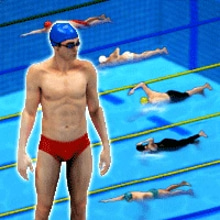
Swimming Pro has that deceptively calm look. Blue water, clean lanes, a simple promise: beat the best swimmers in the world and get the best time. Easy, right? Then the race starts and your brain instantly goes into “tiny panic coach” mode. Faster. No, not like that. Breathe. Don’t waste energy. Grab the medal. Stay smooth. Stay smooth. STAY—okay, you messed up, but keep going.
This is a swimming race game on Kiz10 that lives on rhythm and pressure. You’re chasing times, chasing the podium, and chasing that sweet feeling of a perfect run where everything clicks. But you’re also managing energy, because the pool doesn’t care how motivated you are. If your stamina drops, your speed drops. If your speed drops, the scoreboard turns into a quiet insult.
START BLOCKS AND THE FIRST HEARTBEAT 🏊♂️⏱️
Every race begins with that weird moment of stillness where you’re about to move but you haven’t moved yet. The crowd is implied, the lane lines feel like rails, and you can almost hear the splash that’s coming. Then you launch into it and everything becomes motion. Swimming Pro is not about complicated controls. It’s about timing, consistency, and resisting the urge to mash like a maniac the moment you feel behind.
The first seconds matter because they set your rhythm. If you start too chaotic, you burn energy early and the rest of the race feels like dragging a backpack full of bricks through water. If you start smooth, you build momentum, you stay efficient, and you give yourself space to surge later. It’s funny because the game quietly teaches you the same thing real swimmers learn: speed without control is just noisy fatigue.
ENERGY: THE INVISIBLE ENEMY THAT NEVER TRASH-TALKS 😅⚡
In Swimming Pro, energy is your secret boss fight. You can’t punch it. You can’t pass it. You can only manage it. And the game makes it feel real enough that you start planning around it naturally. You’ll catch yourself thinking, “Okay, I can push here, but I need something to refill soon,” like you’re doing strategy in a pool instead of just racing a timer.
This is where medals come in and suddenly the race isn’t just “go fast,” it’s “go fast while collecting smart.” Those medals aren’t decoration. They’re oxygen for your performance. You grab them to increase energy and stay strong toward the finish. And once you realize how important they are, your brain turns into a greedy little radar system. You’ll spot a medal and drift toward it even if it slightly messes your line, because you know the energy boost will matter.
Of course, this is also where you get punished for being too greedy. You’ll take a bad route just to grab a medal, lose speed, and then realize the energy wasn’t worth the time you bled. That’s the constant tension: efficiency versus reward, clean line versus refill. The best runs are the ones where you grab medals without turning your lane into a zig-zag confession.
THE RACE FEELS LIKE A METRONOME 🧠🌊
What makes Swimming Pro addictive is how it turns into a rhythm challenge. When you’re swimming well, it feels smooth, almost musical. Your pace is steady, your movement is consistent, and the water stops feeling like resistance and starts feeling like a surface you’re cutting through. That’s when you start improving fast, because the game rewards steady timing more than frantic effort.
And then you have the opposite run, the one where you lose the rhythm for a second. Maybe you overpush. Maybe you miss a medal. Maybe you hesitate. Suddenly the whole race feels heavier. Your energy slips, your pace feels uneven, and you start chasing the race instead of controlling it. That’s the moment where players usually get desperate… and desperation is expensive in a timing-based sports game.
It’s weirdly satisfying when you recover from that. When you find the rhythm again mid-race, when you stabilize, when you stop flailing and start swimming. You feel the improvement in real time, like you just corrected your own mistake and the game quietly nods: yes, that was better.
MEDALS AS A MID-RACE DARE 🥇😈
The medal pickups add a delicious layer of risk. Sometimes they’re perfectly placed and you can scoop them without losing your ideal path. Other times they feel like bait. Like the game is daring you to drift off-line. You’ll see one slightly out of the way and your mind immediately argues with itself.
“Take it, you need energy.”
“No, keep your line.”
“But what if I need it later?”
“Later might never happen if you slow down now.”
Then you take it anyway because you’re human. And if it works, you feel smart. If it doesn’t, you blame the medal like it personally betrayed you. Classic.
The smartest approach is treating medals like fuel stops. You don’t chase every single one. You pick the ones that keep your energy stable without sacrificing too much speed. That’s the sweet spot: staying energized while still racing clean.
THE PODIUM VIBE: WHY YOU CARE ABOUT ONE MORE SECOND 🏆😮💨
The goal sounds simple: get the best time and reach the champions’ podium. But time chasing has a special effect on the brain. It makes you obsessive in the funniest way. You finish a run and you’re instantly thinking about where you lost speed. Not in a boring analytics way. In an emotional way.
“I was smooth… until I wasn’t.”
“I grabbed medals… but I grabbed the wrong ones.”
“I started strong… then my energy fell off a cliff.”
“I can do better.”
Swimming Pro is built for that loop. Quick races, clear feedback, immediate reason to replay. You’ll keep trying because the difference between an okay time and a great time feels close. It’s always just one cleaner segment, one smarter medal choice, one better rhythm.
CHAOS SECTION: WHEN YOU PANIC-SWIM LIKE A CARTOON 🫠🐟
There’s a moment that happens to almost everyone. You realize you’re slightly behind and your brain goes full goblin. You start overdoing it, trying to force speed out of thin air. The movement gets choppy. Your energy drains faster. You miss a medal you absolutely needed. And suddenly your “race” turns into a survival crawl where you’re just trying to reach the finish with dignity intact.
It feels ridiculous, but it’s also part of what makes the game fun. Because it’s so obvious when you panic. The game doesn’t hide it. It shows you the consequences. And the next run, you remember that feeling and you try to stay calmer. Sometimes you succeed. Sometimes you panic again in a new and creative way. That’s progress, apparently.
THE “PRO” PART IS EFFICIENCY, NOT JUST SPEED 🧊🧠
If you want to play like a pro, you start thinking in efficiency. Keep your rhythm steady. Don’t waste movement. Don’t overcorrect for medals. Learn how to push without burning yourself out early. The pool rewards consistency. You don’t need to be perfect, but you do need to be controlled.
A good run feels like this: strong start, stable pace, smart medal pickups to keep energy from dipping too low, then a controlled push toward the end where you spend your remaining stamina with purpose. A bad run feels like this: wild start, messy lane, greedy detours, energy crash, regret.
And the best part is you can feel yourself improving. You’ll notice your runs getting smoother. You’ll notice fewer mistakes. You’ll notice you’re collecting medals more naturally, not desperately. That’s when the game turns into that satisfying sports grind: small gains, better times, closer to the podium.
WHY SWIMMING PRO IS PERFECT ON KIZ10 🌟🌊
Swimming Pro works because it’s quick, readable, and replayable. It’s a sports racing game that gives you a clear objective, a simple but meaningful resource system (energy), and that addictive “one more try” pull that time-based games do so well. It’s intense without being complicated, and it turns a straightforward race into a mini strategy of rhythm, stamina, and smart pickups.
If you like competitive sports games, timing challenges, Olympic-style race vibes, and chasing personal bests until you finally nail the run that feels effortless, this one hits the spot. Jump in on Kiz10, chase the best time, grab medals when it matters, and aim for the podium like it owes you a trophy.



 4.2 (49 votes)
 Share
Share
 Embed
Embed