🏺 Sand, stone, and a very bad place to get lost
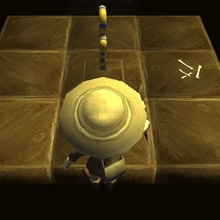
The Pyramid wastes no time pretending this is a relaxing walk through history. You are trapped inside the ancient pyramids of Egypt, and the job is brutally simple: find the exit, avoid falling, do not get lost in the maze, and reach the elevator that takes you to the next level. That is the official heartbeat of the game on Kiz10, and honestly, it already sounds stressful in exactly the right way. This is not the kind of adventure where you admire the architecture and slowly collect lore. This is the kind where every corridor feels suspicious, every ledge deserves respect, and every turn might be the one that sends you into a dead end with your confidence in pieces. It is a 3D skill and maze game built around tension, direction, and survival inside a place that clearly was not designed for comfortable tourism.
🧭 A maze game that keeps your nerves busy
What makes The Pyramid work is the clarity of its danger. The objective is easy to understand, which is exactly why the pressure lands so well. You are not decoding ten systems at once. You are trying to escape. That focus gives the whole game a tighter pulse. Every hallway matters because it might be the correct route. Every wrong step matters because falling is part of the threat. And every time the level opens into a wider area, your brain immediately starts doing that wonderful little panic calculation: safe path or stupid path, left or right, sprint or caution, confidence or regret. Good maze games do not need endless complexity. They just need space, uncertainty, and a reason to doubt yourself. The Pyramid has all three. Kiz10’s own description frames it around escaping ancient Egyptian pyramids, surviving the labyrinth, and finding elevators to continue, which gives the game a clean forward rhythm rather than a random wandering feel.
⚠️ One bad step and the tomb wins
A lot of maze adventures are only about navigation. The Pyramid feels sharper because it mixes navigation with physical danger. It is not enough to know where to go. You also have to not fall while figuring that out. That detail changes everything. Suddenly the environment is not just confusing, it is actively threatening. That makes the game feel more alive. A missed jump or a sloppy movement decision can undo a good route, which means progress depends on both orientation and control. That blend is why this kind of browser game gets sticky. You do not merely memorize paths. You survive them. Every successful level feels like a combination of caution, instinct, and refusing to let the pyramid embarrass you in public. Which it absolutely would, given the chance.
🗺️ Ancient Egypt as a puzzle machine
The Egyptian setting helps more than people think. Without it, this would still be a functional escape maze, but the pyramid atmosphere gives the whole experience a stronger identity. Stone corridors, hidden routes, vertical danger, old-world mystery, all of that makes the maze feel less like an abstract obstacle course and more like a place with weight. A place built to hide things. A place built to confuse intruders. That mood matters because it makes every level feel a little more dramatic. You are not just moving through clean puzzle geometry. You are crossing an ancient trap-filled structure that seems personally invested in your failure. It is a good fantasy, really. Classic treasure-hunt energy, minus the treasure and plus a lot more panic. Kiz10 categorizes the game under 3D, skill, and puzzle-adjacent play, which fits that combination of movement precision and maze-solving pressure.
🎮 Why simple goals become addictive so fast
There is something wonderfully dangerous about games with a short objective loop. Find the route. Avoid the fall. Reach the elevator. Repeat. That structure sounds modest, but it creates exactly the kind of momentum browser games love. You fail, and the reason usually feels visible. You turned too early. You hesitated. You trusted the wrong route. You got a little too casual near an edge and the pyramid corrected your attitude immediately. So you restart, but this time you know slightly more. That tiny increase in understanding is enough to pull you back in. The game becomes a chain of small improvements. Better awareness. Better movement. Better instincts when the labyrinth starts twisting your confidence into knots. That is where the fun lives. Not just in escaping, but in becoming the sort of player who can escape cleanly.
🧠 Calm thinking beats loud panic
The Pyramid looks like the kind of game that punishes reckless speed unless you truly know what you are doing. That is good design for a maze escape title. It encourages composure. You have to read the space, track routes, stay aware of edges, and keep your sense of direction from collapsing when the environment starts feeling repetitive. That last part is always the real enemy in maze games. Not the wall. Not the drop. The slow, creeping feeling that maybe you have already been here and maybe the pyramid is making a fool of you. When a game can create that doubt without becoming unfair, it usually means the tension is working. The Pyramid seems built for exactly that type of steady pressure. You are always close to progress, but never safe enough to relax.
🚪 Elevators, level flow, and the joy of actual progress
The elevator mechanic is also smarter than it looks. Reaching an elevator as the level goal gives the game a very satisfying sense of closure. It is not vague. It is not abstract. You know what success looks like. Find it. Reach it. Escape the current nightmare and move one layer deeper into the next one. Kiz10’s description explicitly points to the elevator as the route to the next level, and that gives the whole adventure a compact, level-based structure that suits short sessions and repeated attempts perfectly. You are not wandering forever. You are solving one dangerous architectural problem at a time. That kind of loop works beautifully in a 3D browser game because it lets each stage feel like a clean challenge with a definite payoff.
🌒 A browser adventure with old-school trap energy
The best thing about The Pyramid is that it understands how to create tension without overcomplicating itself. Ancient setting, maze layout, falling hazards, hidden routes, clear exit. That is enough. It leans into the old fantasy of forbidden ruins and turns it into a practical challenge of movement and orientation. For players who enjoy 3D maze games, escape games, ancient Egypt adventures, and browser skill games where staying calm matters more than raw speed, this is an easy fit. It is readable, atmospheric, and just mean enough to stay memorable. Not cruel, just confident. Like the pyramid knows you are lost before you do.
🔓 Final step before the stone door closes again
The Pyramid on Kiz10 is a 3D maze escape game built around ancient Egyptian atmosphere, risky movement, and the constant pressure of finding the right path before the labyrinth wins. It works because every part of the idea supports the rest. The maze creates uncertainty. The drops create tension. The elevator creates purpose. And the setting gives the whole thing a proper sense of mystery. If you like puzzle exploration, trap-filled escapes routes, and browser games that make every correct turn feel earned, this one has the right kind of bite. You are trapped, the pyramid is smug, and the exit is somewhere ahead. Probably.





 4.5 (5 votes)
 Share
Share
 Embed
Embed