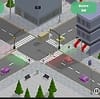
🚦🌆 City X Hands You the Switches
Traffic Light Madness drops you into City X with a job title that sounds calm and professional, right up until the first wave of cars arrives and the sidewalks fill like someone rang a dinner bell. You are the new traffic controller, the invisible person behind the lights, the one expected to keep vehicles and pedestrians moving in perfect sync. That is the dream. The reality is a blinking storm of decisions where every second matters, because if you keep people waiting too long you lose control and the city starts acting like it has never heard of order.
It is a puzzle game wearing a city’s clothes. No fantasy swords, no boss fights, just the quiet terror of watching lanes stack up while someone somewhere is still waiting for the walk signal. The beauty is how simple it feels at first. You look at an intersection and think, I can manage this. Then you notice there are multiple flows, multiple expectations, and a very real limit to how long you can hold anyone before the whole system turns against you. The game asks a brutal question in the most casual way: how long can you keep order?
🧠🚗 The Rhythm of “Go… Not Yet… NOW”
The real gameplay is timing, but not the flashy kind. It is the kind of timing that feels like listening to music while somebody keeps changing the tempo. You are constantly balancing two truths that hate each other. Cars need to move or they pile up and become a wall of metal. Pedestrians need to cross or they gather and become a wall of frustration. If you favor one side too much, the other side punishes you. And the punishment is not a dramatic explosion, it is worse, it is slow loss of control: longer waits, worse flow, more pressure, more mistakes.
At some point you stop thinking of the traffic lights as buttons and start thinking of them as promises. Every green light is you making a promise to a lane: I will let you breathe. Every red light is you making a promise to everyone else: I will protect your space for a moment. The game forces you to keep those promises short, clean, and fair, because “fair” is not moral here, it is survival.
🚶♂️⏳ Pedestrians Are Not Decorations, They Are a Countdown
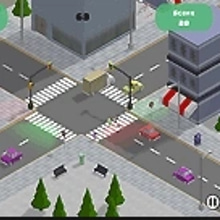
A lot of traffic games treat pedestrians like background flavor. Traffic Light Madness doesn’t. The crowd is a living timer. People waiting too long becomes tension you can feel, even if it is just pixels. There is something oddly stressful about the crosswalk because it looks harmless, and then suddenly it is not. One bad cycle and the sidewalk clogs, then the next cycle you try to fix it, and in the middle of your fix the cars start choking. That is the trap. You do not solve the intersection once. You keep it stable while it tries to drift.
This is where the game starts feeling like a tiny city simulator made of panic. You are not building roads, you are conducting movement. It is the kind of control fantasy that immediately turns into a self-control test: can you stay calm while everything asks for attention at once?
🌀🧩 Small Intersections, Big Consequences
The best moments are when you find a flow that feels smooth, like you discovered the right pattern. You let cars go, you clear the crosswalk, you switch at the perfect moment, and for a few seconds the intersection looks clean, almost elegant. Then a new wave arrives and the pattern breaks, because the city is not a fixed puzzle board. It is a moving one. Traffic Light Madness thrives on that shift. Your best solution is never permanent, it is just your best solution for right now.
And your brain adapts in a funny way. You start scanning for the “weakest” part of the system, the lane that is about to overflow, the crosswalk that looks like it will become a problem if you ignore it for ten more seconds. You begin making decisions early instead of late. Late decisions in this game feel like trying to stop a rolling cart by politely asking it to slow down.
🎬😅 The Comedy of Confidence
There is a special kind of embarrassment this game creates, and it is weirdly charming. You will have runs where you feel like a genius, flipping lights like a conductor, and you will think, I’ve got it, this is easy. Then the city punishes you for that thought. You mis-time one switch, the waiting grows, you scramble to correct, and suddenly you are not managing traffic, you are apologizing to it with frantic toggles. The shift is fast and hilarious and painful.
That emotional swing is why it is addictive. It does not need complicated mechanics to keep you hooked. It just needs you to believe you can do better next time, that you can hold order a little longer, that you can avoid the one mistake that started the collapse. The game is basically a loop of “almost” that keeps daring you to turn “almost” into “clean.”
🧯🚦 Staying in Control Without Freezing
A smart way to play is to think in waves, not individual cars. If you always react to the front vehicle, you end up switching too often, creating messy micro-cycles that satisfy nobody. But if you let a lane breathe long enough to actually clear, you reduce pressure for a moment and buy yourself space to handle the crosswalk. The same is true for pedestrians. Let them cross in a proper window instead of tiny scraps of permission, or they stack and become a larger emergency later.
The trick is not being “nice.” The trick is being consistent. Short, deliberate cycles. Clear a flow, then rotate. If you feel yourself clicking out of panic, pause mentally, look at what is truly about to break, and fix that first. The city always looks like it wants you to solve everything at the same time. You can’t. You pick the next fire, you put it out, you move on.
🌙⚡ When the City Starts Feeling Alive
After a while, something clicks that is hard to describe unless you have played a good traffic control game. The intersection becomes readable. You start sensing when a switch will cause problems before it happens. You start anticipating the wait limit and treating it like a boundary you cannot cross. Your decisions become quieter, more confident. You are no longer just reacting, you are guiding.
That is the sweet spot. It feels like you are holding a fragile balance in your hands and you are actually doing it. Then, inevitably, the balance slips and the city turns chaotic again, and you laugh, because of course it did. You are in City X. The job was never supposed to be peaceful.
🏁🧠 Why You Keep Coming Back
Traffic Light Madness is simple enough to understand instantly and tense enough to stay interesting. The premise is clean: keep cars and pedestrians flowing in sync, do not keep them waiting too long, and see how long you can keep order. That combination makes it perfect for “one quick run” sessions that accidentally become five runs because you keep chasing a cleaner flow, a longer survival, a moment where the intersection looks perfect.
If you like puzzle games that feel like skill, management games that feel like nerves, and quick browser challenges where your best opponent is your own impatience, Traffic Light Madness on Kiz10 is the kind of traffic-control chaos that turns a simple green light into a personals challenge.





 Share
Share
 Embed
Embed