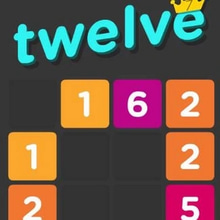
Twelve is the kind of puzzle game that looks almost harmless until your board starts filling up and your confidence quietly falls apart. The whole idea is beautifully simple on paper: slide numbered tiles around, merge matching values, and push the board toward the number twelve. Public descriptions of the game are very consistent about that core mechanic. It is a sliding block puzzle where same numbers combine into bigger numbers, and the challenge is to create a tile with the number 12 without trapping yourself in a dead board first. That direct setup is exactly why it works. You understand the objective in seconds, but the board starts asking smarter questions than it first seemed ready to ask.
What makes Twelve so sticky is that it lives in that dangerous space between “this is easy” and “I have absolutely ruined this.” A lot of number puzzle games survive because the rules are simple enough to keep the player moving, but deep enough to punish lazy planning. Twelve sounds built exactly that way. You are not just matching numbers for the satisfaction of a pop or a clear. You are shaping space. Every merge changes the future of the board. Every slide decides whether you are building toward something elegant or quietly manufacturing a disaster that will corner you three moves later. That is where the game starts getting properly addictive. Not because it is noisy, but because it is honest. Every mistake is visible. Every better run feels possible.
The number 12 itself gives the game a stronger identity than a generic merge puzzle. Public descriptions repeatedly frame that as the goal, and that matters because a specific target changes the emotional rhythm of the board. You are not merging endlessly for the sake of endlessness. You are climbing toward one clean, meaningful destination. That makes every tile feel more valuable. A merge is not just progress, it is a step closer to the exact number the game is named after. That sort of structure works really well in browser puzzles because it gives the player a clear reason to care about every move. Twelve is not asking for random motion. It is asking for intention.
One of the nicest things about this kind of game is how quickly it teaches you to respect the board. Early on, merging same numbers feels natural and satisfying, almost automatic. Then the grid starts getting tighter. Now the problem is not whether you know how to combine tiles. It is whether you know where to combine them. A good merge in the wrong place can still poison the whole run. That is the sort of subtle cruelty that makes puzzle players lean closer to the screen. You stop playing casually and start thinking about flow. Which numbers should stay near each other? Which side of the board needs breathing room? How much space can you sacrifice for one larger merge before the whole structure becomes awkward? Twelve sounds like exactly the kind of puzzle that rewards that shift from reaction to planning.
There is also something satisfying about how clean the concept feels. Public descriptions of Twelve keep coming back to the same few ideas: movable numbers on a grid, matching same numbers, and trying to reach twelve. That level of clarity is a strength, not a limitation. Browser puzzle games often work best when they can explain themselves in one sentence and then spend the next twenty minutes proving that sentence was more dangerous than it sounded. Twelve seems to belong to that tradition. It does not need giant systems or decorative mechanics to stay interesting. It just needs enough board pressure to make every calm player slowly become a very tense player with strong opinions about tile placement.
What makes a number puzzle memorable is usually not the numbers themselves, but the way the game makes the player feel about them. Twelve likely does this very well because the target is both near and far at the same time. Twelve is not some absurdly huge number that feels abstract. It feels reachable. That is what makes it dangerous. A reachable target invites repetition. You do not walk away thinking the game is impossible. You walk away thinking you almost had it, and that “almost” is what keeps the next run alive in your head. If a board collapses, you can usually see where it started going wrong. If a run goes well, the board probably begins to feel cleaner, calmer, more cooperative. That visible difference between a bad line and a good one is exactly what keeps merge puzzles alive.
The educational side helps too, even if the game is primarily there to be fun. Y8’s description calls it a basic game for kids to learn math and a hyper-casual puzzle game, which suggests Twelve works for more than one kind of player. Younger players can enjoy the number logic and straightforward objective, while older players can sink into the strategy of board control and efficient merging. That crossover is useful. It gives the game a very broad appeal. You do not need to be a puzzle expert to understand it, but you do need to think if you want to play it well. That is usually the sweet spot for a browser logic game.
On Kiz10, a game like Twelve would fit perfectly for players who enjoy merge puzzles, number games, and clean logic challenges that stay replayable without needing flashy presentation. It has the right kind of structure for browser play: quick to understand, easy to restart, and hard to leave alone once the board starts revealing how much smarter you need to be. For people who like math games, tile merging, and casual puzzles that quietly become serious, Twelve has exactly the right kind of pull. The board looks small, the goal looks simple, and then suddenly every square matters more than it should. That is usually the sign of a very good puzzles.



 4.7 (16 votes)
 Share
Share
 Embed
Embed


