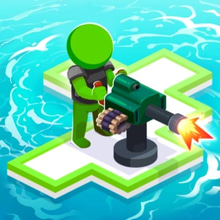
War of Rafts Crazy Sea Battle starts you at the absolute bottom of the food chain. One tiny square of raft, one lonely soldier and an ocean that feels way too big for how fragile you are. For a few seconds you just drift and think “there is no way this thing survives.” Then you spot the first loose tile floating nearby, move toward it, snap it onto your raft and something clicks in your head. If you can grab enough pieces and enough people, this pathetic plank might actually turn into a floating monster.
From that point on, the sea stops being pretty scenery and turns into a living arena. Everywhere you look there is something that wants to change your fate. A free soldier bobbing in the water, waving for help. A spare raft tile turning slowly with the waves. A huge enemy platform loaded with fighters that could erase you if you get too close. Every decision is a quick little gamble: drift in, grab the reward and hope no one sees you, or pull back and look for an easier opportunity.
You never stand still for long. Your raft glides across the surface while you constantly nudge it forward or backward, trying to line up perfect approaches. The controls stay simple, but your brain is doing quiet math all the time. That boat looks bigger than yours. That one looks weaker. Those two are about to crash into each other, which means whoever survives will be wounded and maybe just right for you to clean up afterward. It is part instinct, part greed and part common sense.
The growth of your raft might be the most satisfying part. In the beginning it barely holds your first fighter. After a couple of minutes, if you have been careful, it stretches out like a strange floating island. New tiles click into place around the edges, giving you more space to stand and more room for future recruits. Each rescue adds another little warrior to your crew, filling in empty spots and making the whole thing feel like a tiny army instead of a sad emergency boat.
There is a rhythm you fall into without even thinking about it. Patrol the area, scoop up stragglers, avoid obviously bigger opponents, and pounce on anyone who misjudges their strength. When you slam into a weaker raft and watch it crumble while their soldiers leap onto your deck, it feels like winning a bet you were not completely sure about. When you misjudge and hit someone stronger, the punishment is instant and you learn very quickly what “outgunned” really looks like.
The game never stops reminding you that the sea itself is dangerous. Mines float in unsuspecting places, waiting for a moment of distraction. Supply boats cruise around like moving treasure chests, loaded with extra people you can steal if you approach from the right angle. Some objects are simply too big and too risky to touch at your current size, and learning to recognize those on sight is part of surviving more than a few minutes.
There is a surprising amount of strategy hiding under the bright, casual look. You cannot just collect everything and hope for the best. Position matters. A long narrow raft hits hard from the front but leaves your sides exposed. A wide platform gives you more surface to ram with, but you are a bigger target and easier to corner. Sometimes backing off from a fight is the smartest play you can make, even when your fingers are itching to charge into the action.
Little by little, you also learn to read body language on the water. A player that keeps weaving around you without closing in is probably afraid of your size. Someone who points their nose straight at you again and again is either reckless or very sure they are stronger. Spotting those attitudes early lets you choose where to spend your courage and where to pretend you never saw them.
The loop is brutally simple and that is exactly why it works. You start small. You collect. You avoid. You risk a fight. You win and grow, or you lose and start again with the memory of exactly what went wrong. There are no complicated menus between runs, no long explanations. You learn by doing, and the ocean does not sugarcoat its lessons.
What keeps you coming back is how quickly things can flip. In one run you might stay underpowered, scraping together a few tiles before some giant smashes you out of existence. In the next, you find a cluster of survivors, win one lucky fight, steal a huge chunk of raft and suddenly you are the name everyone else silently curses. Being hunted and being the hunter are both only a couple of good decisions apart.
War of Rafts Crazy Sea Battle is perfect when you want something fast and reactive that still gives you room to think. It is not about memorizing complex combos or grinding through heavy upgrades. It is about looking at the sea in front of you, judging who you really can beat with the strength you have right now, and committing to that choice. One tile at a time, one rescue at a time, one bold collision at a time, your shaky starter raft can grow into the kind of floating fortress that makes the entire ocean feel too small.





 Share
Share
 Embed
Embed


