🦵🫨 Wobbly Legs, Serious Consequences
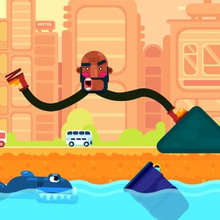
What a Walk feels like someone took the simple act of walking, removed all dignity from it, and then dared you to be precise anyway. You do not glide forward like a hero. You lurch. You wobble. You launch one floppy leg and hope the other one remembers it is supposed to be helpful. And somehow that becomes wildly addictive, because every step is a tiny gamble you chose on purpose. The controls are easy to understand, but the outcomes are never fully obedient. That is the charm. You are playing a skill game disguised as a joke, and the joke is that your best run will still look like a penguin learning ballet.
The core idea is beautifully cruel. Pull back, release, and watch your character fling a leg forward. That single motion decides everything. Distance, balance, timing, confidence, regret. Sometimes you land clean and feel like you cracked a secret code. Sometimes you land one millimeter off and the whole body tilts like a slow motion disaster you can already see coming. You will whisper no no no like that helps. It does not. But you will do it anyway.
🚩🌊 Checkpoints That Feel Like Tiny Lifeboats
The levels are built around gaps, platforms, and water that waits below like an audience ready to clap when you fail. That water is not just decoration. It is the threat that makes every step matter. When you see a flag checkpoint, it stops being a normal game object and becomes a personal promise. Please let me reach that. Please let me hit it so I never have to do that last section again. When you finally tag a flag, the relief is real, the kind of relief you feel in your shoulders. Not because the game is deep and emotional, but because your brain had been holding tension for longer than it wanted to admit.
And the checkpoints change how you play. Before a flag, you might take safer steps, shorter launches, cautious little movements that look ridiculous but keep you alive. After a flag, you suddenly get brave. You start experimenting. You start pushing distance. You start acting like a professional. That confidence lasts until the next gap reminds you who is in charge.
🎮🧠 The Weird Strategy of Not Panicking
There is a rhythm to walking in What a Walk, and it is not the rhythm you expect. Fast does not always mean better. Big launches look impressive, but they also turn your character into a wobbling question mark. Short controlled steps can feel boring until you realize they are how you survive the tight sections. The game quietly trains you to think in timing instead of speed. Pull back a little more for wide gaps. Release earlier for short hops. Pause between steps to let the body settle. Yes, you will actually learn patience in a game where your character looks like a noodle.
The funniest part is how human your thinking becomes. You start negotiating with yourself. Okay, small step. Just one small step. Stop showing off. Then you immediately pull back too far, launch a leg into space, and spend the next second praying the other foot lands somewhere reasonable. It is a loop of intention and chaos, and that loop is exactly why it stays fun.
🧩🦵 Each Gap Is a Puzzle You Solve With Your Wrist
Even though it looks like an arcade platform game, the gaps act like little physics puzzles. A short gap is not always easy, because short gaps punish overconfidence. A wide gap is not always hard, because wide gaps at least make you commit. The real difficulty comes from the awkward in between spaces, where you have to measure distance by feel. You begin to recognize shapes in the level. Two short gaps in a row means controlled stepping. One long gap after a narrow platform means you need to land centered. A section with wide platforms invites longer launches, but only if your balance is calm.
And that is the subtle magic. You are not solving puzzles with numbers or switches. You are solving them with your sense of momentum. You learn what happens when you release a fraction too late. You learn that your character needs a breath between steps, even if the game never says so. You learn to watch the landing surface, not the empty space. You stop staring at the water like it is hypnotizing you. Mostly.
😅🚀 The Launch That Makes You Laugh Out Loud
There will be moments where your leg launches perfectly and you feel unstoppable. Your character lands, wobbles, recovers, then steps again with a smoothness you did not know was possible. It feels like a miracle you earned. Then the next step goes wrong and you fall in a way that is so ridiculous you cannot even be mad. That is the sweet spot for this kind of funny physics game. Failure is annoying, but it is also entertaining. The falls have personality. The flops look dramatic. The water splash feels like the game politely saying, nice try.
And because restarts are quick, frustration never fully settles. You fail, you reset, you try again immediately with a tiny adjustment. A smaller pull. A quicker release. A different pause. It becomes a game of micro improvements. You are not grinding levels. You are refining your feel.
🌟🫣 The Tension of Going Further Than You Should
As you progress, the game starts asking for longer distances and more confident timing. The platforms get trickier. The gaps start looking like dares. And you get that classic sensation of a run that is going too well. You start thinking about the future. If I just clear this next part, I might reach a new record. That thought is dangerous. The moment you think about your record, your hands get slightly greedy and you overlaunch. You will do it. Everyone does it. The game knows it too. That is why it is addictive. It constantly offers you one more chance to beat yourself, and it makes that chance feel close enough to taste.
There is also a great feeling in seeing your level number climb. Not because you unlocked a hundred things, but because you survived the nonsense longer than last time. That is pure skill game satisfaction. Simple, direct, personal.
🏁✨ Why This Silly Walk Sticks
What a Walk works because it respects a simple idea and commits to it. It is walking, made weird, then made challenging, then made hilarious again. It turns a basic mechanic into a constant source of tiny drama. You will celebrate flags like trophies. You will fear wide gaps like villains. You will develop a strange pride in landing cleanly on a platform that is not even that big. And once you get into the rhythm, you will keep going just to see how far your wobbly legs can take you.
If you want a quick browser physics game that feels funny, tense, and strangely satisfying, this one is a perfect pick. Play it on Kiz10.com, breathe before the long gaps, and remember the most important rule. The water is patient. Your legs are not.





 4 (154 votes)
 Share
Share
 Embed
Embed


