🖊️🛡️ Lines that save the day
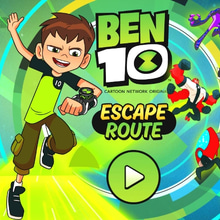
The door locks behind him, the timer blinks, and the room looks like a blueprint with opinions. In Ben 10 Escape Route, you don’t jump your way out—you draw your way out. Each stage is a tidy puzzle-box packed with switches, nodes, bumpers, and hazards, and your job is to sketch a safe route that carries Ben from spawn to exit in one confident sweep. Simple? At first. Then the game starts adding toys, rules, and complications until your doodles feel like engineering. It’s fast to learn, satisfying to master, and every clean solution lands with that quiet “ohhh” that puzzle fans chase.
🧠✨ Sketch, simulate, succeed
You trace a line with your finger or mouse, connecting key spots: a switch here, a bounce pad there, a door trigger in the corner, and finally the glowing exit. Release… and the route comes alive. Ben zips along your ink like a rollercoaster car on rails, riding curves, hitting triggers, and (if you drew well) clearing the room in a single, elegant motion. The magic is in iteration: your first path is a guess, the second is a fix, and the third suddenly looks like something a cartoon genius would scribble on a napkin. Run after run, you feel smarter—not because the game tells you so, but because your lines say it for you.
🚧⚙️ Rooms with personality (and attitude)
Early chambers are welcoming: a single gate, one switch, stars tucked along a gentle curve. Then the designers start grinning. Conveyor floors that nudge you off sloppy lines. Laser grids that pulse on a beat, daring you to time your crossing. Gravity pads that flip orientation, making your path feel like a loop-de-loop in a notebook margin. Magnetic nodes pull your line into tidy arcs if you plan for them—and into chaos if you don’t. Even better, every new gimmick stacks with old ones; by midgame you’re stitching together mixed mechanics like it’s second nature.
🎯🧭 Micro-habits of players who look lucky (they’re not)
Draw anchors first: short, sharp dots at switches and stars you must hit, then connect those anchors with smooth segments. Favor wide curves over jagged zigs; smooth lines conserve speed and reduce derail risk. Trace along walls to “snap” timing with moving hazards—hugging a boundary often buys the half-second you need. When a door opens on a delay, draw a tiny spiral loop as a holding pattern, then break out on the beat. And remember: a line that ends pointing at the exit is faster than a perfect line that arrives sideways.
🚀🔄 Momentum is your co-pilot
Ben accelerates on down slopes and drags on climbs, so your pen becomes a throttle. Sketch shallow descents to build speed before long spans; add a micro-dip just before a jump to “prime” the launch. If a star hangs one tile too far, a subtle S-curve can sling you without messy corrections. Need to brake? Draw through a mild uphill to bleed speed cleanly rather than slamming into a bumper and praying to cartoon physics. The feeling when a well-placed dip carries Ben neatly through three obstacles in a row is… embarrassingly good.
🧩🌟 Stars, secrets, and the art of tidy routes
Every level has stars placed like commentary: “try the high route,” “prove you can thread this gap,” “we dare you to take the scenic wall-ride.” You can ignore them and be fine, but collecting them teaches better lines. Often the optimal star path is also the smoothest route—designers love hiding speed in swagger. Watch for slightly darker tiles, off-color panels, or oddly generous ceiling space; those are secret corridors that reward curiosity with shorter paths or safer timing windows.
🔧🛠️ Tools of the trade (and when to use them)
Bump pads catapult you along a fixed angle; draw into them straight to preserve speed, angle slightly if you want a cheeky redirect. Teleporters beg for clean entry vectors; curve into the portal center so exit momentum points at your next target. Switch plates love precise taps: drop a tiny dot to guarantee contact before you peel away—don’t scribble, you’ll waste distance. Directional fans? Build a sheltering curve that approaches low and exits high, letting airflow carry you like a friendly elevator.
🕒🎵 Rhythm puzzles that play like music
Some levels stop being geometry and start being drum sets. Lasers blink on a four-beat, crushers descend on threes, conveyors reverse on twos. Draw a route that “dances” across those counts—loop once to sync, glide through on the downbeat, and let the room accompany your plan. You’ll catch yourself nodding along when a chain of timed hazards lines up with a route so clean it feels rehearsed.
🧪🎮 Modes for every mood
Campaign strings puzzles with escalating complexity, perfect for learning the language of lines. Time Trials confess whether your route is clever or merely cute—speed exposes inefficiency. Star Challenges lock in extra collectibles and ask for elegance under pressure. Daily Boards remix elements so returning players get a fresh “aha” with their first coffee. Each mode respects your time: fast resets, clear goals, and replay value powered by your brain, not by grind.
📈🏆 Progress that flatters your skill
Finish rooms to unlock new sets with new toys. Earn cosmetics—trail effects that sparkle when you collect every star, color schemes for Ben’s route, victory stamps that autograph your best runs. They don’t change physics; they celebrate mastery. Ghost replays let you race your own best line (or a friend’s), and there’s nothing quite as motivating as beating yesterday-you by a single, delicious frame.
🧠🗺️ Design notes from the sketchpad
If a corridor is wider than usual, expect moving parts or multiple solutions. If the exit sits after a long straight, the challenge is earlier—your line probably needs to harvest speed before that section. When the game gives you two switches, the closer one is rarely first; draw through the far trigger and return on a cleaner angle. And if a node sits near the ceiling with nothing under it, the intended path is a high arc—think rainbow, not ladder.
🎮📱 Feel-first controls on any device
On desktop, click-and-drag to draft, release to run. Hold Shift (or keep your hand light) to sketch micro-adjustments without wobble. On mobile, your finger becomes a pen—the canvas tracks small curves faithfully, so you can “write” solutions, not wrestle them. Undo is snappy, reset is instant, and the camera keeps the next goal framed so you draw with foresight instead of guesswork.
🔊🎶 Audio that nudges without nagging
A soft chime tags every star, switches thunk with a satisfying “yes,” and doors purr open on beat. When your line is particularly smooth, the music layers in a subtle high-hat like the game noticed your swagger. Miss a timing window and the percussion drops for a bar—a gentle hint to tighten the loop. Play with headphones and you’ll start sketching in rhythm.
🧯🌀 When the plan faceplants (and how to unfail it)
You clipped a laser by a millisecond or missed a switch by a pixel. Don’t redraw the world—adjust the beat. Add a half-loop to delay entry, or trim a corner to arrive earlier. If speed is the problem, insert a tiny dip before the jump; if alignment is the problem, widen your approach to straighten the exit. And if a level feels cursed, draw the path backward from the exit; solutions appear when you stop arguing with the room and start listening to it.
🌟🏁 One sketch before the next door
Try a level collecting all stars with a single continuous curve—no sharp angles, no backtracking. Or run a time trial where your path never touches a wall, using only gravity and pads to steer. Braver still: solve a laser rhythm room by drawing a loop that syncs perfectly to the hazard cycle, then watch Ben slide through like ink on satin. Ben 10 Escape Route on Kiz10 is puzzle elegance with cartoon energy—draw, test, refine, smile—and that delicious moment when a messy scribble becomes a clean solution and the exit door opens like it was always waiting for your line.





 Share
Share
 Embed
Embed