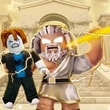
The temple breathes in dust and secrets. Somewhere inside, gears murmur under stone, a guard coughs, and a golden idol waits like a grin you’re not supposed to see. Bob adjusts his gloves, checks the lockpick tucked behind his ear, and steps into the dark as if it invited him by name. Bob The Robber 5 Temple Adventure is a compact stealth puzzle where every hallway is a riddle and every solution sounds like a soft click. It’s not about running fast. It’s about moving right, reading rooms, and smiling when a plan lands with the delicate thunk of a door that didn’t realize it was already open.
🕵️ Shadow work and soft shoes
You don’t conquer this place. You negotiate. Lights carve honest islands on the floor; shadows stitch them together if you’re patient. Hug walls. Count patrol beats in your head. When a flashlight sweeps, don’t flinch—freeze just outside the cone and let it pass like a tide. Bob moves with that tiny glide animators give to characters who know the difference between speed and silence. Within minutes your thumbs learn it too. Tap-linger, tap-linger, slip. You’ll wonder why more games don’t trust you to be this quiet.
🔮 The temple that watches you back
This is not a dead ruin. Eyes carved into statues swivel when you swagger. Lenses hide behind cracked mosaics. Floor plates shiver if you stomp instead of step. It’s fair, though. Every trap adverts its personality if you study it. A guardian’s gaze blinks before it scans. A dart launcher wheezes half a second before it spits. Pressure tiles have hairline gaps that catch light at the right angle, like a warning whispered by the floor. Once you notice, you stop being surprised. You start being ready.
🧰 Tools of a quiet thief
Bob’s kit is low drama and high utility. A basic lockpick opens stubborn doors, sure, but it also shaves time off route experiments because you can test shortcuts without commitment. A tiny stun tool hums just enough to make a guard reconsider today, buying you a window to slide past. Smoke puffs are get-out-of-sight cards if you place them with intent instead of panic. The best tool might be the decoy coin: toss it and the clink telegraphs a story the guard is eager to believe. Use it to steer patrols into loops that leave corridors empty just when you need them to be.
🗝️ Locks, levers, and little lies
Puzzle locks here feel like conversations, not chores. A rotating glyph ring that wants a certain constellation. A three-lever gate that opens only if you learn the order from a mural you almost ignored. Even keypads, the eternal enemy of fun, behave with grace: numbers hint at themselves in the dust smears on the buttons, and once you spot it you feel like a detective instead of a guesser. The solution rarely shouts. It nudges. You learn to nudge back.
👣 Routes, rhythm, and risk
There’s always a safe path—the one a cautious mind finds first. It works, it’s slow, and it grants a bronze time with a relieved sigh. Then there’s the route your hands whisper after three attempts. Cut across the shadow cast by the big idol while the torch sputters, tap the switch with a fingertip, roll behind the short pillar, and catch the guard’s turn by half a heartbeat. That line hums. You’ll replay stages just to feel that hum again, shaving seconds the way a barber shaves hair: careful, practiced, satisfied.
👁️ Statues that blink when you blink
The temple’s eyes are a game inside the game. Statues animate with little ticks—pupil darts, eyelid flutters—that signal when it’s safe to cross their sightlines. If you barrel through, the alarm yawns awake and everyone gets noisy. If you watch, you see the pattern: two slow, one fast, a pause, then a full sweep. That’s your window. Slip through and try not to grin. It’s hard.
🧟 Mummies are slow problems with loud consequences
They’re not fast. They’re not clever. They’re just inevitable if you treat them like scenery. Hear the bandage whisper around the corner? Back up. Let a patrol pass. Stretch their spacing so you never share a narrow corridor with one. If you must deal with them, do it at a choke where a quick stun and a flank keep the rest of the room asleep. The game rewards patience with silence, and silence is the currency that buys clean runs.
🎭 Disguises, vents, and other polite scams
Costumes pop up as delicious little lies. A guard mask buys three seconds of indifference if you keep your distance; step too close and the NPC brain wakes up, as it should. Vents are the alleyways of the temple—dusted shortcuts where your map redraws itself in your head. Use them to leapfrog cameras or to appear behind someone who thought they knew the whole story. If a route feels busy, ask the walls for permission to go around. They say yes more often than you’d think.
💡 Micro techniques that turn near misses into clean clears
Feather movement at the edge of light; the detection cone is honest but forgiving to players who move like they mean it. If a camera’s sweep is tight, count the hinge sound instead of staring at the beam—your ears will cue the go sooner than your eyes. On lever chains, pre-position your thumb over the next prompt so inputs land like a pianist, not a typist. When two guards chat, wait for the laugh—animations open their posture and widen your pass window by a breath. That breath matters.
🎼 Sound as a map
This soundtrack isn’t wallpaper; it’s a metronome. Drums soften when patrols drift farther. A faint bell adds itself when a statue’s eye is about to reset. Even the wind through the cracks plays fair—stronger in rooms with high vents, quieter in sealed chambers where your options narrow. Learn the mix and you’ll start moving on cues the UI never had to print. It feels grown-up in the best way.
📱 Controls that respect stealth
Inputs land light. There’s no sticky momentum to betray you, no clumsy animations that lock you into mistakes. If you slip, it’s your read, not the game’s ego. The prompt to interact appears early enough that you can chain actions without panic—door, lever, hide, breathe—like a single sentence said under your breath. On mobile, taps are crisp; on keyboard, micro-adjusts feel surgical. The camera never steals your peripheral vision when it matters most.
🧭 Level design that teaches without lecturing
Early rooms place traps alone so you learn their grammar. Later, the grammar becomes poetry: a statue eye aligned with a floor plate aligned with a camera that only matters if you took the greedy route. The best stages are the ones where you realize you could have been bold two rooms ago and that knowledge makes you bolder now. The retry button becomes an invitation, not a punishment.
🏆 Why you’ll keep robbing this temple
Because competence feels good. Because a clean heist is its own applause. Because the game respects your attention and pays it back in small, delicious victories—the soft click of a lock, the hush of a perfect pass, the glitter of an idol slipping into a pocket that looks like it was sewn for that exact shape. You don’t need explosions to call this thrilling. The thrill is in moving like you belong where no one thinks you do.



















 Share
Share
 Embed
Embed