🔫 Steel doors, bad air, and no room for mistakes
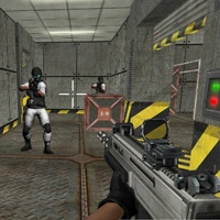
Bullet Fury drops you into the kind of place that already feels wrong before the shooting even starts. A secret laboratory. Enemy guards. Tight corridors. Heavy silence that clearly will not stay silent for long. It is a 3D first-person shooter on Kiz10 where your troop has located an enemy lab, and your job is brutally simple: grab your weapon, move in, and eliminate the guards inside.
That setup works because the game does not need a huge dramatic speech to make its point. You are going in. They are armed. The facility is hostile. Good luck. There is something wonderfully direct about that. No decorative nonsense, no endless warm-up. Just a shooter built around pressure, movement, and the deeply unhealthy relationship between tight indoor spaces and automatic gunfire. The moment you start moving through the lab, the mood becomes clear. This is not a sightseeing tour. This is a room-to-room cleanup job where hesitation can get you folded in half by incoming fire.
And honestly, that is where Bullet Fury gets its teeth. Lab shooters have a very specific kind of tension. Open battlefields let you breathe. Laboratories do not. They give you corners. Blind spots. Doorways that feel suspicious in ways doorways really should not. Every step forward becomes a small act of confidence, and every peek asks the same dangerous question: are you about to outshoot the room, or is the room about to embarrass you?
Sometimes the answer is the second one 😅.
🧪 The laboratory fights back without moving an inch
A good FPS does not need the map to be gigantic. It needs the map to matter. Bullet Fury understands that. The enemy laboratory setting gives the whole game a sharper, more compact kind of stress. You are constantly moving through spaces that feel built for ambushes. Corridors compress the action. Small rooms become danger boxes. Every angle matters a little more because the distance between “I’m in control” and “this has gone horribly wrong” is about half a second.
That is why the shooting feels so immediate. You are rarely drifting through empty terrain waiting for something to happen. In a facility like this, something always feels close. Enemies can appear fast, pressure can spike instantly, and the pace stays lively because the environment refuses to relax around you. It is the kind of map design that turns even basic movement into decision-making. Do you clear left first? Commit to the doorway? Push aggressively before the guards settle? Back off and reset the fight? Bullet Fury keeps feeding you those tiny decisions, and the whole experience gets stronger because of it.
There is also a nice old-school honesty to the mission structure. You are there to wipe out the guards. That is the fantasy. Not political drama. Not survival crafting. Not ten systems stacked on top of each other. Just a gun, a target-rich hostile facility, and a very firm understanding that your presence is not welcome.
💥 Every firefight feels one mistake away from disaster
What makes Bullet Fury fun is not just the shooting itself, but the constant instability around it. The firefights have that familiar FPS tension where a clean engagement makes you feel sharp, efficient, almost invincible, while a sloppy one makes you look like a man arguing with geometry and losing. That swing in feeling is exactly what keeps a shooter like this alive.
You clear one encounter smoothly and start feeling brave. Maybe too brave. Then the next room reminds you that confidence is not armor. The guards do not care about your momentum. The lab does not care about your feelings. If you push a bad angle, you pay for it. If you overstay in the open, you pay for it. If your aim drifts for even a blink, the whole situation can sour immediately.
That kind of punishment is healthy for a shooter. Not unfair punishment. Useful punishment. The kind that teaches you to respect space, check corners properly, and stop treating every doorway like a personal challenge. Bullet Fury works best when you play with that balance between aggression and caution. Move too slowly and you lose rhythm. Move too wildly and you become part of the lab floor.
And yet, when it clicks, it really clicks. A clean push through a dangerous area feels fantastic. You swing the angle, snap onto the target, fire, reset, move again. Suddenly the whole mission has flow. You are no longer reacting in panic. You are controlling the pace. In shooters, that sensation is gold.
🎯 Aim matters, but composure matters more
There is a point in most FPS games where players realize raw speed is not enough. Bullet Fury definitely has that point. Fast reactions help, sure, but composure is the real weapon. Because the map is tight and the encounters are immediate, panic shooting becomes very expensive. You need to keep your head clear enough to take the correct fight, not just the loudest one.
That is what gives the game a little more depth than its simple premise suggests. You begin learning how to enter rooms with less chaos. How to use brief pauses without losing momentum. How to re-center after a messy exchange instead of sprinting straight into another bad one like your previous mistake somehow made you wiser. Sometimes it did not. Sometimes it absolutely did not.
Still, the learning curve feels satisfying. Bullet Fury is one of those browser shooters where the improvement is visible. At first, every corridor feels dangerous because you are unsure. Later, the same corridors feel manageable because your habits get cleaner. You stop exposing yourself unnecessarily. Your aim steadies. Your movement stops looking like emergency improvisation and starts looking intentional. That progression gives the game replay bite. A second run does not just feel like repetition. It feels like a chance to do the whole mission better, faster, and with far less accidental drama.
🚨 Why the simple setup actually works so well
A lot of shooters overload themselves with ideas. Bullet Fury does the opposite. It picks one strong scenario and commits to it. Secret laboratory. Armed guards. Tight 3D FPS combat. That focus gives the whole experience energy. According to the Kiz10 page, it is an HTML5 shooter playable in the browser across desktop, mobile, and tablet, and it sits inside Kiz10’s shooting, gun, and war game categories.
That makes sense, because the game really does feel like a compact war-zone fantasy shrunk into a lab complex. You are not managing huge battle lines. You are surviving concentrated combat. That smaller scale helps everything feel louder. Every encounter has weight because it happens up close. Every cleared section feels earned because the environment is always trying to trap your confidence somewhere between a wall and a burst of bullets.
And there is charm in that simplicity. It is easy to jump into. Easy to understand. But still sharp enough that you cannot fully sleepwalk through it. For Kiz10 players who like classic browser FPS action, that is a strong combination. You get the mission quickly, but the execution still demands something from you.
🪖 A compact shooter with proper bite
Bullet Fury holds up because it knows what kind of game it wants to be. It is not trying to become some giant military epic. It is trying to deliver focused first-person shooting inside a dangerous indoor map, and it does that well. The secret lab theme gives the action a tense frame, the guards provide constant pressure, and the narrow spaces make every burst of gunfire feel more personal than it probably should.
So expect tight firefights. Expect dangerous corners. Expect a few glorious moments where you clear a room like a professional and a few others where the room clears you right back 😵. That is normal. That is part of the FPS ritual.
On Kiz10, Bullet Fury stands out as a straightforward but effective browser shooter: fast, hostile, and built around the old reliable joy of entering a bad place with a gun and trying to leave it cleaner than you found it. Sometimes that is all a shooter needs. A sharp setting, clear enemies, and enough pressure to makes every hallway feel like a tiny war.





 4.4 (37 votes)
 Share
Share
 Embed
Embed


