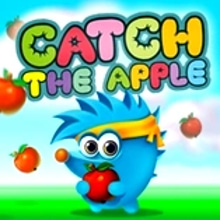
🍎🦔 THE HEDGEHOG HAS ONE PLAN: EAT. YOU HAVE THE OTHER PLAN: THINK.
Catch the Apple is the kind of puzzle game that pretends it’s just a cute little snack hunt, then immediately turns into a tiny physics laboratory where everything rolls, swings, falls, bounces, and occasionally ruins your confidence. On Kiz10, it feels like a classic “use the environment” brain game: you’re helping a hungry hedgehog collect apples scattered around each level, and the only way to do it is by poking the world until it behaves. Sometimes that means knocking something loose. Sometimes it means using a tool at the exact right moment. Sometimes it means staring at a simple wooden box for ten seconds like it personally insulted you.
The best part is how the game communicates without overexplaining. You see the apple. You see the hedgehog. You see the obstacles. The puzzle is not hidden behind menus, it’s right there on the screen, smiling at you. And the moment you click one thing and the whole structure reacts, you realize what Catch the Apple really is: a chain reaction sandbox with rules that feel consistent, but outcomes that can surprise you in a fun, “ohhh that’s what that does” way.
🧠 LITTLE LEVELS, BIG BRAIN ENERGY
Each stage is basically a small scene built out of objects that look harmless until you nudge them. A box might be a platform. Or it might be a blocker that needs to be destroyed. A tube might be a gentle slide… or a trap that sends something the wrong way if you activate it too early. There’s a special satisfaction to physics puzzles like this because you’re not just matching shapes or memorizing patterns. You’re interacting with weight, timing, angles, and gravity. It’s a puzzle, but it’s also a tiny experiment.
You’ll get early levels that teach the basics: get the apple to the hedgehog, don’t overcomplicate it, learn that the world moves when you touch it. Then the game starts layering ideas. You’ll need to trigger an action to create a path, then trigger another action to keep the apple from escaping that path. And yes, you will do the classic mistake: you’ll solve half the puzzle, watch the apple roll beautifully for one second, then see it slip away into a corner you can’t reach anymore. That’s not a failure, that’s the game training you to stop rushing.
🍏 CONTRAPTIONS, CHAINS, AND “WHY DID I CLICK THAT” MOMENTS
Catch the Apple shines when it makes you feel clever for using the level’s tools in the “right” order. The order matters. A lot. You can have the correct idea and still lose the apple because you fired the sequence too early. Timing is the quiet villain here. You’re often setting up the world, then letting physics do the work. If you interrupt the process with an extra click, you can collapse the whole plan.
That’s why the game feels playful but not mindless. It rewards patience. It rewards observation. It rewards the ability to pause and ask yourself a slightly dramatic question: if I break that crate now, where will the apple go, and will I still have a way to guide it? Then you click anyway, because curiosity wins, and sometimes you’re right, and sometimes you’ve created a rolling disaster. 😅
🌀 WHEN THE LEVEL STOPS BEING A PUZZLE AND BECOMES A STORY
A good physics puzzle level has a beginning, middle, and end. In Catch the Apple, the “story” is the motion you create. First you set the stage. Then you trigger the domino effect. Then you watch it unfold and hope your plan survives contact with gravity. It’s weirdly cinematic for such a small game. The apple drops, hits something, bounces into a tube, rolls out at a new angle, and ends up right where it needs to be. When a plan works cleanly, it feels like you directed a tiny stunt scene.
And when it doesn’t work, it’s usually because of one tiny detail you ignored. Maybe you didn’t account for the apple’s speed. Maybe you assumed a box would fall straight down, but it tilts and nudges the apple sideways. Maybe you triggered a fan-like mechanic at the wrong time and it pushed the apple into the wrong lane. Failures here often feel fair, which is why retries don’t feel like punishment. They feel like revision. Same idea, better execution.
⭐ OPTIONAL STARS, OPTIONAL… LIES. YOU WILL WANT THEM.
Catch the Apple type games often include stars as bonus goals, and stars are the perfect kind of trouble. Apples are the main objective. Stars are the tempting side objective that makes you take riskier routes, try cleaner solutions, or solve the level with fewer “messy” moves. They’re optional, but they quietly turn the game from “finish the level” into “finish the level like a genius.”
This changes how you think. You stop brute-forcing. You start aiming for elegant chain reactions that collect everything in one smooth sequence. And when you miss a star by a hair, you’ll probably restart even though you already won, because your brain doesn’t accept “almost” in puzzle games. That’s the loop. That’s how a cute hedgehog turns into an obsession.
😈 THE MOST COMMON MISTAKE: DOING THE RIGHT THING TOO EARLY
Here’s a Catch the Apple classic: you spot the solution, you click the object that clearly should move, and the apple immediately rolls away before you’ve built the path it needs. You did the right action, just at the wrong time. The fix is simple but annoying: set up first, trigger second. In most levels, you’re building a route, not just releasing the apple and praying.
Once you learn to think in setups, the difficulty becomes fun instead of frustrating. You begin scanning levels like a planner. Where can the apple travel safely? What needs to be removed? What needs to remain as a barrier for a few seconds longer? Which object is the “key” that starts everything moving? That last one matters because if you trigger the key too soon, you lose control of the scene.
🎮 WHY IT WORKS SO WELL ON Kiz10
Catch the Apple fits perfectly on Kiz10.com because it’s quick to start, easy to understand, and naturally replayable. You can play a couple levels when you want a calm brain break, or you can play for a long stretch because the puzzles keep giving you that one-more-try tension. It’s not about reflexes. It’s about cleverness with a sprinkle of chaos, because physics will always find a way to surprise you.
If you like puzzle games where you manipulate objects, trigger mechanisms, and solve problems by thinking about movement instead of memorizing rules, this is a strong pick. It’s cute, but it respects your brain. It’s simple, but it doesn’t let you sleepwalk. And best of all, it gives you that satisfying feeling of watching your own plan work in real time, like you just outsmarted a tiny universe built of boxes and apples. 🍎🦔✨



 4.8 (10 votes)
 Share
Share
 Embed
Embed