🎄🤝 Tiny elves, big holiday problems
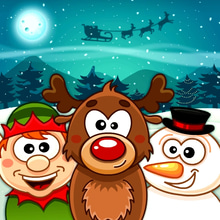
Christmas Friends is the kind of puzzle game that looks gentle for a second, then quietly traps your attention with a very specific holiday mission: move the elves around until they connect hands with their friends and finally look happy again. Kiz10’s own page says it plainly. The elves are happy when they are connected to their friends, and your job is to move them around to make that happen. That sounds innocent, and it is, but it is also exactly the kind of clean little idea that becomes surprisingly addictive once you start trying to solve one more stage before leaving.
That is really the secret here. Christmas Friends does not need noise, explosions, or frantic pressure to keep working. It relies on something much sneakier: the small emotional reward of fixing a festive mess. A group of elves is scattered. Their little chain is broken. The room feels wrong until you solve it. Then suddenly everything clicks, the holiday mood returns, and your brain gets that tiny satisfying spark that puzzle games chase so well. It is simple, yes, but simple in the good way. The kind that feels welcoming instead of empty.
And the Christmas setting helps a lot. A regular abstract puzzle with blocks and lines might still work mechanically, but elves holding hands in a wintery holiday mood gives the whole thing more warmth. It feels playful. Soft. Friendly. Even when a level is being a little rude and refusing to line up the way you want, the atmosphere never turns harsh. It stays bright and festive, which makes the challenge feel comforting instead of cold.
❄️🧩 Sliding pieces, stubborn little miracles
What makes Christmas Friends interesting is that its main mechanic is easy to understand right away. You move the elves around until their hands connect. That clarity matters. A good puzzle game often starts with a rule you can explain in one sentence, then spends the rest of its time twisting that rule into trickier shapes. Christmas Friends seems built exactly on that principle. The job is obvious. The execution gets more demanding once the level layout starts pushing back.
That kind of design is great for browser play because it lets you jump in fast. You do not need a giant tutorial. You do not need ten menus. You look at the stage, understand the goal, and start experimenting. One move changes the whole shape of the solution. One elf sliding into place can suddenly make the rest of the puzzle visible. Or, of course, one move can make the board look even worse than before, which is also part of the fun. Holiday logic can be cruel.
There is something satisfying about how physical the objective feels, too. You are not matching abstract colors just for the sake of it. You are reuniting characters. That gives every correct move a little more personality. The elves are not just pieces. They are tiny festive problems waiting to become tiny festive victories.
🎁😅 Why calm puzzle games can still be dangerous
Christmas Friends belongs to that wonderful category of games that feel relaxing and then quietly steal more time than you meant to give them. Because the challenge is not loud, your brain assumes it is safe. Then you get stuck on one level and suddenly you care far too much about arranging a perfect line of holiday elves. That is how these games get you.
The best part is that the challenge usually feels fair. Since the core goal is so readable, every mistake teaches you something. Maybe you moved the wrong elf first. Maybe the space needs to be opened from another side. Maybe the solution is simpler than the complicated nonsense your brain started building after two failed tries. Puzzle games like this are at their best when they make you feel silly and smart in alternating waves, and Christmas Friends seems built for exactly that rhythm.
There is also a lovely kind of quiet tension in hand-connection puzzles. You are always looking for alignment. You are trying to create order from a messy arrangement. Each movement either brings the chain closer to life or sends it drifting away again. That back-and-forth keeps the board active in your mind even though the presentation stays gentle. It is a soft game with a very stubborn little brain inside it.
✨👀 Holiday charm doing real work
The festive atmosphere is not just decoration. It changes how the game feels to play. Elves, friendship, connection, Christmas warmth, all of that makes the puzzle-solving more inviting. You are not merely clearing a stage. You are restoring a tiny scene of holiday happiness. That sounds small, but small things matter a lot in casual puzzle games. Theme gives purpose to mechanics, and Christmas Friends clearly understands that. Kiz10 frames the game around making the elves happy by connecting them with their friends, which gives the entire experience a nice emotional anchor.
This also makes the game a good fit for younger players or anyone who likes lighter puzzle experiences. It is approachable. The concept is easy to read. The visuals and tone lower the barrier to entry. But that does not mean it is empty. Good casual puzzle design often hides its real strength inside simplicity. Once the level progression starts introducing tighter arrangements, the player has to think more carefully about sequence and space. That is where the real satisfaction lives.
And honestly, there is something refreshing about a game that is content to be kind. Not every browser title needs to scream for attention. Sometimes a few elves, a holiday theme, and a neat logic hook are enough.
🧠🌟 The pleasure of making the board feel right
A lot of puzzle games succeed because they let players chase a feeling rather than just a score. Christmas Friends seems to be about that feeling of correctness. A board starts off awkward, disconnected, slightly wrong. Then you make the right move and suddenly it begins to breathe. The hand-holding chain starts to take shape. The disorder fades. Everything feels cleaner.
That kind of satisfaction is hard to fake. It is why so many players return to compact puzzle games again and again. The joy is not huge and explosive. It is precise. You solve the room, and for a second the world makes a tiny bit more sense. In holiday-themed form, that feeling becomes even sweeter. The elves are happy. The scene is complete. The level stops resisting.
Then the next stage arrives, naturally, and the whole process begins again.
That cycle is probably why Christmas Friends works so well on Kiz10. It is fast to understand, festive to look at, and based on a goal that is instantly readable but still flexible enough to create a chain of satisfying little brain-teasers. Kiz10 lists it among puzzle games, and that category fits perfectly because the real appeal here is not speed or chaos. It is arrangement, connection, and the quiet thrill of getting a small holiday puzzle exactly right.
So if you like Christmas games, gentle logic challenges, elf-themed browser fun, or any puzzle where the main reward is turning confusion into something neat and complete, Christmas Friends has the right kind of charm. It is soft, clever, and just stubborn enough to keep you there longer than planned. Tiny hands, tiny moves, tiny holiday victories. Sometimes that is all a game needs.





 Share
Share
 Embed
Embed