🍬🧲 The candy is calling… and gravity is laughing
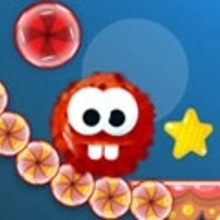
Eat the Candy starts with a very innocent promise: there’s candy, there are stars, and you just need to get the little creature to the right place so it can collect everything. Simple, right? Then you make your first drop, the character bounces like a jelly bean with opinions, the candy sits there sparkling like it knows something you don’t, and suddenly you’re staring at a field of spikes thinking… okay, maybe this game is not as sweet as it looks. 😅
On Kiz10, it lands in that perfect spot between “quick casual puzzle” and “why am I still here twenty levels later arguing with a physics engine.” It’s a game about timing, angles, and tiny decisions that feel harmless until they become catastrophic. Because Eat the Candy isn’t about speed. It’s about control. Or at least the illusion of control while your adorable little droplet-creature tumbles into chaos.
You’re essentially directing a candy rescue mission using gravity as your main tool. Sometimes gravity helps, like a reliable friend. Other times gravity is the villain, shoving your character into danger with the confidence of someone who has never faced consequences. And the best part is that the game keeps you learning without lecturing. Every stage quietly teaches a new trick, then dares you to use it under pressure.
🎯🍭 One drop, ten outcomes, and one tiny scream
What makes Eat the Candy feel alive is how much variety you can get from a single choice. The concept of “drop the character here” sounds straightforward, but the moment the character hits a surface, the real game begins. Bounce, slide, wobble, stop, roll, panic-roll, do a dramatic little flip for absolutely no reason… and there goes your perfect star run. 🙃
It’s one of those physics puzzle games where your brain starts creating a plan before you even realize it. You look at the level layout and immediately imagine a clean path: first candy, then a little bounce off the edge, then a gentle landing near the second candy, then a quick hop to the finish. You’re already celebrating. Then reality arrives. The bounce is too strong, the angle is wrong by a millimeter, and your character turns into a sugar-powered pinball headed straight toward spikes. That’s when you start laughing, because the failure is dramatic in a way that feels almost designed for comedy.
And yet, it never feels pointless. You can usually tell why you failed, which is dangerous because it means you believe you can fix it. Just a slightly earlier drop. A slightly different landing. A calmer approach. Eat the Candy turns “I lost” into “I learned something,” and that’s exactly how it traps you in the best way.
🧠✨ Stars are optional (lie), candy is mandatory (truth)
Technically, you can play Eat the Candy like a relaxed puzzle: get the candy, reach the goal, move on. But then the stars show up, shining like tiny challenges whispering, come on… you can do better. And you think you’ll ignore them. You always think you’ll ignore them. Then you grab one star by accident, miss the second, and suddenly you’re restarting because your pride cannot accept a two-star finish. 😭⭐
This game understands a very human weakness: completion. Once you know a perfect run is possible, you want it. Not because you need it, but because your brain gets itchy. You start replaying levels not out of frustration, but out of obsession. You’ll do a run that’s totally fine, then restart because it wasn’t clean. You’ll take a safe path, then restart because you saw a riskier path that might be faster, smoother, prettier. The game becomes less about finishing and more about mastery.
And the levels keep the pressure balanced. They’re short enough that retrying doesn’t feel like punishment. You can experiment quickly, fail quickly, learn quickly. It’s that rapid feedback loop that makes Eat the Candy such a satisfying free online puzzle game on Kiz10. You’re always adjusting, always improving, always just one try away from the run that feels “right.”
🧷😬 Spikes: the polite reminder that you’re not in charge
Let’s talk about spikes, because spikes deserve their own paragraph. They’re the game’s way of saying: you may be adorable, but you are not invincible. One bad bounce and it’s over. Spikes turn a cute candy chase into a careful, tactical puzzle. They force you to respect momentum. They punish careless drops. They also create those slow-motion moments where you watch your character sliding toward danger and you can’t do anything except whisper, no no no no no… and then it happens. 😵
But spikes also make victories sweeter. When you thread a path between hazards and land perfectly, it feels earned. When you grab candy that sits dangerously close to spikes, it feels like stealing treasure from a trap-filled temple, except the treasure is sugar and the temple is a pastel nightmare. In a weird way, spikes are what give the game its bite. Without them, it’d be relaxing. With them, it’s thrilling.
🎢🍬 The “I meant to do that” physics moment
There’s a specific kind of joy in this game when your plan fails… but succeeds anyway. You drop in the wrong place, the character bounces off an edge you didn’t even notice, hits a slope at the perfect angle, scoops up candy like a pro, snags a star mid-air like it’s doing a stunt, and lands safely. You sit there for a second, stunned, then immediately pretend you calculated it. Totally intentional. Absolutely. 😎
Those accidental victories are part of why Eat the Candy feels playful instead of punishing. It gives you room for lucky chaos, but it still rewards skill. Over time, your “luck” turns into instinct. You start recognizing bounce patterns. You start understanding how surfaces influence movement. You learn where to drop for a soft landing versus a fast roll. And without realizing it, you get better. That’s a great feeling in a casual physics puzzle game: growth that happens quietly, without grinding.
🕹️💥 The brain talks, the hands do the rest
Eat the Candy is the kind of game you can play with a relaxed posture, but your brain will be doing tiny calculations like it’s trying to land a spacecraft. You’ll catch yourself analyzing shapes and thinking about trajectory. You’ll have little internal conversations mid-level. Okay, if I drop here, it’ll bounces there… unless it slides… unless it hits the corner… wait, what if I drop slightly higher? And then you do it, and it works, and you feel weirdly proud of yourself for something that is, technically, a candy game. 😄
That’s the charm. It looks simple, but it offers enough challenge to make you feel clever. It’s a puzzle game with a light tone and a sharp edge. It’s cute on the outside, tactical on the inside, and it keeps your attention because every level is a tiny scenario waiting to be solved in your own messy style.
🏁🍭 Why Eat the Candy is perfect “one more level” fuel
On Kiz10, Eat the Candy is an ideal pick when you want a game that’s easy to start but hard to drop. The levels are quick, the goals are clear, and the physics keep things unpredictable enough to stay fun. It’s not about reading long instructions or memorizing controls. It’s about experimenting, laughing at your own mistakes, and eventually pulling off a run so clean you’ll want to show someone… even if nobody asked. 😅
If you like physics puzzles, candy-themed challenges, star-collecting perfection hunts, and that satisfying moment when a chaotic bounce turns into a perfect landing, this one delivers. Just be warned: the candy is never “just candy.” It’s a trap. A delicious, sparkling trap. 🍬✨



 3.3 (17 votes)
 Share
Share
 Embed
Embed