🌴🪢 TIED UP, THROWN OUT, AND SUDDENLY YOU’RE A PROJECTILE
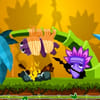
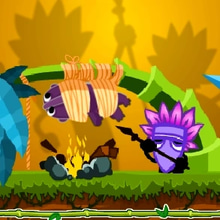
Flying Snack begins in the least polite way possible: you’re captured, tied to a palm tree, and the local “we eat what we catch” crowd has already decided you’re on the menu. No negotiation, no heroic speech, no “press X to plead.” You get launched. That’s the whole opening statement. And from that first moment, the game locks into a deliciously simple loop that feels like an arcade prank with teeth: fly as far as you can, survive whatever comes next, and squeeze every extra meter out of a run that was never supposed to be fair.
It’s a distance launcher game with survival tension. You’re not just going for a long flight because numbers are pretty. You’re going for distance because distance is your escape route, your score, and your tiny act of defiance. The world below you is not friendly. The air is not forgiving. And the ground is basically a reminder that gravity is always watching.
💨🍖 THE LAUNCH MOMENT FEELS LIKE A SLAP AND A DARE
That first throw is the hook. There’s something absurdly funny about being flung like a snack, yet it still creates real focus because the game punishes lazy control. The instant you’re airborne, you start reading the run like a moving problem. Where’s the safest line? What’s going to slow you down? What’s going to end you immediately? You’re balancing momentum, timing, and a tiny bit of luck, but it never feels purely random. It feels like the kind of chaos you can learn to manage, which is the best kind.
Some runs start strong and then fall apart because you get greedy. Some runs start messy and then you catch a lucky chain of movement that makes you feel unstoppable. The game loves those emotional swings, the ones where you go from “this is a bad run” to “WAIT… this might be the run” in about three seconds.
🧠🎯 THE REAL SKILL IS CHOOSING WHEN TO INTERFERE
Launcher games have a sneaky rule: the best players don’t touch everything, they touch the right things. Flying Snack rewards that calm, slightly stubborn discipline. There are moments when doing nothing is the smartest move, letting your current arc carry you through a safe stretch. Then there are moments when you must act, because if you don’t, you’ll crash into something, lose speed, or get shoved into a dead line with no recovery.
That tension makes the game feel sharper than it looks. It’s not a complex simulator, but it asks you to pay attention. You start developing instincts: you learn what kinds of angles keep you alive, what kinds of angles waste distance, and what kinds of angles are basically you signing a death certificate with confidence.
🌪️🦴 THE MID-AIR PANIC ZONE
There’s a specific moment in Flying Snack where your brain starts screaming in fast fragments. You’re flying, something dangerous shows up, your line looks wrong, and you have about half a second to decide. Not a comfortable half second either. The sweaty half second. You know the one. You make a correction and instantly wonder if it was smart or if you just made it worse.
And the game is built out of those micro-decisions. That’s why runs don’t feel identical. Even if the premise stays the same, your path through the chaos changes depending on how you reacted to a single moment. You’ll replay and think, okay, last time I tried to “save” the run too early. This time I’ll hold my line longer. Or the opposite: last time I hesitated and paid for it. This time I’ll act immediately. That back-and-forth is what turns a simple launcher into something you actually want to master.
🏝️💥 THE WORLD WANTS TO SLOW YOU DOWN
Flying Snack isn’t interested in letting you glide peacefully. The environment exists to shave off momentum. Anything that stops you, bumps you badly, or forces you into a low-speed crawl is effectively the enemy. Speed is your oxygen here. Lose it and the run dies quietly. Keep it and you can chain distance like you’re stealing it from the universe.
You start appreciating the difference between a “good hit” and a “bad hit.” A good hit keeps you moving forward, even if it’s messy. A bad hit kills your trajectory and turns you into a stone. The game teaches you to hunt for forward motion, not drama. Drama shows up anyway, but distance is built on control.
😅🛟 “ONE MORE TRY” IS NOT A CHOICE, IT’S A CONDITION
The funniest part is how quickly you become personally invested. It’s not a story-heavy game, yet it creates its own tiny narrative every run. You remember the run where you escaped cleanly for a long stretch. You remember the run where you messed up early and still somehow turned it into a decent distance. You remember the run where everything was perfect until one stupid mistake erased it.
And the restart loop is quick enough that you don’t feel like you’re being punished with downtime. You fail, you learn, you try again. You keep trying because the game’s promise is always believable: you can do better. Not because of grinding a hundred hours, but because your decision-making improves in small, satisfying steps.
⚡🧩 HOW THE GAME TEACHES YOU WITHOUT TALKING
Flying Snack doesn’t need a wall of instructions to teach you. It teaches through consequences. If you rush your inputs, you’ll overcorrect and lose your line. If you wait too long, you’ll miss your chance to recover. If you chase a risky route, you might get rewarded, but the game will also remind you that “might” is not a guarantee.
The learning curve feels like sharpening a reflex. You start predicting what’s coming. You start reading the space ahead instead of staring at your character. You stop making huge, panicked moves and start making smaller, cleaner adjustments. That’s when your distances climb. It feels earned because it is earned.
🍽️😈 THE HUMILIATION FACTOR (IN A GOOD WAY)
The theme is hilarious because it’s blunt: you are literally a flying snack to a bunch of dangerous cannibals. That makes every failure a little comedic, even when it’s frustrating. You’re not losing in a tragic epic. You’re losing in a ridiculous escape attempt where the universe keeps trying to turn you into dinner.
That humor matters. It keeps the game light. It makes the chaos feel playful instead of oppressive. Even when you crash, you’re more likely to laugh than rage, then immediately decide you’re not ending on that run.
🏁🌟 WHY FLYING SNACK WORKS ON Kiz10
Flying Snack is the perfect “fast commitment” game. You can play a run in seconds, but it still has depth in the way timing-based launch games always do. The better you get, the more it feels like you’re controlling chaos instead of being controlled by it. It’s simple, but it’s not sleepy. It’s funny, but it still rewards skill. And it’s the kind of game that turns a silly premise into an actual challenge, which is exactly why it sticks.
If you like distance launcher games, survival arcade gameplay, and the feeling of pushing a run farther through smarter timing, Flying Snack is a great pick on Kiz10.com. Just remember: the moment you start celebrating mid-air is usually the moment the game decides you’re overdue for humility. 🌴💨😅



 4.2 (10 votes)
 Share
Share
 Embed
Embed