🟩⭐ A Little Creature With A Big Problem
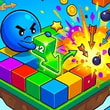
Greenie 2 begins with a dangerously simple idea: you’re a tiny green thing in a world that looks like it was built from pure pixels and bad intentions, and all you want is stars. Not “some stars.” Not “maybe one if it’s convenient.” You want every star on the stage because the exit doesn’t care about your feelings, it only cares about completion. That obsession is the engine of the whole game. It turns each level into a compact dare where your reward is a door opening and your punishment is a restart that feels like the room smirking at you. And on Kiz10, that loop hits fast: quick levels, fast retries, and that stubborn thought that shows up after every mistake like a little gremlin whispering, you can do this cleaner.
At first glance it looks like a classic retro platformer. You move, you jump, you avoid enemies, you go to the exit. Then Greenie 2 shows you its real trick: phasing. You can shift your state and pass through certain blocks like they’re not even there, which sounds like a superpower until you realize it’s also a responsibility. Because if you can go through walls, you can also fall through floors. If you can ignore a barrier, you can also remove the thing that was protecting you from a hazard. It’s a power with teeth. The game doesn’t want you to spam it. It wants you to time it, respect it, and occasionally use it mid-jump while your brain is politely screaming.
🧩🫧 Phasing Is Not A Button, It’s A Timing Language
The phasing mechanic changes how you think about space. A normal platform game asks “Can I reach that ledge?” Greenie 2 asks “Which version of reality do I need for that ledge to exist?” You’ll stand in front of a block arrangement that looks impossible, then realize the solution isn’t a bigger jump, it’s a different state. This is where the game gets addictive: you start reading levels like puzzles instead of like courses. A wall becomes a suggestion. A ceiling becomes a route. A solid platform becomes a trap waiting for you to forget what mode you’re in.
And it’s not just about passing through blocks. It’s about switching at the right moment. Switch too early and you drop into danger before you can correct. Switch too late and you smack into a surface that stops your momentum, ruining the timing window you needed. The best runs feel smooth, almost like choreography, because you’re blending movement with state changes in one clean motion. The bad runs feel like slapstick. You jump, you phase, you realize you phased at the wrong time, and you watch your little green hero fall with the kind of dignity only a pixel character can pretend to have. 😅
🚪🛑 Doors, Hazards, And Rooms That Hate Shortcuts
Greenie 2 loves tight rooms. Not wide open fields where you can relax, but compact spaces where every tile matters. Doors open only when you’ve done what the level demands, and the level demands stars. Those stars are placed with intent. Some are obvious, sitting right in your path like a snack. Others are bait, placed near hazards, enemies, or awkward geometry that forces you to commit to a risky route. You’ll constantly choose between safety and efficiency, and the game is very good at making the safe route feel boring. That’s the trap. The safe route is there so you can reach the hard star without panicking. If you sprint straight for the hard one like you’re proving something, you’ll usually pay for it.
The hazards are the kind you learn to respect. Spikes that wait for sloppy landings. Tight corridors that punish oversteer. Situations where you have to phase through a block, but only after you’ve used it as a stepping stone first. That’s the brain twist Greenie 2 loves: the same block can be a platform and an obstacle depending on timing. The room isn’t just asking “Are you fast?” It’s asking “Are you paying attention?”
👾⏳ Enemies That Turn Simple Jumps Into Decisions
Enemies in Greenie 2 aren’t there only for decoration or cheap difficulty. They’re moving timers. They patrol, they pressure you, they force you to choose when to move. A star that looks reachable becomes scary if an enemy’s route intersects the one safe landing spot you need. The clever part is how phasing changes the interaction. Some enemies feel like they ignore the environment in ways you can’t, others feel blocked by the same structures you’re manipulating, and that means the level becomes a living puzzle. You’re not just dodging, you’re learning what can be used as a shield, what can be used as bait, and what will absolutely ruin you if you assume it behaves like the last enemy you saw.
This is where you start doing that classic puzzle-platformer thing: you pause. Just for a second. You watch the movement loop. You let the room show you its rhythm. Then you go. When you time it right, it’s satisfying in a quiet way. No giant explosion, just a clean route that makes you feel clever. When you time it wrong, you don’t feel “unlucky.” You feel caught. And that’s why you retry. Because being caught feels fixable.
🎮🧠 The “One More Star” Mental Spiral
The most dangerous moment in Greenie 2 is when you have two stars and you only need one more. That’s when your brain starts lying to you. It says you’re basically done. It says you can rush. It says you can take the tight line without setting up properly. That’s when you clip a hazard or mistime a phase and suddenly you’re back at the start, staring at the room like it personally insulted you.
But that’s also why it’s fun. The game creates these tiny emotional stories. You’ll have a run where everything is smooth, then you choke on the last star because you got impatient. You’ll have a run where you mess up early, then somehow recover and finish perfectly because you stayed calm afterward. You’ll have a run where you collect the hardest star first like a rebel, then realize you accidentally made the rest easier. Greenie 2 rewards experimentation, but it rewards disciplined experimentation, the kind where you learn something every attempt instead of repeating the same mistake with louder frustration.
🌟🕹️ Why It Feels So Good When It Clicks
At some point, the phasing stops feeling like a trick and starts feeling like your movement. You’ll switch mid-air without thinking too hard. You’ll land already preparing the next toggle. You’ll start seeing solutions in your head before your character even reaches the obstacle, like the level is drawing itself in your brain. That’s the sweet spot: you’re not guessing anymore, you’re executing.
And the retro style helps. The clean pixel look keeps information readable. Platforms are obvious. Hazards stand out. The world feels simple enough that your mistakes feel honest. When you fail, it’s usually because of timing or decision-making, not because the game hid something unfairly. That honesty is a huge part of why puzzle platform games like this stay memorable. They don’t just challenge your reflexes, they challenge your habits. They ask you to be patient when you want to rush and confident when you want to hesitate.
If you like puzzle platformers with a strong mechanic, levels that feel like little brain traps, and that satisfying “I mastered the room” feeling, Greenie 2 is exactly that kind of compact challenge. It’s cute, it’s cruel in a fair way, and it turns a simple hunger for stars into a full rhythm of timing, phasing, and stubborn improvements. 🟩⭐



 4.7 (8 votes)
 Share
Share
 Embed
Embed