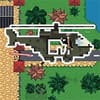
🚁🌫️ Rotors on, nerves louder than the engine
Heli-Rescue drops you into that specific kind of chaos where the sky feels too small and the ground feels too angry. You’re piloting a rescue helicopter, but it’s not the calm, cinematic “hover gently and wave at the crowd” type of rescue. It’s the messy kind. The kind where you’re trying to hold a steady hover while something is falling apart below you, while time is chewing on your ankles, while your helicopter wants to drift just enough to ruin everything. On Kiz10, it plays like an action rescue game with a constant pulse: fly in, find the target, pick them up, get out, repeat… and somehow every step becomes harder the moment you start feeling comfortable.
There’s a special tension to rescue games because the goal isn’t “win a race,” it’s “bring someone back.” And even if the game doesn’t force a dramatic story onto you, your brain invents one anyway. You see a survivor marker and suddenly it’s personal. You start talking to yourself. Not out loud, obviously. Just that internal voice like, okay, buddy, don’t mess this up. Don’t tilt. Don’t overcorrect. Please don’t overcorrect.
🧭🛬 The hardest part isn’t flying fast, it’s flying clean
Heli-Rescue rewards the kind of control that looks boring to spectators and feels incredible to the person doing it. Smooth approaches. Gentle turns. A clean line to the pickup zone without wobbling like a shopping cart on ice. The helicopter responds to your inputs in a way that makes you respect momentum. If you yank the controls, the craft swings. If you panic-correct, the craft swings harder. If you keep your hands calm, the helicopter settles into that sweet spot where you’re actually steering it instead of arguing with it.
And once you understand that, the game becomes less about rushing and more about precision under pressure. You’re balancing altitude, angle, and speed while watching the environment for threats and obstacles. Landing zones aren’t just “a place to touch down.” They’re puzzles. How do you arrive without bouncing? How do you hold still long enough to complete the pickup? How do you leave without clipping something because you got impatient the exact second you should’ve been careful?
⏱️🧯 The clock is the real villain, politely wearing a mission label
Every rescue mission has that invisible shove forward: hurry up. Even if the timer isn’t screaming at you, the structure of the game makes you feel like every second matters. That pressure changes how you fly. You take sharper lines. You cut corners closer. You try to save time in tiny ways, and sometimes those tiny shortcuts become huge mistakes.
The funniest part is how the clock changes your personality. When you have plenty of time, you fly like a professional. When time gets tight, you fly like you’re late to your own rescue. That’s when you start doing risky approaches, forcing landings, trying to hover while drifting sideways, pretending it’s fine, it’s fine, it’s fine—until it isn’t. Heli-Rescue is great at creating those moments where you barely succeed, not because the game is unfair, but because you chose speed over stability and paid the price in stress.
🧲👤 Pickups feel simple until you realize hovering is a skill, not a pause button
Rescuing someone sounds easy: get close, pick them up, leave. But the pickup itself is where the game flexes. Hovering in place is not “doing nothing.” Hovering is active control. It’s tiny micro-corrections that keep your position locked while the helicopter naturally wants to drift. And drift is dangerous, because drift turns a clean rescue into a clipped edge, a missed pickup, or a forced reset.
You’ll learn to treat hovering like a rhythm. Small adjustments. Brief stabilizing moments. Quick re-centers. It starts feeling like you’re balancing a glass of water while running. You can’t slam the controls; you have to finesse them. And when you finally nail a perfect hover—steady, quiet, controlled—it feels ridiculously satisfying. It’s one of those gamer joys that sounds silly to explain and feels completely real when you experience it. 😅
🚧🌪️ Obstacles, tight spaces, and the art of not letting fear drive
Heli-Rescue loves giving you routes that look open until you’re actually inside them. Narrow passages. Awkward angles. Objects placed in exactly the wrong spot. You’ll have moments where you realize you’re committed to a corridor and your only way out is to keep the helicopter steady through a turn you should’ve approached slower. This is where the game becomes a little cinematic: rotors slicing through the air, obstacles close, your eyes scanning for clearance, your brain repeating the same phrase like a mantra: easy… easy… easy…
The challenge isn’t just avoiding a crash. It’s avoiding a messy near-crash that throws off your alignment and ruins your approach. Because even if you don’t fail instantly, a bad bump can cost time, position, and control. And control is everything. A pilot who stays calm in tight spaces wins. A pilot who tries to bully the helicopter through a gap usually ends up learning humility the loud way.
🔧💥 Action pressure: when rescue turns into survival
Depending on how the mission pressure ramps, Heli-Rescue can feel like more than a flight challenge. It becomes a survival run. The environment feels hostile. The urgency rises. You’re forced to decide quickly: do I go for the pickup now, or reposition first so I don’t get trapped? Do I take the short route with higher risk, or a longer route that keeps me safe and stable?
Those choices are what make the game feel alive. You’re not just following arrows, you’re managing risk. And that risk management becomes your playstyle. Some players will go full hero and dive straight into danger, relying on quick hands. Others will fly like a careful professional, choosing safer angles and cleaner exits. Both approaches can work, but the game always respects the same thing: composure. If you stay composed, you fly better. If you get rattled, you fly sloppy. And sloppy flying is how rescue missions turn into rescue comedy.
🏁✨ The “perfect run” is quiet, smooth, and almost suspicious
The best runs in Heli-Rescue don’t feel explosive. They feel controlled. You approach cleanly, hover steady, scoop the survivor, depart smoothly, and your helicopter never does that awkward wobble that screams “I’m about to mess up.” It feels like you’re gliding through a plan that actually makes sense.
That’s why the game is so replayable on Kiz10. You’re not only chasing completion, you’re chasing elegance. The next run can be cleaner. The next pickup can be steadier. The next landing can be less chaotic. You start caring about efficiency in a very gamer way, like you’re trying to prove to yourself that you can do it without the panic sweats.
Heli-Rescue is the kind of helicopter rescue action game where the thrill comes from staying controlled while everything around you pushes you toward mistakes. Save the survivors, master the hover, and keep your hands calm even when the missions begs you to rush. The sky rewards skill, not noise. 🚁🧊





 3.7 (21 votes)
 Share
Share
 Embed
Embed