🚪 Knock, run, and hope they don’t catch you
Knock and Run: 100 Doors Escape drops you into a hotel that looks normal for about five seconds. Long carpets, identical doors, soft lighting… and then you sprint past the first room, slam the bell, hear someone scream inside, and your brain goes oh, this is not a vacation. You are a tiny stickman troublemaker with exactly one mission race through the corridors, pull off the loudest pranks possible, and get away before anyone has time to grab you by the collar.
The rules sound simple. Run to the end of the hallway, ring as many doors as you can, and stay alive. But that simplicity is a trick. Every corridor has just enough blind corners and suspicious silhouettes to make you second guess your next prank. You never know if the door you are about to poke belongs to a terrified guest who will freeze, or a furious neighbor who charges out like a cartoon boss with bed hair and problems.
😈 Prank routes and split second decisions
The hotel becomes a playground the moment you start treating it like a maze of opportunities instead of a straight line. You see three doors in a row and your brain instantly starts running simulations. Hit all three and risk someone opening right into your face Or hit one, skip the second, loop around a corner and try to chain another prank further ahead Every choice changes how the next few seconds feel.
There is no time to carefully plan a perfect route. You are making decisions on instinct while your stickman legs are already moving. Sometimes that instinct is brilliant you time your knock just as a grumpy guest turns away, you slide past them and hear the angry stomp behind you while you laugh in real life. Other times that instinct is awful and you slam a doorbell, hesitate for half a heartbeat, and get caught by an angry resident who definitely did not appreciate the early wake up call. Those tiny failures burn into your memory and quietly teach you where to be bold and where to bail.
👀 Residents, jump scares and almost getting grabbed
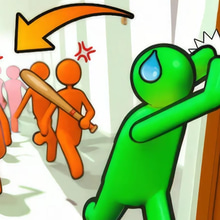
The real spice of Knock and Run lives in the reactions. Not all hotel residents behave the same way, and that unpredictability is what keeps your heart rate just a little too high. Some doors open slowly with a scared guest peeking out, giving you a moment to dash past and feel like a ghost. Others fly open with someone already mid–yell, sprinting after you while you mash the movement keys and hope the corridor is long enough to escape.
Sometimes you will misjudge a situation and run straight into danger. Maybe you turn a corner and a resident is already there, halfway through furious animation, blocking almost the entire hallway. You try to juke around them, your thumb or fingers slipping slightly, and you feel that tiny panic spike when your character stutters. When you do pull off the escape at the last frame, barely slipping under an arm or past a swinging object, it feels like cheating fate. When you fail, you stare at the screen and swear that next round you will never be that greedy with your pranks again… at least until the next level.
🕹️ Controls that melt into pure reaction
Mechanically the game is straightforward. You guide your stickman with WASD, cursor keys, or touch controls, always leaning forward, always pushing for speed. There are no complicated combo inputs, no fifteen button tutorials to memorize. You move, you knock, you dodge, and you run. That simplicity is deliberate. When the hotel is full of surprises, your fingers should not be arguing with the control scheme.
On desktop, your left hand rides the movement keys while your right hand handles the small aim and timing decisions. On mobile, your thumb glides on a virtual joystick as you slide from door to door, tapping just long enough to trigger a prank before cutting away. After a few runs, your body starts to predict the rhythm. You will find yourself leaning into corners, pre-turning before the camera shifts, and snapping to doors almost automatically. Your brain moves from thinking about “how to control” to “where to cause trouble next,” which is exactly where an arcade game like this wants you.
🏨 Stickman chaos in a minimal hotel
The visual style keeps everything clean enough that you can read danger at a glance. Simple stickman characters, bright corridors, bold doors and clear silhouettes mean you rarely lose track of what matters. That minimalism also makes the reactions pop. An angry resident bursting out of a door feels bigger than life precisely because the shapes are simple. A scared guest shrinking back into their room is instantly readable, even when you only see them for a split second while you dash past.
Because the art is so focused, your imagination fills in the rest. You start inventing personalities for different doors. That one room where the resident always seems extra fast. That corner where you swear someone is waiting ready to jump out if you linger. The hotel becomes more than just geometry. It starts to feel like a living, slightly cursed building that remembers every prank you pull. And somewhere in that stack of floors and hallways there is always one more unsuspecting door waiting for your next knock.
🎵 Little sounds, big tension
Audio does a lot of quiet work here. The slap of your footsteps, the tiny ring of doorbells, the sudden burst of voices when someone answers all of it feeds your nerves. You might be casually cruising through a corridor, tapping doors without a care, when an especially sharp sound cue snaps you back to full alert. The difference between a frightened gasp and a furious shout matters, and your brain starts categorizing those noises so you can react before your eyes even fully process what happened.
There is a strange comedy to it all. You laugh when a resident erupts from a room a split second after you sprint away. You flinch when one appears the moment you press the bell. You feel oddly proud when you manage to weave through multiple responses in the same hallway, turning chaos into a kind of improvised rhythm game. The soundtrack and effects are not screaming for attention all the time, but when they hit at the right moment, they turn simple corridor runs into tiny stories.
🏁 The strange addiction of hallway chaos
What makes Knock and Run: 100 Doors Escape so easy to replay is how quickly a run resets and how many micro-goals you can invent. One attempt you aim to ring every door you see, consequences be damned. The next you play it sneaky, testing how few pranks you can pull while still feeling like a menace. Sometimes you just want to see how close you can let an angry resident get before you cut away at the last moment.
There is always another level, another layout, another corridor with slightly nastier angles and tighter reaction windows. You tell yourself “this is the last run” and then the game throws a new pattern of doors at you and your curiosity wins. Could you clear this stretch without being touched Could you prank every room in the hall without getting caught Even failure feels useful, because every mistake reveals a better way to weave through that section next time.
And because you can jump into the chaos directly from your browser on Kiz10, it becomes dangerously easy to “just hop in for a minute.” A minute turns into a handful of corridors, a handful of corridors turns into that one perfect sequence where you prank half the floor and still make it to the exit. The hotel never really stops daring you to knock on one more door. The only real question is how long you can keep outrunning the consequences.





 Share
Share
 Embed
Embed