🎯🐾 Pull back, breathe… release like you mean it
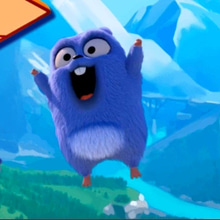
Lemmings Sling is the kind of game that looks innocent for exactly one second. Cute little lemmings, bright colors, a slingshot sitting there like a harmless toy. Then you take your first shot, miss the box by a hair, watch your lemming ricochet off a wall like a rubber panic thought, and suddenly you’re locked in. Because this is not just “throw the thing into the thing.” This is a physics puzzle wrapped in cartoon chaos, a score chase disguised as a silly fling-fest, and it lives on Kiz10 like it was built for those moments when you want something quick… and then you realize you’re still playing because your brain refuses to accept that last miss 😅
The main idea is wonderfully simple: you pull the slingshot, aim, and launch lemmings upward into moving boxes. Sounds easy. It is… until the boxes start drifting like they have personalities and grudges. One box glides left when you aim right. Another pauses for just long enough to trick you, then slides away the second you release. Your goal becomes less about “can I aim” and more about “can I predict motion under pressure while staying calm.” It’s the kind of calm you pretend to have while your finger is twitching to shoot again.
And yes, it’s timed. Of course it’s timed. The timer adds that delicious urgency where every decision feels slightly dramatic. You’re not just trying to score, you’re trying to score fast. You’re trying to build a rhythm: pull, release, adjust, repeat. Miss? No time to mourn. Hit? Great, don’t celebrate too hard, the next box is already drifting away like it heard you say “I’m getting good at this” 😭
📦🌀 Boxes that move like they’re avoiding your success
The moving boxes are the heart of the challenge. They’re targets, sure, but they’re also pressure. They force you to shoot with anticipation instead of reaction. If you aim directly at where the box is right now, you’ll often be late. You need to aim where it’s going to be, which sounds obvious until you remember you’re doing it in a fast loop, under a timer, with lemmings flying like tiny fluffy missiles.
That’s where the game gets strangely satisfying. You start learning little rules without even thinking about them. You begin to lead your shots. You notice patterns in movement. You recognize when a box is drifting into a “perfect lane” and you capitalize instantly. Then the pattern breaks, and you adapt, and that adaptation is the real skill. The game doesn’t ask for complicated mechanics, it asks for quick learning and cleaner instincts.
The walls matter too. They’re not just background. They’re tools. A straight shot is nice when it works, but bounce shots are where the game starts feeling smart. You can bank a lemming off a wall to widen your angle, to catch a box that’s moving unpredictably, to turn a “no chance” shot into a sneaky score. And when you pull off a good bounce, it feels like a little magic trick. Not because it’s random, but because it’s physics doing you a favor for once 🙏🧠
⏱️🕰️ The timer is your enemy, the clocks are your obsession
Nothing in Lemmings Sling changes your mood faster than extra time. The moment you see a clock bonus, your brain goes into hungry mode. You stop thinking about safe points and start thinking about extension. Because more time means more shots, more shots means more score, and score means you get to feel smug for exactly five seconds before you miss again.
Chasing time bonuses is a mini-game inside the main game. It’s tempting, risky, and sometimes absolutely worth it. You’ll have moments where you ignore an easy box because you’re hunting the clock like it owes you money. Sometimes you land it perfectly and feel like a genius. Sometimes you miss the clock and also miss the boxes you could have scored, and that’s when you learn the painful truth: greed is a strategy, but it needs discipline 😅
The best part is how the timer changes your pacing. Early seconds feel spacious, like you can line things up. Late seconds feel like a sprint, like you’re trying to squeeze meaning out of every flick. The game turns into controlled chaos. Your hands speed up, your eyes scan higher, and your brain starts doing quick math without permission: “I have enough time for two more shots… maybe three if I don’t hesitate.” That’s the whole vibe. Don’t hesitate.
🧠💥 Tiny tactics that turn random flings into real scores
At first, Lemmings Sling can feel like luck. It isn’t. Not really. It’s skill disguised as silliness. The trick is learning what to prioritize. Some boxes are easier and safer, and stacking those hits builds steady points. Some shots are flashy but unreliable, and chasing them can waste time. You start asking yourself little questions mid-run, like a competitive player pretending they’re casual. Do I take the guaranteed box now, or do I wait half a second for the better angle? Do I shoot straight up and hope, or do I bank off the wall for a wider landing path? Do I chase the moving target or let it come into my lane?
And there’s the rhythm of rapid firing. One miss doesn’t cost you much, but hesitation does. The game rewards confidence. Even if you miss, you keep the flow. You keep the tempo. You keep the scoreboard moving. It’s almost musical in a chaotic way. Pull, release, pull, release… and suddenly you’re in that zone where you’re not thinking in words anymore, you’re thinking in angles.
Another weirdly helpful habit is aiming for “space,” not for “the box.” That sounds backwards, but it works. When the box movement is unpredictable, you aim for the lane the box is likely to pass through. You let motion do the last part of the job. You’re not sniping a pixel, you’re setting a trap. And when it lands, it feels clean, like you outsmarted the level instead of begging it to cooperate 😈📦
😅🏆 Why it’s dangerously replayable on Kiz10
Lemmings Sling is built for replay. It’s short-session friendly, but it also has that score-chasing hook that makes you restart immediately because you know you can do better. You remember the shot you messed up. You remember the clock you missed. You remember the moment you hesitated and the box slipped away. The game gives you clear feedback, which makes improvement feel real. That’s why it sticks.
It’s also the kind of physics puzzle game that stays entertaining because it doesn’t ask you to memorize a long campaign. It asks you to improve your feel. Your timing. Your confidence. Your ability to handle moving targets under pressures. Every run is slightly different because the motion and timing create new little moments, new opportunities, new mistakes you didn’t know you were capable of making.
So yeah, it’s cute. It’s funny. It’s chaotic. But it’s also sneaky, because it turns you into a person who cares deeply about putting tiny lemmings into floating boxes before time runs out. And once you care, you’re done. You’re in the loop. One more run. Cleaner shots. Better bounces. More clocks. Higher score. Same chaos. Perfect 🔥🐾🎯



 2.5 (80 votes)
 Share
Share
 Embed
Embed