🌊 Trapped below, thinking fast above
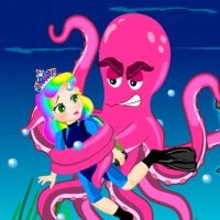
Princess Juliet Underwater Escape has that delicious kind of problem that immediately makes your brain sit up. The sea is all around you, the room feels wrong in that quiet, pressurized way, and escape is no longer a fun idea. It is the only idea. This is the kind of puzzle adventure that grabs you with atmosphere first. Before you even start connecting clues, the setting does part of the work. Underwater danger has a special flavor. It is not loud chaos at first. It is silence, pressure, glass, mystery, and that tiny voice in your head whispering, “This is probably bad.” Then the puzzle solving begins and suddenly that feeling becomes exciting instead of scary.
On Kiz10, Princess Juliet Underwater Escape feels like a compact point-and-click adventure built for players who enjoy searching, thinking, and poking at every suspicious object on screen like they were born to investigate weird rooms. It is not about speed in the usual sense. Nobody is asking you to smash buttons with superhero reflexes. What matters here is curiosity. Observation. Patience. That odd moment where you stare at a harmless decoration for three seconds and realize, wait, why does that shell look important? Why is that lever slightly too clean? Why am I emotionally attached to this random key already? That is the energy this game lives on.
🐚 Clues, corners, and tiny details with attitude
The best thing about an escape game like this is how it turns simple clicking into something strangely dramatic. You are not just selecting objects. You are hunting for answers in a place that does not want to give them to you easily. Every room feels like it is hiding something. Every item might matter later. Every puzzle solution feels a little like stealing a secret from the game itself. Princess Juliet Underwater Escape understands this beautifully. It knows that players love the rhythm of explore, notice, test, fail, rethink, and finally solve.
And honestly, that process is weirdly satisfying. You click around, collect tools, examine your surroundings, and gradually the scene stops feeling confusing. A pattern appears. A lock suddenly makes sense. A problem that looked impossible ten minutes ago starts looking manageable. There is a quiet thrill in that transformation. It is not explosive, not flashy, not overly dramatic, but it is powerful in its own way. Your brain goes from scattered to sharp. The room goes from hostile to readable. Princess Juliet goes from trapped to hopeful. Nice. Very nice.
There is also a special joy in the way escape games reward attention. Not effort in the loud sense. Attention. You are being asked to care about the world, and when you do, the game pays you back. A hidden object is not there to annoy you. It is there to reward the player who slows down and really looks. That is why the gameplay feels fair. Challenging, yes. Sneaky, definitely. But fair.
🫧 Why the underwater setting changes everything
Now, if this same structure happened in an ordinary room, it could still be fun. But underwater? That changes the mood completely. Suddenly every puzzle has extra tension. The environment does not just look pretty. It feels fragile. It feels temporary. Like the whole place might sigh, crack, and remind you that breathing is a privilege. That pressure gives the adventure a stronger hook than a generic escape room ever could.
The underwater theme also brings visual charm. You expect shells, glass, sea colors, hidden mechanisms, odd little decorations that feel like they belong to a forgotten world below the surface. That matters because puzzle games live or die on whether players enjoy looking at the screen long enough to inspect everything. If the environment feels magical, the search becomes part of the fantasy. You are not just solving tasks. You are exploring a submerged little mystery, one click at a time 🐠
And there is something almost storybook-like about Princess Juliet herself being placed in this setting. She is not a warrior crashing through walls. She is a character who turns problem solving into the real adventure. That gives the game a lighter, more charming personality. The danger is there, but it is wrapped in curiosity rather than brutality. For players who enjoy cute games, princess games, hidden object games, and escape puzzles, that mix works beautifully.
🔑 The honest truth: you will miss something obvious
Let us respect the sacred tradition of puzzle games for a second. At some point, you are going to miss an item that is basically sitting in plain sight. It will happen. Maybe it is a tiny shape blending into the background. Maybe it is an object you clicked once but did not understand yet. Maybe your brain just decided to ignore the most important clue in the room because brains enjoy comedy. Princess Juliet Underwater Escape absolutely has that flavor, and weirdly, that is part of the fun.
Because when you finally find the thing you missed, the satisfaction is immediate. Not huge, not cinematic, but deeply personal. Like, “Ah. So I am not stuck. I am simply dramatic.” That small emotional cycle is what keeps escape games addictive. You are never that far from progress. Usually the answer is already there, waiting for your attention to sharpen. That is much more rewarding than random guessing. It makes the game feel clever instead of unfair.
And once momentum starts, it really starts. One solved puzzle leads to another. One object opens a path to the next clue. Soon you are moving through the game with a completely different energy than you had at the beginning. The panic becomes purpose. The confusion becomes momentum. The room that once felt impossible starts to feel beatable. That shift is one of the quiet superpowers of a good puzzle adventure.
👑 A princess game, yes… but also a brain game
It would be easy to label this as only a girls game or only a princess game, but that would undersell it. Princess Juliet Underwater Escape is really a thinking game dressed in a charming storybook style. The princess theme gives it personality and softness, but the real engine is puzzle logic. Search carefully. Use objects correctly. Understand the room. Progress step by step. That is why it can appeal to more than one type of player.
Some people come for the princess setting. Some for the hidden objects. Some because they love any online escape game where clicking around turns into a tiny detective mission. And some, probably the most dangerous type of player, come because they know they cannot rest until every room has surrendered its secrets 😌 On Kiz10, that balance works very well. The game feels friendly, but not empty. Cute, but not brainless. Relaxing, but never dull.
That is an important difference. A lot of casual puzzle games are pleasant for a few minutes and then vanish from memory. This one sticks more because the scenario is distinctive. Underwater escape is a strong hook. Princess Juliet is a recognizable center. The puzzles give structure. Together, they create something that feels more like a tiny adventure than just a sequence of clicks.
🪸 The final push out of the deep
Princess Juliet Underwater Escape is the kind of online puzzle game that wins by mood, detail, and the slow thrill of figuring things out. It does not need noise to feel intense. The underwater setting creates tension naturally, the puzzles reward observation, and the whole adventure has that charming browser-game magic where a simple idea becomes surprisingly hard to stop playing.
If you enjoy escape games with hidden clues, point-and-click problem solving, and a princess adventure that feels smarter than it first appears, this is a very good match. It invites you to look closer, think harder, and enjoy the tiny victories that come from solving one stubborn problem after another. On Kiz10, it fits perfectly beside other cute puzzle adventures, but its underwater atmosphere gives it a personality all its own. By the time you finally make progress and feel the route opening up, the game has already done what the best puzzle games do. It made you care. It made you curious. And it made one little object in the corner feel more important than your entire days. Which is honestly the sign of a pretty good escape game 🫧





 Share
Share
 Embed
Embed