🧪 Pixel plague in Norrisville
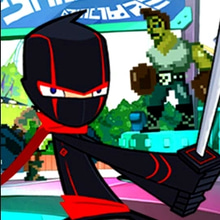
Randy Cunningham Punchademic doesn’t waste time explaining why the world has gone weird. One moment, Norrisville is doing its usual “teen problems plus secret ninja” routine. The next, the city is overrun by glitchy enemies, pixels dripping off them like a bad virus from an arcade cabinet gone rogue. Every corrupted character is marching toward chaos, and the Sorcerer is somewhere in the background laughing way too hard.
You drop in as Randy, ninth grade ninja, with Howard shouting in your ear and an entire “punchademic” sweeping the streets. Everything feels slightly off: colors too bright, enemies too jagged, reality itself looking like it downloaded the wrong update. It’s not just a brawl; it’s a straight-up system crash happening in real time, and the only patch available is your fists.
🥊 Punch combos, counters and ninja rage
At its core, Randy Cunningham Punchademic is a fighting game dressed up as a cartoon disaster. You move Randy around arenas, tapping and swiping (or clicking and dragging) to punch corrupted foes into pixel dust. Light taps throw quick jabs, swipes unleash heavier attacks, and charged moves dump a whole lot of ninja fury into whoever had the misfortune of standing in front of you.
The game loves timing. Enemies flash red before big attacks, giving you a split second to react. Tap at the right moment and Randy counters, flipping the whole situation and blasting the attacker back across the screen. Each successful counter builds your rage meter, and once it’s full you can trigger a powered-up mode that turns every hit into a mini explosion of pixels. You’re not just mashing buttons; you’re reading patterns, punishing openings and trying to stay in that perfect flow where nothing touches you and everything you hit goes flying.
🤝 Howard, the buddy in the disaster
Of course, Randy never does nonsense alone—Howard is right there, adding commentary, chaos and just enough encouragement to keep you going. Even when he’s not physically throwing punches, his presence shapes the mood of the entire game. You’re not a silent warrior; you’re a teen ninja whose best friend is yelling hype and panic in equal measure.
Between waves, you almost feel like you’re in an episode of the show: Randy trying to stay cool and ninja-like, Howard freaking out about the “pixel pandemic,” both of them realizing that if they don’t handle this, the Sorcerer wins and everyone ends up stuck in some cursed glitch forever. That buddy comedy vibe keeps the game light even when you’re surrounded, low on health and one bad dodge away from defeat.
🧟♂️ Enemies from the corrupted screen
The Punchademic isn’t picky about victims. Familiar enemies and background characters get “stanked” into jagged, pixelated versions of themselves, and they don’t just walk forward politely. Some rush in for close brawls, others hang back and try to snipe you, and a few bigger ones stomp around like mini-bosses that demand full focus.
You quickly learn to prioritize. The weaklings clutter the screen, but the real threats are the ones charging heavy attacks or coordinating in groups. Let too many stack up and your safe space shrinks to a tiny circle. Clear them efficiently and the battlefield suddenly becomes your playground again. Every stage is a mini crisis management lesson: who do you hit first, when do you dodge, when do you blow your rage meter just to survive the next ten seconds.
🎮 Controls that get out of the way
The controls are built so anyone can jump in fast. On touch devices, you tap to move, tap near enemies to punch, swipe for stronger attacks and long-press for special moves like the ninja ball. On keyboard and mouse, clicking and simple directional inputs handle movement and strikes, while a couple of keys map to block and rage mode. Nothing complicated, no secret combos hidden three menus deep.
Because the inputs are simple, the challenge comes from decision-making under pressure. Do you stay aggressive and keep your combo going, or block for a second and risk losing momentum. Do you dodge to the side or trust your counter timing. Those small choices stack up quickly, especially as waves grow thicker and enemy patterns overlap. When you finally make it through a brutal wave without getting hit, it feels less like luck and more like your brain and thumbs finally signed a peace treaty.
🌆 A city turned into a glitchy arena
Each level drops you into another slice of Norrisville that’s been twisted by the pixel plague. School halls, city streets, rooftops and weird digital spaces all get repurposed as arenas for your ninja beatdowns. Backgrounds flicker, signs and billboards warp, and subtle visual glitches remind you that the Sorcerer has basically turned the whole town into his personal game board.
Hazards aren’t just enemies. Some stages have environmental traps you need to respect—areas that stun you, zones that slow your movement, spots where corrupted energy erupts at the worst possible time. Reading the room becomes as important as reading enemy animation. Stand in the wrong place and you’ll find yourself knocked into a corner with three pixel mutants suddenly very interested in your health bar.
⚡ Power spikes, upgrades and that one perfect run
As you progress, Punchademic steadily cranks things up. Enemies hit harder, appear in nastier combinations and force you to lean on everything you’ve unlocked so far. You might gain new attacks, stronger specials or better ways to fill your rage meter. Each upgrade feels like you just dug a new secret page out of the NinjaNomicon—some extra technique that turns impossible sections into “okay, I’ve got this.”
The game is great at serving those “one more try” moments. You get demolished on a boss wave, stare at the retry button and think, “If I just block that one move and save my rage a little longer, I can do it.” Then you jump back in, adjust your plan and suddenly the same enemy that wrecked you is exploding in a storm of pixels. Those tiny improvements from run to run make it dangerously easy to lose track of time.
🎭 Cartoon energy with legit fighting tension
Even when the punches are flying and the screen shakes from rage mode, Randy Cunningham Punchademic never stops feeling like a cartoon. The animations are light, the colors are loud, and the whole game hums with that “after school TV” energy. Jokes, reactions and dramatic poses slide right next to serious last-second dodges and clutch counters.
That blend is what makes it work. Younger players can enjoy smashing corrupted enemies and watching Randy look cool. Older fans can dig into the timing, the perfect counters and the satisfaction of flawless runs. The pixel plague looks silly until you’re the one stuck in the middle of it with three enemies winding up heavy hits at once. Suddenly you’re sweating over a Disney ninja game, and honestly, it feels great.
⭐ Why Randy Cunningham Punchademic belongs on Kiz10
On Kiz10, this game hits that sweet spot between quick arcade fun and “okay, I’m actually invested now.” You can hop in for a few waves, burn some stress by punching neon monsters and log off. Or you can grind deeper, master counter timing, chase perfect no-hit stages and treat each arena like a training ground for your inner ninja.
If you like fighting games, ninja action, cartoon tie-ins or anything that lets you chain combos while a city collapses into glitchy madness behind you, Randy Cunningham Punchademic absolutely deserves a slot in your favorites. It’s fast, it’s loud, it’s weirdly strategic, and it never forgets that at the end of the day, there’s only one rule in a punchademic: stay standing, keep swinging and don’t let the Sorcerer win.





 Share
Share
 Embed
Embed


