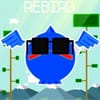
🐦 A bird game that attacks your brain before your reflexes
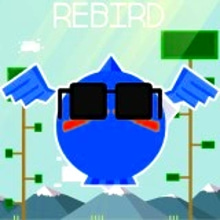
Rebird is the kind of game that looks innocent for one second and then immediately starts messing with your attention span like it has a personal grudge. You see a bird, you see gates, you see colors and shapes, and part of your brain says, all right, I understand this. Then the first few transitions happen, the bird changes, the gate demands the right match, and suddenly the whole thing becomes a clean little war between memory, reaction, and panic. Public descriptions of ReBird consistently explain the core rule the same way: you must pass through gates by matching either the bird’s current color or its current shape, while each gate changes one of those properties and forces you to stay alert.
That is a fantastic setup for an arcade puzzle game because it creates pressure without needing a huge ruleset. You do not have to memorize twenty mechanics. You just need to pay attention. Constantly. Relentlessly. The bird changes, the gates come faster, and the challenge becomes less about raw tapping and more about keeping your mind from tangling itself into a beautiful little knot. On Kiz10.com, Rebird fits naturally beside fast browser puzzle and reflex games because it turns one strange idea into something surprisingly addictive.
And honestly, that is where the charm starts. Rebird does not need fake complexity. It has a very specific trick, and that trick is mean in exactly the right way.
🎨 One gate changes the color, the next one changes your confidence
The brilliance of Rebird is that the bird is never stable for long. The moment you think you understand its current identity, the game changes part of it. A gate may alter the color, or the shape, and from then on your brain has to update instantly. Public game descriptions stress this exact idea: every time you pass a gate, the bird’s color or shape changes, so you have to remember what the bird currently is before choosing the next path.
That creates a very specific type of tension. In most arcade games, you react to what is in front of you. In Rebird, you also react to what is inside your own head. Are you actually remembering the bird correctly? Did the last gate change the part you think it changed? Are you following the right rule, or are you one second away from steering directly into failure because your brain got distracted by its own false confidence?
That is what makes the game sticky. It is not only hard because it moves quickly. It is hard because it makes you maintain a little running identity puzzle in real time. You are flying, yes, but you are also constantly updating information. That combination is wonderful because it gives the arcade flow a more mental edge than a normal endless flier.
🧠 This is not just reaction speed, this is attention under pressure
A lot of bird arcade games are about rhythm. Rebird is more devious than that. Reactions matter, of course, but the core challenge is attention management. Public descriptions even frame it as a test of how difficult it can be for the brain to match color and shape correctly when both are shifting. That gives the whole experience a slightly puzzle-like identity inside the arcade shell.
And that is a great combination.
Because now every gate feels like a tiny decision. You are not just threading through space. You are selecting the correct logic in motion. One right choice feels clean and satisfying. A wrong one usually feels immediate and slightly humiliating, because the mistake is often visible the instant it happens. You realize you followed the wrong property, confused the current state, or simply trusted the wrong half of your memory.
Those are the best kinds of failures in browser games, honestly. Fast, clear, and just painful enough to make you want another try immediately.
It also means the game has a nice learning curve without needing formal lessons. You get better not because the rules expand, but because your brain starts adapting. You begin tracking changes more naturally. You stop hesitating at the gates. You read the bird faster. You still make mistakes, obviously, because the game is not that kind, but the improvement feels real.
⚡ A clean endless game with a surprisingly sharp hook
Public listings describe ReBird as an endless game. That matters because endless formats live or die by whether the core loop is satisfying enough to repeat. Rebird seems to have exactly the right structure for that. The challenge is immediate, the failures are quick, and each run feels like it could have gone farther if your concentration had stayed just a little cleaner.
That “I can do better” energy is everything in games like this.
You do one run and get caught because you followed color when you should have followed shape. Fine. Next time you are more careful. Then you fail because you remembered the wrong current form after a gate transition. Also fine, technically. Then you get a little farther, feel clever, and immediately make a different mistake with even more confidence. Perfect arcade behavior.
The endless structure also makes the game feel more personal. There is no big campaign to hide behind. No excuse that the level was weird or the boss was unfair. The score or distance becomes a reflection of your current focus. That is both rude and brilliant. It turns each session into a very direct conversation between your brain and the game’s trick.
😵 Why such a tiny rule can become so brutally effective
The best simple games always find one idea that produces endless self-inflicted disaster. Rebird clearly has one of those ideas. Match the right property, survive the next gate, remember what changed, repeat. It sounds manageable. Even elegant. Then speed, repetition, and mental overload start stacking on top of it, and the whole thing becomes much nastier than it first appeared.
That is why the game works so well conceptually. It exploits a gap between understanding and execution. You understand the rule almost immediately. Executing that rule cleanly over time is a very different story. And that gap is exactly where addictive games live. A challenge that feels impossible is discouraging. A challenge that feels just barely manageable is dangerous. It keeps you clicking restart because success always seems one cleaner run away.
There is also something funny about how a bright, colorful bird game can create so much tension. The visuals sound light. The mechanic is sharp. That contrast makes the game more memorable. It is not a dark survival gauntlet or a noisy shooter. It is a bird trying to pass the correct gates, and somehow your brain still manages to collapse under the pressure. Beautiful.
🌈 A color-and-shape challenge that fits Kiz10 perfectly
I could not verify a live dedicated Kiz10 page specifically for Rebird, so I am not treating it as a confirmed current Kiz10 URL. What I could verify from public game listings is the core mechanic: an endless arcade game where the bird must pass gates by matching either color or shape, with each gate changing part of the bird’s identity. That concept fits Kiz10 extremely well because the site already has a strong catalog of bird games, reaction games, and color-based puzzle challenges.
For players who enjoy browser games that are quick to learn and surprisingly hard to master, Rebird has exactly the right kind of bite. It is bright, weirdly stressful, and built around a rule that keeps twisting itself just enough to stay dangerous. You are not saving kingdoms or fighting zombies here. You are doing something much more personally offensive: trying to keep a tiny bird’s current color and shape straight while gates keep rewriting the rules in motion. That is simple, clever, and more chaotic than it has any right to be.
And those are usually the games that stick.














 4.5 (5 votes)
 Share
Share
 Embed
Embed