⚔️ A kingdom one bad decision away from ruin
Royal Warfare begins at that awful moment when the kingdom has already run out of easy choices. The banners are torn, the fields are scarred and every mile of ground feels like it has been fought over five times already. You are handed command not in a bright throne room but on the edge of the battlefield, with tired soldiers staring at you and enemy shapes gathering in the distance. There is no calm planning phase. You look at the map, you look at your squads and then the first wave starts walking toward you with grim determination.
From the first clash it is clear that this is not a simple idle defense game. Royal Warfare is all about squads, positioning and panic decisions that somehow have to turn into something that looks like strategy. You do not place towers and wait. You drag groups of soldiers into position, assign them to quick access keys and watch as the front line bends, stretches and sometimes cracks under pressure. Every order feels personal because you are the one who chose to hold that hill or abandon that path, and the game is very good at reminding you when that choice was wrong.
🛡️ Squads that feel like real troops, not just icons
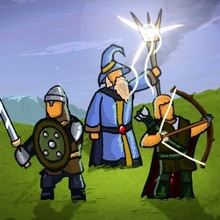
Soon you stop seeing your units as generic blobs and start recognizing personalities in each squad type. Heavy infantry are the stubborn heart of your line, standing close together with shields raised while everything else swirls around them. Archers are nervous glass cannons, deadly from the right distance but constantly in danger if you forget to cover them for even a few seconds. Mages and special units bring strange bursts of power that can freeze a dangerous charge in place or melt a tight formation of enemies in a flash of light.
When you group soldiers under a number, you are not just creating a shortcut. You are marking them as your go to answer for a specific problem. That squad of spearmen becomes the group you always throw at cavalry. That line of archers becomes the formation you trust to clear slow moving hordes before they reach your walls. As battles stack up, you begin to remember which squads survived impossible situations and which ones you accidentally left to be surrounded. Royal Warfare quietly turns your army into a cast of characters, each with a role in your mental story of the campaign.
🐺 Enemies that refuse to die politely
Of course, no heroic defense is interesting without enemies that know how to make your life miserable. Royal Warfare sends waves that feel almost polite at first, small groups that let you practice formations and get used to your hotkeys. Then the game stops being nice. Heavily armored brutes step forward and absorb arrow after arrow. Fast raiders ignore your front line and sprint toward your weakest point. Dark spellcasters stand behind the crowd, making everything tougher while you grit your teeth and try to break through to them.
The best battles are the ones that start tidy and turn ugly within a few seconds. You think your line is solid, then a new wave appears from a different path and you realize your archers are about to be flanked. You rush to pull a squad away from the center, send them running to plug the gap and hope you are not opening a new problem somewhere else. There is a constant tug of war between controlling the field and chasing emergencies. That feeling when you finally stabilize a collapsing flank, with just a few soldiers left standing, is the kind of quiet victory that keeps you clicking the next mission button.
🎯 Controls, hotkeys and the rhythm of command
Royal Warfare becomes truly satisfying once the controls fade into the background and your hands start moving on their own. Selecting units, dragging formations and assigning groups is simple enough that anyone can learn it, but the real depth appears when you begin to treat the keyboard as a command network. One number is your shield wall, another is your ranged support, another is your fast response squad waiting behind the main line. With a quick tap you jump between them, shifting the focus of the battle with a few efficient moves.
That rhythm creates a kind of flow that is unique to this style of real time defense strategy. You catch yourself leaning forward as the big wave arrives, cycling through groups, pulling damaged squads back for a moment of breathing room and pushing fresh ones into the gap. When an enemy elite finally falls under a combined volley from your archers and a timely spell, there is real satisfaction in knowing it happened because you managed the timing correctly. Even defeat feels strangely instructive. You can usually point to the exact moment when you reacted too slowly or trusted the wrong unit to hold the line.
New players can treat early missions as a gentle training ground, experimenting with how different unit types behave and how control groups work in practice. More experienced players can push themselves by trying cleaner formations, minimal losses and risky counterattacks that demand precise control. Either way, the game rewards attention rather than raw speed, which makes each victory feel earned instead of random.
🌄 Battlefields that matter more than they first appear
Maps are more than pretty backdrops in Royal Warfare. Terrain shapes your tactics from the opening seconds. Narrow paths are natural choke points where a small group of tough soldiers can hold back a large force if you support them correctly. Open fields are dangerous spaces where your formation can easily be surrounded if you spread out too far. Some levels present uneven ground and odd layouts that tempt you into risky positions just for the advantage of height or flanking angles.
Part of the satisfaction comes from playing a mission more than once and watching how differently it can unfold when you change your initial placement. Move archers slightly further back and they survive longer. Shift infantry a little to one side and they suddenly control two paths at once. The game does not need complicated base building because the battlefield itself becomes your main tool. When you finally find the arrangement that turns a once impossible wave into a manageable fight, it feels like solving a tough puzzle that just happens to be filled with swords and arrows.
🏰 Why Royal Warfare feels right at home on Kiz10
On Kiz10, Royal Warfare becomes that strategy game you keep coming back to whenever you want something deeper than a quick clicker but still easy to launch in a browser. You can drop into a mission during a break, give yourself ten minutes of focused command and walk away feeling like you just directed a full fantasy war scene. Or you can sit down for a longer session, slowly pushing through missions, upgrading your army and learning to anticipate the tricks the game uses to surprise you.
What makes it stand out is the combination of real time tension and clear readability. You can see the waves coming, you can see your squads straining to hold, and you know that your choices will decide whether the kingdom falls or survives for one more day. There is always one more formation to try, one more idea to test on that level that keeps beating you. And when it finally works, when the last enemy collapses and the battlefield falls quiet, you get that calm little moment of triumph that only a hard fought defense can deliver.
If you enjoy fantasy strategy games that focus on squads rather than single heroes, if you like feeling responsible for the whole battlefield instead of just one corner, Royal Warfare is exactly that kind of experience. Load it up on Kiz10, take a breath, assign your groups and get ready for the kind of battles where one smart order can save the kingdom and one sloppy mistake can ruin everything.





 4.1 (108 votes)
 Share
Share
 Embed
Embed


