🚀 Neon noise and very fragile confidence
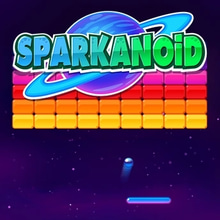
Sparkanoid wastes absolutely no time pretending to be calm. The moment it starts, it already feels like a classic brick breaker got launched into deep space, drank three energy drinks, and decided your reflexes were now part of the experiment. It is an arcade game built on a simple, brutally effective idea: keep the ball alive, smash every block, and try not to fall apart when the screen gets loud, fast, and just a little unfair. Public descriptions of the game consistently frame it as an Arkanoid-style space brick breaker where you move a paddle, destroy colored blocks, collect power-ups, and manage extra hazards in the field.
That structure is exactly why it works so well on Kiz10. You do not need a long explanation or some giant dramatic setup. You see the paddle. You see the ball. You see the wall of blocks waiting to be demolished. Your brain instantly understands the mission. The trouble begins one second later, when you realize Sparkanoid is not interested in being a sleepy retro tribute. It wants movement. It wants pressure. It wants that delicious old-school panic where the ball clips an angle you did not expect and now your whole body leans toward the screen like that might somehow help.
And honestly, yes, it does help. Spiritually.
🪐 The old formula still hits absurdly hard
There is something almost unfair about how good brick breaker games still feel when they are done right. Sparkanoid takes that familiar rhythm and gives it a sharper, brighter, more energetic personality. You slide left. You slide right. You aim the rebound as best you can. Hit the center and the ball stays clean. Catch it near the edge and suddenly it starts cutting strange angles through the brick field like it has personal issues.
That is where the game becomes addictive.
Every rebound matters. Not in some heavy, dramatic role-playing sense. In the very immediate arcade sense. One good return can clear half a lane, open a gap, drop a useful bonus, and swing the whole level in your favor. One sloppy touch can send the ball drifting into the exact corner you did not want, and now you are scrambling to survive the consequences. The tension is tiny and constant, which is the best kind for a game like this.
Public descriptions also mention score bonuses, falling power-ups, and even the ability to slow time, which adds a very welcome layer of chaos management to the classic paddle-and-ball loop. That matters because Sparkanoid is not just about endurance. It is about reading the screen fast and deciding what kind of risk you want to take. Grab the power-up? Stay centered? Chase an aggressive angle? Trust your reflexes? Terrible idea, maybe, but a fun one.
✨ A space arcade with sharp little teeth
The outer-space presentation does a lot more than decorate the background. It gives Sparkanoid its mood. This is not some plain brick wall floating in a void of boredom. It feels electric, synthetic, a little flashy in exactly the right way. The glow, the movement, the color of the blocks, the speed of everything once the level wakes up — all of it gives the game a more futuristic pulse than a barebones breakout clone.
And then there are the extra threats.
One public description specifically mentions “space blobs” as hazards to avoid while you clear the blocks. That small detail changes the tone nicely. Suddenly you are not only preserving the ball and breaking the field. You are surviving a hostile screen. Sparkanoid does not want you sitting there in perfect comfort, lazily tapping rebounds back into place. It wants your attention split between offense and survival, which makes every level feel a little more alive.
That is the secret spice. A game like this does not need massive complexity. It just needs enough friction to make each level feel unstable in a fun way. Sparkanoid gets there by layering its arcade danger carefully. First the bricks. Then the angles. Then the bonuses. Then the hazards. Nothing is overwhelming on paper, but together they create a lovely little storm of decisions.
🎯 Angles, greed, and the lies you tell yourself
Brick breaker games always create one very specific kind of delusion. You start thinking you are in complete control. You are not. Not really. You are guiding probabilities with a paddle and pretending it is mastery. Sparkanoid is especially good at feeding that illusion because when you do find the right angle, the result looks glorious. The ball cuts upward, ricochets between blocks, triggers a chain, drops a bonus, clears a lane, and suddenly you feel like a cosmic engineer of destruction.
That feeling is incredible.
It is also exactly how the game tricks you into taking bad risks. You start chasing cleaner shots, smarter rebounds, greedier routes through tight corners. You stop just surviving and start trying to dominate. That is when the mistakes get really funny. The rebound is a little too sharp. The return is slightly late. The ball drops harder than expected and now you are doing emergency paddle work with the emotional stability of a collapsing toaster.
Still, that is the joy of Sparkanoid. It keeps every level close enough to control that you always believe the next run will be smoother. Maybe not easy, but smoother. You know where the bad angles were. You know which power-up you missed. You know you can do better. That “one more level” loop is classic arcade poison, and this game serves it cold and bright.
🕹️ Why it fits Kiz10 perfectly
Sparkanoid feels at home on Kiz10 because it delivers instant action with almost zero barrier between curiosity and gameplay. Open it, move the paddle, and the whole situation starts unfolding right away. For players who enjoy retro arcade games, space games, reflex games, and brick breaker challenges, it is a very natural fit. Public sources consistently describe it as a classic block-breaking game with a space setting and arcade power-up loop, which lines up perfectly with that audience.
It also has that great browser-game quality where it can be casual for thirty seconds and intense the moment after. That swing keeps it lively. You are never too far from disaster, but you are also never too far from a perfect recovery. A clean save at the bottom edge of the screen feels fantastic. A combo run through the upper bricks feels even better. A time-slow power-up arriving exactly when you needed it? Beautiful. Almost suspiciously beautiful.
And because the rules are so readable, the satisfaction stays pure. You always know why a great moment felt great. The angle was right. The timing was right. The screen exploded into progress because you held it together just long enough.
🌌 Final thoughts from the paddle zones
Sparkanoid is a sharp, energetic brick breaker that takes the classic Arkanoid idea and throws it into a faster, flashier, space-themed arcade shell. It keeps the best part of the genre intact — that hypnotic rebound-and-destruction loop — while adding power-ups, hazards, and enough visual energy to make each level feel alive. On Kiz10, it lands as the kind of game that is easy to start, hard to leave, and strangely capable of making one bouncing ball feel like the center of the universe.





 3.9 (10 votes)
 Share
Share
 Embed
Embed