🟣😈 The purple ones have to go (and they’re annoyingly smug about it)
Transblockies is one of those deceptively cute puzzle games that smiles at you while quietly planning your downfall. Everything looks friendly: bright colors, simple shapes, soft little movements. Then you realize the “evil” purple blocks are sitting there like stubborn squatters, and the only way to remove them is to mess with the laws of physics using transformations. Not “push a button and win” physics either. More like “touch this shape once and you just changed the entire future of the level” physics. On Kiz10, that’s exactly the type of brain-tickling puzzle that makes you lean closer to the screen, stop blinking for a second, and whisper, “Okay… I can totally do this.”
The premise is clean: get rid of every purple shape, and ideally collect the stars too, because your pride will demand it. The method is the fun part. You don’t directly punch the purple blocks. You manipulate the other shapes, changing how they roll, slide, tip, fall, or bump. It’s like setting up tiny domino reactions, except the dominoes are adorable, gravity is moody, and your mistakes are permanent in the most humiliating way. One careless click and a block rolls away forever, leaving you staring at a purple enemy you can no longer reach. And the game doesn’t apologize. It just lets you sit with that decision like a bad haircut.
🧩🖱️ Click-to-transform feels simple, until it starts feeling like strategy
The core mechanic is satisfying because it’s instant. You click a block, it changes form, and that change affects everything: its balance, its contact points, how it interacts with slopes, how easily it can push something, whether it gets stuck, whether it becomes a rolling menace. The game teaches you quickly that transformations aren’t upgrades. They’re tools. Sometimes transforming makes a block stronger. Sometimes it makes it useless. Sometimes it makes it dangerous to you. That’s the beauty of it: every form has a personality.
Early levels feel playful, like a gentle introduction to the idea of “shape = behavior.” You click, a block rolls, a purple piece topples off, and you get that easy win grin. Then levels start layering complications. Multiple purple targets. Narrow platforms. Stars placed in annoying “yes you need to risk it” positions. Suddenly you’re not clicking to see what happens. You’re clicking because you already predicted what will happen… and you’re praying your prediction is correct. 😅
🌪️🧠 The real gameplay is planning reactions, not reacting fast
Transblockies isn’t about speed. It’s about sequence. You’re basically choreographing a tiny physics performance. If you transform the wrong block first, you might lose the ability to push a purple target later. If you transform too early, a piece might roll off before it collects a star. If you transform too late, the whole structure might settle in a stable position and refuse to move, like the game is folding its arms at you.
What makes it feel “human” and not mechanical is that you’re constantly negotiating with uncertainty. You can predict, sure, but there’s always that little wobble factor. The block doesn’t always fall exactly the way you imagined. It might bump slightly, rotate a bit more, clip an edge, and suddenly your “perfect plan” becomes a “panic plan.” That’s where the fun lives. You’re not solving a sterile logic grid. You’re solving a living little physics toy that sometimes misbehaves, and you adapt.
⭐🧲 Stars are optional… until your ego turns them into the main quest
The stars are brilliant bait. You can often clear a level by removing the purple blocks, but collecting the stars turns the solution into something more elegant. It forces you to think about pathing and timing, not just elimination. You might be able to smash the purple enemy off the platform easily, but doing that might send the only moving block away from the star you still need. So you start making tradeoffs. Do you go for the quick clear, or do you go for the clean clear?
And if you’re anything like most puzzle players, the answer becomes obvious: you go for the star, fail, restart, laugh at yourself, then try again because now it’s personal. The star system turns each level into a small story: first you survive, then you perfect it.
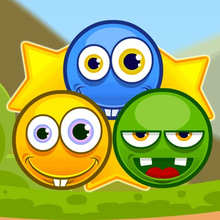
🟦🟡🟢 Shapes with mood swings (and why that’s the best part)
One of the most charming things about Transblockies is how much “character” the shapes seem to have, even though they’re just blocks. Rectangles can be stable, but sometimes they’re awkward if they tilt and refuse to roll. Rounder forms are great for movement, but they’re also unpredictable, like a shopping cart wheel that suddenly decides it has free will. Some shapes are perfect for nudging enemies off platforms. Others are better for reaching stars tucked into corners. You learn to treat transformations like roles in a team: this form is my pusher, this form is my roller, this form is my careful star collector, this form is my accidental disaster.
That variety keeps the game from feeling repetitive. You’re not repeating one trick across 60 levels. You’re learning a vocabulary of motion. Roll. Tip. Slide. Catch. Bounce. Settle. Then you remix that vocabulary depending on the level layout. When a level finally clicks, it feels like you just solved a tiny physics poem. Dramatic? Yes. Accurate? Also yes. 😄
😬🧱 When the level becomes “impossible,” it’s usually because you got greedy
The harsh lesson in Transblockies is that the game punishes impulsive clicking. If you transform something “just to see,” you might burn your only chance. Many levels are designed so that one key block needs to stay in its original form until the right moment. Change it too early and it rolls away, leaving you with no pushing power. Change it too late and it can’t reach the angle you need. That makes every click feel valuable. It’s not a casual clicker. It’s controlled chaos.
And yes, you will have those moments where you’re one purple block away from clearing everything, and you’re feeling confident, and then you click something and the entire structure collapses in the wrong direction. The purple enemy stays. The star is gone. Your solution evaporates. You stare. You restart. You pretend you’re fine. You are not fine. 🤡
🕯️🎯 A small set of tips that actually helps
Look at the level like a map of future motion. Before clicking anything, track where each transformable block could end up if it rolls or tips. Pay attention to slopes, edges, and narrow platforms because those decide whether a shape becomes a tool or a runaway liability. Try to identify which block is your “main actor,” the one that will do most of the pushing, and protect it from rolling off too early. If stars are present, plan how you’ll collect them before you remove the last purple piece, because sometimes the act of clearing the enemy also removes your ability to reach the star.
Most importantly, don’t chase perfection on the first try. Treat the first attempt as reconnaissance. Learn what each click does. Then on the next run, execute like you meant it the whole time. That’s the rhythm Transblockies wants: experiment, understand, then perform.
🏁🧠 Why this puzzle sticks with you
Transblockies is the kind of physics puzzle that feels light and cute, but plays with real bite. It rewards planning, timing, and creative thinking, while still keeping the controls simple enough that you can focus on the puzzle instead of fighting the interface. Clearing purple enemies feels satisfying, collecting stars feels addictive, and every levels has that “one more try” energy that makes you forget you only meant to play for five minutes. If you like puzzle games that combine logic with real movement and real consequences, Transblockies fits perfectly on Kiz10: smart, charming, and just chaotic enough to keep your brain awake. 🟣💥⭐



 4.4 (11 votes)
 Share
Share
 Embed
Embed


