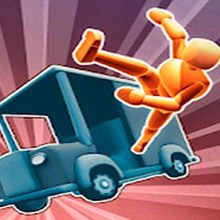
The ramp hums like a dare and the camera leans just enough to make your stomach laugh. Turbo Dismounting is not about being careful. It is about what happens when you give curiosity an engine, a ragdoll a helmet that will not help, and a runway pointed straight at a very bad idea. You pick a vehicle, sprinkle hazards like confetti, take a breath, and press go. The first second is speed and promise. The second second is physics waking up. After that, it is a loud love letter to gravity where every crash tells a story you cannot wait to improve.
🎬 Cold Open Energy: Three… Two… Too Late
The best runs begin with silence. No crowd, no countdown, just your thumb hovering and a ragdoll blinking the way only ragdolls can. A scooter looks innocent; a wedge truck looks inevitable. You line the approach a hair to the right because you want to clip the booster, skim the oil slick, and hit the billboard at a friendly angle that will turn the driver into a comet. This is not cruelty. It is craft. You are creating a one take stunt where timing is the script and momentum is the punchline.
🚗 Core Loop, Clean and Chaotic
Build the course, send it, watch the disaster, learn something, tweak, send it again. That is the loop and it is dangerously pleasant. A tiny adjustment to a ramp changes the arc of a body and the way it rakes through breakable signs. Moving a turbo pad by a meter turns a whiff into a clean shoulder check that detonates the scoreboard. Adding a single traffic cone can be the difference between a boring slide and a pinball cascade that feels like fate but is actually your brain getting good at angles.
🧠 Why It Hooks: Physics You Can Read
Nothing here is fake. Wheels bite, bodies bend, and hinges moan in ways that make sense, even when the results are ridiculous. You can see weight transfer before a flip. You can hear a chassis protest a moment before it gives you the last perfect bounce you needed to kiss the billboard and spill through the window into a shower of score multipliers. Because the rules are honest, you stop guessing and start aiming. Your second run is funny. Your fifth is intentional. Your tenth is a plan with a punchline.
🕹️ Hands That Disappear Into Habit
Controls are the quiet hero. On desktop, a tap of the arrow nudges line, a press stretches throttle, and a reset is instant so failure never scolds you for trying. On mobile, swipes read like thought rather than panic, and the go button lands where your thumb already lives. You are never fighting inputs. You are negotiating with gravity. That leaves your head free to think about entry angle, spin rate, where to plant a fan so a launched ragdoll gets one extra gust for style.
🛠️ Toys on the Table: Vehicles and Props
A shopping cart makes courage look cute and dumb. A sports bike turns straight lines into spears. A wedge truck and a bulldozer do what they were born to do: throw mass at problems until the problems stop being one piece. Sticky jumps add air where none existed. Oil spills erase traction with a wink. Fans add the gentlest “what if” to a trajectory that was otherwise doomed to land safe. You will develop favorites because they speak your language. Maybe you love precise bikes that punish sloppy wrists. Maybe you love vans that are bad at everything except being loud. The point is choice. Your loadout is your sense of humor with physics.
🎯 Scoring That Rewards Intent, Not Luck
Points love violence but they adore choreography. A clean break on multiple joints, a billboard smash, a traffic cone chain, and a tasteful slide under a bus will outscore a single giant collision because the game understands that a seen-it-coming sequence is harder to engineer than one big boom. Multipliers respect speed, airtime, distance, and variety, which means the best runs feel like a tour through your course rather than a headbutt. You will start building for score the way skaters build lines—linking one trick to the next in a flow that looks inevitable when it finally works.
💥 Sections You Will Learn to Love
The launch is the thesis. If your approach is crooked, everything after is panic math. The impact is the argument. Hit something that gives: breakable billboards, sandwich boards, fragile scaffolding that explodes into points. The drift is your ribbon. A long, low scrape along railings or the side of a van adds story and time to keep multipliers breathing while you angle toward the next hit. The dismount—the moment the driver becomes the projectile—is your signature. Headfirst through a sign is one vibe. Backflop into a fan that yeets you back into traffic is another. You will know your style the moment you watch replays and smile at the same kind of chaos twice.
🧭 Micro Habits That Turn Mess Into Mastery
Feather throttle off the ramp to control rotation rather than holding gas like a daredevil. Nudge the line by pixels so boosters meet wheels at the center, not the edge. Place one small obstacle near the end of a run to “catch” a dying multiplier with a polite bump. If you keep overshooting, tilt the ramp down a degree instead of moving the whole platform—small changes preserve everything you liked about the setup. And when you get a great flight with a boring ending, add a single fan or a low sign on the landing zone to create a satisfying last beat without ruining the arc.
🔊 Sound and Feel, The Unseen Coach
You will start to listen. The whine that rises a half beat before a wheel leaves ground. The hollow bonk that means you hit wood not metal and should aim a hair lower next time. The long, coarse scrape that tells you the slide is money and you should not reset until the last bolt stops singing. Music gives you room to grin. Effects tell the truth. If you wear headphones, you will begin to steer by ear.
📈 Difficulty Curve You Build Yourself
The first hour is a sandbox with a friendly lifeguard. Nothing hurts but your pride when a scooter faceplants a ramp it should not have attempted. Then you get greedy. Longer flights, nastier stacks, tighter windows. The game never locks you behind a checklist you hate. It hands you tools and asks what kind of chaos you want to become good at. The climb is self-inflicted and that is why it sticks: you chase the run you pictured in your head, not a star rating that forgot why you came.
🎨 Why Replays Matter
Replays are not vanity here; they are notebooks. You will watch a great crash three times: once to laugh, once to notice the angle that worked, and once to see where to nudge a pad so the same miracle becomes reliable. Sharing a clip turns into a tiny design conversation with yourself. You set a seed. You iterate. You learn to make lightning strike on purpose.
✨ Modes and Mindsets
Some days you are a stunt coordinator with a clipboard: clean lines, readable arcs, points that stack like tidy bricks. Other days you are chaos with a driver’s license: maximum boosters, minimum mercy, a bus pileup that makes the game cough dust. Both moods are valid and the game smiles at each. If you need calm, pick a simpler course and chase elegance. If you need loud, load the street with junk and press go until your cheeks hurt.
🏁 The Run You Will Remember
A scooter. A ramp tilted one degree down from sensible. Two fans kissing the edge of a billboard because you wanted a second act. You hit the boost cleaner than you deserve, skim the oil like a pro, and launch into a rotation that should not work and absolutely will. The ragdoll parts company with a seat at the exact moment the first fan sighs, offering one more yard of air—just enough for a paper sign to explode like confetti. You land sideways on a delivery van, slide, catch a cone, catch another, and the scoreboard wakes up the way a dog does when you say walk. The last bump kisses a barricade you placed for vibe, the multiplier holds a second longer than it should, and the number that appears is a proper laugh. You take a breath and hit reset without thinking. Not because you need more points, but because you want that feeling again with one tiny change to make it cleaner.
Turbo Dismounting is a physics playground with a comedian’s timing and a tinkerer’s heart. It rewards intent, forgives curiosity, and turns trial and error into a craft you can feel in your shoulders. Build a silly course, drive it like you meant to, listen to what the crash teaches, and try again with one better idea. You are not breaking things. You are composing slapstick that just happens to involve a truck, a billboard, and a ragdoll that keeps coming back for the next take. Press go. Gravity will handle the applause.



 4.4 (234 votes)
 Share
Share
 Embed
Embed


