🌀 Smooth on the surface, vicious underneath
UltraFlow is the kind of puzzle game that looks almost too clean to be dangerous. One ball. One target. A blank, minimalist space with obstacles placed like quiet little threats. It feels calm for exactly one second. Then you take the shot, the ball ricochets the wrong way, and suddenly the whole level turns into a very personal conversation about angles, control, and whether you actually understand geometry as well as you thought. The clearest public descriptions all agree on the core idea: UltraFlow is a minimalist puzzle game where you launch a ball toward a goal and must finish each level with a limited number of bounces. There is no score and no timer. The challenge is pure smoothness.
That setup is brilliant because it removes all the usual noise. No countdown screaming at you. No giant combo meter. No fake urgency. Just you, the level, and the consequence of your shot. That kind of design creates a very specific kind of pressure. Quiet pressure. The kind that comes from knowing the game is simple enough to understand instantly, which means every failure feels painfully traceable to your own decisions. Lovely. Terrible. Lovely again.
And that is exactly why UltraFlow works so well as a browser-style puzzle experience. It strips the idea down until nothing is left but precision, rhythm, and the beautiful humiliation of missing by a few pixels.
🎯 One shot, a few bounces, no excuses
The heart of UltraFlow is the bounce limit. Public descriptions consistently present that as the central mechanic: you launch the ball once, it rebounds through the level, and if it exceeds the allowed number of bounces, the run fails.
That one rule changes everything.
Because now every wall matters. Every obstacle matters. Every angle matters more than it would in a normal physics puzzle game. You are not simply trying to reach the hole. You are trying to reach it elegantly, economically, almost politely. A messy route is not just ugly. It is often impossible. The game quietly teaches you that efficiency is survival. A bad rebound is not a minor inconvenience. It is the beginning of collapse.
This is where UltraFlow becomes addictive. Every level looks solvable. Not easy, necessarily, but solvable in a way that feels clean. That feeling is dangerous. It makes you want to try again immediately because the solution always seems close enough to touch. One softer launch. One smarter bank off the wall. One less greedy angle. Suddenly the puzzle stops being random and starts becoming readable.
Then you overshoot again and the level reminds you not to get arrogant.
⚪ Minimalist design doing maximum damage
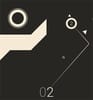
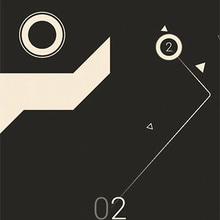
UltraFlow’s visual style is one of its biggest strengths. The official descriptions lean hard on the word minimalist, and that is exactly the right word for it. The screen is stripped down so thoroughly that your attention has nowhere else to go. No decorative clutter. No noisy background. No giant interface trying to distract you from your own decisions. The puzzle is the entire room.
That kind of presentation is perfect for a game built on control. It makes the geometry feel cleaner, and clean geometry makes failure feel sharper. You can see the route. You can imagine the path. You can almost feel the correct line before you take it. That clarity is why the game feels so good when it clicks. A successful level does not feel accidental. It feels deserved.
And because the art is so restrained, the motion itself becomes satisfying. The ball gliding, bouncing, correcting, slipping through narrow gaps, finally landing where it belongs — that is the whole show. UltraFlow does not need spectacle because the path is the spectacle.
🧠 Puzzle game, but also a weirdly emotional skill test
Official descriptions call UltraFlow a puzzle game, which is correct, but that only tells half the story. It is also a skill game in disguise. Not because it needs twitch reflexes, but because execution matters as much as planning. You can understand the right route and still miss it with one slightly bad launch.
That makes the game feel wonderfully tense. A pure logic puzzle ends once you know the answer. UltraFlow does not end there. It asks whether you can deliver the answer. That extra layer gives each level more bite. The mind solves it, but the hand still has to prove it.
And that is where the game gets under your skin. You know what the ball should do. You can picture the path. You can practically hear the clean rebounds in your head. Then the shot goes wide and you sit there in silence, betrayed by your own confidence. Great puzzle design often creates that kind of emotional swing: understanding followed immediately by execution drama.
UltraFlow just does it with circles and walls instead of words.
📱 Calm format, sticky progression
Several sources describe UltraFlow as having 99 levels and being completely free, with no ads and no score or timer pressure. That structure makes sense because this kind of game thrives on compact, escalating stages. You do not need giant worlds. You need many small rooms, each with a slightly crueler question than the last.
That level-by-level format gives the game a wonderful pacing. You finish one stage and immediately want to see the next layout. New shapes, new bounce counts, new ways to embarrass yourself. Because the rules stay clean, the increasing difficulty feels fair. The game is not changing the contract. It is just demanding more from your aim and your patience.
That is why it fits so naturally into the kind of play people want on Kiz10. Fast entry, readable mechanics, strong replay loop, and a challenge that feels satisfying without needing a huge explanation. It is the sort of puzzle game that can fill two minutes or twenty depending on how stubborn you feel.
🔵 Why UltraFlow belongs on Kiz10
UltraFlow’s core identity is incredibly search-friendly and easy to understand: minimalist puzzle game, physics ball game, bounce puzzle, skill puzzle, one-shot puzzle, no-timer challenge. The title itself already sounds smooth and abstract, and the gameplay described across itch.io, the App Store, and Android mirrors matches that feeling exactly: launch a ball, manage a limited bounce count, and reach the target through clean geometry.
On Kiz10, that gives it a very strong lane. It sits naturally beside simple puzzle titles, physics ball games, and other clean, minimalist challenge games where execution matters more than spectacle. It is easy to start, hard to perfect, and just frustrating enough to become memorable.
Which is probably the highest compliment a game like this can get.
🏁 Final thoughts from someone who absolutely wasted one bounce
UltraFlow works because it trusts simplicity. Multiple public descriptions agree on the essentials: it is a minimalist puzzle game with no score and no timer, built around launching a ball to a goal while respecting a strict bounce limit. That single idea is strong enough to carry the whole experiences because the execution is where the challenge lives.
If you like clean physics puzzles, geometry-based aiming, and games that stay visually calm while quietly testing your patience, UltraFlow is a perfect fit for Kiz10. It is smooth, sharp, elegant, and just rude enough to keep you coming back.



 4.6 (6 votes)
 Share
Share
 Embed
Embed