🌊 Engines wake up, water gets loud
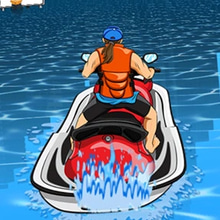
Watercraft Rush doesn’t start with a gentle warm-up lap. It starts with that very specific “rev… GO” feeling where your brain goes empty and your hands take over. You’re on a watercraft, the track is ahead, and everything around you is basically a wet obstacle course pretending to be a race. The rules are simple on paper: finish your laps before time runs out, don’t smash into things, keep moving. In practice? The water is slippery, the turns are sharp, and the course loves throwing nonsense into your path at the exact moment you decide to relax. On Kiz10, it hits like a clean arcade racing game: quick to pick up, easy to understand, and weirdly hard to put down because the next run always feels like it could be better.
There’s a special kind of tension in water racing. You’re not gripping asphalt. You’re skimming across a surface that looks calm until it decides it isn’t. That makes every correction feel dramatic. You lean into a turn, the craft slides just a little, and for half a second you think, okay, this is the run… then a barrier appears and you’re suddenly doing emergency steering like you’re dodging a surprise tax bill. 😅
🚦 The clock is your real rival
In Watercraft Rush, the timer isn’t just a number sitting politely in the corner. It’s the heartbeat of the whole game. It pushes you forward, it pressures your decisions, and it turns every mistake into a small tragedy. Clip an obstacle? You lose speed and the timer starts to feel personal. Take a corner too wide? You can almost hear time laughing. The best runs aren’t about reckless full-throttle panic. They’re about clean lines and steady momentum, because water punishes messy driving harder than you expect.
And that’s where the game becomes addictive. When you fail, you don’t feel like you lost a long race. You feel like you lost a moment. A decision. A single sloppy turn that cost you everything. That makes the restart button dangerously tempting. You tell yourself, “I’ll just redo that corner.” Then you’re back in, chasing the perfect lap like it owes you money.
🗺️ Three worlds, nine tracks, and an endless supply of “oops”
One of the coolest parts of Watercraft Rush is the way it stretches its challenge across different areas. You’re not stuck on one boring circuit. You’re moving through different worlds, and each world comes with multiple tracks that ramp up the intensity. The early tracks teach you how the craft handles, how tight the turns can be, and how nasty an obstacle can feel when it clips your side at full speed. Then the later tracks start asking for discipline. You can’t just react; you have to anticipate.
You begin to spot patterns. You start reading the course ahead like you’re scanning a street in a driving test, except the street is made of water and the consequences are immediate humiliation. You learn where the risky sections are. You learn which turns are “tap the brakes” turns and which ones are “commit and pray” turns. And because the tracks get tougher as you progress, you always feel that forward pull: finish this one, unlock the next, prove you can handle what’s coming.
There’s also something satisfying about the way water tracks can feel like roller coasters. Straight stretches that beg for speed, then sudden corners that demand respect. It creates a nice rhythm: accelerate, focus, adjust, recover, accelerate again. When you get into that rhythm, the game feels smooth and cinematic, like you’re cutting a clean racing line through chaos.
🧠 The secret skill: steering without panicking
Here’s the truth most people learn the hard way: Watercraft Rush isn’t really a “fast fingers” game. It’s a “calm brain” game. Yes, you need reflexes, but more than that you need the ability to not overcorrect. Panic steering is the enemy. You hit a tiny bump, you jerk the controls, and suddenly you’re drifting into the exact obstacle you were trying to avoid. Classic. The game loves that mistake because it’s so human.
A smoother approach wins. Tiny adjustments. Early turn-in. Give yourself space on the exits. If you’re always fighting the craft, you’re losing time. If you’re guiding it, you’re saving time. It’s the difference between slamming into every corner like a stubborn shopping cart and gliding through like you actually meant to be there.
And once you start driving smoothly, you notice something: the game feels faster. Not because the top speed changed, but because the run feels uninterrupted. No jolts. No crashes. Just flow. That flow is what you chase. That flow is what makes you replay the same track until you nail it, then immediately move to the next one like you’re on a personal water racing tour.
🚧 Obstacles that ruin your ego in creative ways
Watercraft Rush is generous with obstacles, and it’s not shy about placing them where your instincts want to go. The course design constantly asks the same question in different forms: can you stay fast while being precise? Because going slow makes timing hard, but going fast makes steering hard. You’re always balancing those two problems, and the game keeps nudging you toward that sweet spot where speed and control finally agree.
The funniest part is how you’ll start making little deals with yourself. “Okay, I’ll take this turn wide, but I’ll make it up on the straight.” Then you take it wide, hit something, and the straight becomes a sad recovery lane. Or you’ll think, “I can squeeze through that gap.” And maybe you can… but not with the confident wobble you just did. 😄
Yet it never feels unfair in a rage-quit way. It feels like a skill check. It tells you what it wants: clean navigation, good timing, smart risk. When you mess up, you usually know why. That’s what makes improvement feel real instead of random.
🎮 Why it’s such a good arcade racing pick on Kiz10
Watercraft Rush fits perfectly into that category of online racing games you can play for a few minutes or accidentally play for an hour. The structure is clear, the tracks are short enough to encourage retries, and the difficulty ramps in a way that makes you want to prove something to yourself. It’s a water racing game that keeps the focus on the fun parts: speed, dodging, time pressure, and that satisfying feeling of completing a lap cleanly.
If you like jet ski games, speedboat racing vibes, times trial challenges, or any arcade racer where you’re constantly threading through hazards while the clock breathes down your neck, this one scratches that itch. It’s fast, splashy, and a little bit mean in the way good arcade games are mean. The kind of mean that makes you smile, shake your head, and hit restart because you know you can do better. 🌊🚤











 Share
Share
 Embed
Embed