🧠 A game that smiles while it sabotages your brain
Stroop is one of those puzzle games that looks almost too simple when you first see it. A few colored boxes. A few words. Nothing loud, nothing dramatic, no explosions, no racing engines, no huge fantasy kingdom begging to be saved. Just color, text, and a tiny little challenge that seems innocent for about five seconds. Then your brain trips over itself.
That is the whole magic of Stroop. It takes something basic, twists one small rule, and suddenly you are no longer playing casually. You are staring harder. Reacting faster. Doubting what you just saw. On Kiz10, the game lands with this wonderfully sneaky energy because it does not need complexity to create tension. It simply puts your reflexes and your perception in the same room and lets them start arguing.
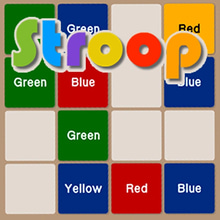
The premise hits that sweet spot between logic puzzle and reaction test. Colored squares appear in sequence, each one carrying text that may or may not match what your eyes want to believe. Your task is not just to click quickly. That would be too easy. Your task is to resist the automatic shortcut your brain loves taking. That little hesitation, that tiny mental stutter between what the word says and what the color actually is, becomes the battlefield. And wow, what a weirdly effective battlefield it is.
🎨 Words lie, colors lie louder
What makes Stroop so good is that it weaponizes confusion in a very elegant way. Most games challenge your speed, your memory, or your planning. This one challenges that split-second moment where your brain tries to process conflicting information and accidentally reveals that it is, in fact, a bit dramatic under pressure. You look at a word, you see a color, and for a split second your mind goes, wait, which truth are we using here?
That’s where the tension comes from. Not from some giant external threat, but from your own perception turning into a tiny traitor. Stroop turns cognition itself into gameplay. That sounds very serious and academic, but the actual feeling is much funnier. It feels like your eyes and your brain are having an awkward meeting without you. One says blue, the other says green, and your hand just wants everybody to calm down and make a decision already 😵
On Kiz10, this kind of puzzle game stands out because it is so direct. No tutorials dragging for ages. No clutter. The challenge is visible immediately, and the difficulty rises in a way that feels fair but increasingly rude. The faster the sequence becomes, the more exposed your reflexes feel. You cannot simply rely on instinct, because instinct is exactly what the game is trying to trip. That is deliciously mean design.
⚡ Fast hands, slower ego
There is a special kind of frustration in Stroop, and I mean that as a compliment. It is the frustration of knowing the rule, understanding the task, and still getting it wrong because your brain jumped the wrong way. That makes every mistake personal in the funniest possible sense. You do not lose because the controls are bad. You lose because your brain got overeager and guessed before it really looked.
And because the structure is so clean, every improvement feels real. You can sense your focus sharpening. At first, you fumble, second-guess, and click with all the confidence of someone trying to solve a riddle in a moving elevator. Then something changes. Your eyes slow down without slowing down, if that makes sense. You begin reading the trick instead of falling for it. You stop reacting to the obvious signal and start hunting the actual one. That shift is incredibly satisfying.
Stroop becomes addictive because it keeps rewarding mental control rather than brute speed alone. Yes, speed matters. Absolutely. But raw speed without clarity is a disaster here. The best runs happen when your brain stops panicking and starts filtering. That is a cool feeling. Very small game, very big “okay wait, I’m actually locked in now” moment.
🌀 The chaos is tiny, but it is real
The beauty of this game is how little it needs to feel intense. A shooter has noise. A racer has motion. Stroop has contradiction. That contradiction does all the heavy lifting. One second you feel totally comfortable, the next the pace rises and your confidence dissolves like cheap paper in rain. It is fantastic.
There is also something oddly theatrical about the way the challenge unfolds. Each new colored box feels like a tiny test arriving on stage. Quick, answer this. No, faster. No, now do it again while ignoring the most obvious clue. It creates a rhythm that is almost hypnotic until you break it with a bad click and immediately mutter, “No way, that was absolutely the right one,” even when it clearly was not.
The game’s simplicity makes it ideal for quick sessions, but that same simplicity is exactly why it keeps dragging you back. You know you can do better. The rule is easy to remember. The failure feels fixable. That combination is dangerous. It creates the classic browser-game trap: one more try. Then another. Then one more because now you are annoyed. Then another because now it is personal.
🧩 A puzzle game with reflexes instead of pieces
Even though Stroop does not look like a classic puzzle game full of blocks, locks, or hidden objects, it absolutely belongs in that world. It is a brain puzzle stripped down to pure cognitive friction. There is no filler. No extra decoration needed. The puzzle is simply this: can you ignore the wrong signal fast enough to trust the right one?
That makes it oddly elegant. It feels almost like a lab experiment that escaped the classroom and learned how to be fun. But not sterile fun. Real fun. The kind that pokes at your habits and exposes how quickly your brain wants to automate everything. Stroop punishes that automation beautifully. It reminds you that perception is fast, but not always faithful.
And that is why the game stays memorable. It is not just about beating a level. It is about noticing yourself. Your hesitation. Your patterns. Your favorite kind of mistake. Some players rush. Some overthink. Some do both in alternating waves of self-sabotage. The game quietly reveals all of it.
🎯 Why it works so well on Kiz10
Kiz10 is full of games that chase action, speed, or spectacle, and Stroop does something refreshingly different. It creates intensity through mental tension. It proves that a browser game can be engaging with almost nothing except a clever rule and the confidence to let that rule do the work.
If you enjoy brain games, reflex puzzles, concentration challenges, and online games that test your focus instead of your firepower, Stroop is a great little trap to fall into. It is fast to learn, hard to master, and way more chaotic than it first appears. Not chaotic in the loud sense. Chaotic in that quiet, psychological, “why did my hand do that?” sense.
That’s what makes it fun. It catches you in the gap between seeing and understanding. It turns your own processing speed into the obstacle. It looks minimal, but it feels alive because every second demands attention. One wrong read, one rushed click, one tiny lapse, and the whole rhythm breaks.
So if you want a puzzle game that does not need noise to feel intense, Stroop absolutely delivers on Kiz10. It is sharp, clever, a little sneaky, and weirdly hilarious once you realize how easily your own brains can be tricked by a colored word on a screen. Tiny game. Big ego damage. Excellent combination 🎨🧠



 4.4 (28 votes)
 Share
Share
 Embed
Embed


