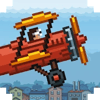
✈️ Smoke in the sky and no promise of a safe landing
Air Wolves Flight does not open with elegance. It opens with danger, engine noise, and the kind of old-school aerial tension that makes even a quiet patch of sky feel suspicious. On Kiz10, this is a World War I airplane game built around vintage dogfights, survival, and constant pressure above the battlefield. The official Kiz10 page frames it clearly: you become the ace of the Air Wolves squadron, fly and fight through hardcore sky battles during the First World War, and do it all inside a pixel-art world that deliberately leans into the spirit of early twentieth-century air combat. That setup alone gives the game a great identity. It is not trying to be a cold simulator. It wants drama, speed, and that wonderful old-warplane feeling where every turn looks heroic until bullets start stitching the air around you.
🛩️ A vintage war machine with arcade blood in its veins
What makes Air Wolves Flight immediately interesting is the mood created by its aircraft and visual style. These are not sleek modern jets with smooth glass cockpits and sterile missile locks. These are propeller-driven warplanes from the rough, dangerous era when air combat still felt improvised, personal, and a little insane. You can feel that in the game’s presentation. The pixel-art style is not just decoration; it reinforces the whole atmosphere. It gives the battles a sharp retro texture, like some lost arcade memory of a war story told through clouds, tracer fire, and impossible last-second escapes. The Kiz10 description specifically notes that the game uses pixel art to emphasize the spirit of vintage airplanes and the dogfights of the early twentieth century, and honestly, that artistic choice does a lot of heavy lifting. It makes the game feel rough-edged in exactly the right way.
The result is a flight game with personality. Not polished in the modern military-tech sense, but alive. Every battle feels like metal, fabric, wind, and stubbornness trying to stay airborne a few seconds longer than the enemy. There is something charming about that. Also something deeply stressful. A good combination, really.
🔥 Dogfights are never as simple as they look from the ground
From below, dogfights probably look romantic. Two planes cutting through the sky, banking through clouds, chasing each other in wide circles like some elegant airborne dance. Air Wolves Flight does a good job reminding you that from the cockpit, the feeling is much messier. It is less ballet, more panic with wings. You are not floating through a cinematic postcard. You are fighting to survive. You are reading enemy movement, repositioning constantly, choosing when to attack and when not to get greedy, and hoping your next line through the sky is smarter than the last one.
That is where the game’s hook really lives. The challenge is not just shooting. It is surviving while flying with intent. The Kiz10 page doesn’t describe some passive sightseeing experience; it emphasizes hardcore battles for the sky, and that wording fits. This is an air combat game. The sky is not scenery. It is the battlefield itself. Every pass matters. Every enemy encounter becomes a question of angle, timing, and nerve. Can you line up the attack without exposing yourself too long? Can you keep enough control during pursuit to avoid turning a kill attempt into your own flaming mistake? That tension gives the game a pulse.
☁️ The sky looks open until it becomes a trap
One of the sneakiest things about airplane combat games is how open the environment seems at first. Endless sky, plenty of room, freedom in every direction. But once the fight begins, that openness shrinks. Fast. Air Wolves Flight leans into that feeling beautifully. The battlefield overhead may look wide, but combat compresses everything. Distance suddenly matters. Position matters. A small mistake in direction can become a huge tactical problem a moment later. You drift too far during a turn, lose the better angle, and now the enemy has room to punish you. You chase too hard and forget to respect your own vulnerability, and the battle turns against you in one ugly instant.
That sensation is what keeps games like this alive. Space feels elastic. Safe one second, dangerous the next. In a vintage warplane setting, that pressure feels even stronger because the whole fantasy is built on fragile machines and pilot skill. The official page’s focus on surviving First World War aerial battles adds weight to every encounter. You are not just flying. You are enduring. And endurance in the sky always feels more dramatic than it should. Maybe it is the altitude. Maybe it is the fact that there is nowhere to hide when things go wrong.
🎯 Why the best moments come right before disaster
A lot of the fun in Air Wolves Flight comes from those moments when you are almost in trouble, almost out of position, almost one bad turn away from getting punished... and then somehow you recover. That is the emotional center of the game. Not perfect calm. Not sterile dominance. Recovery. Those quick corrections that save a fight. The risky pursuit that barely works. The desperate dodge that leaves you alive and absurdly proud of yourself for the next ten seconds.
Because this is a vintage dogfight game, everything feels a bit more raw. More physical. More immediate. The game page talks about flying, fighting, and surviving, and that trio tells you everything about its rhythm. You attack, yes, but survival never leaves the conversation. That balance matters. If a warplane game only gives you offense, it becomes shallow. If it only gives you evasion, it loses bite. Air Wolves Flight feels like it wants both instincts running at once. Be brave enough to engage. Be smart enough not to overstay the attack. That push and pull is where the excitement lives.
And then there is the aesthetic payoff. Pixel explosions, old-school aircraft silhouettes, and fast aerial movement combine into a look that feels crunchy in a satisfying way. Not delicate. Not overly clean. Crunchy. Like every battle has a little static in it, a little grit. That makes success feel earned and failure feel dramatic instead of flat.
🧭 A retro war game that rewards nerve more than elegance
Air Wolves Flight also works because it understands the appeal of classic browser action. It gets to the point. You are not drowning in systems before the fun starts. The premise is immediate, the mood is strong, and the action speaks clearly. Become the ace of the squadron. Enter the sky. Fight. Survive. Kiz10 presents it as an HTML5 browser game, and that accessibility fits the design well because the whole experience feels built for instant intensity without losing identity.
That last part matters more than people think. A lot of flying games are functional but forgettable. They have planes, yes, but not much soul. Air Wolves Flight has soul because its theme and presentation push in the same direction. The WWI setting, the pixel-art look, the focus on hardcore dogfights, the idea of becoming an ace inside a legendary squadron, all of it forms one clean fantasy. You are not here to cruise. You are here to earn the sky the hard way. Through pressure, mistakes, instinct, and a little glorious recklessness.
So if you like airplane combat games, retro air shooters, vintage warplanes action, or browser games that turn a simple premise into a tense arcade experience, Air Wolves Flight has a very easy way of pulling you in. It gives you old propellers, hostile skies, and the constant sense that one sharp turn could change everything. Which, for a dogfight game, is exactly the right feeling. On Kiz10, it becomes the kind of flight challenge that looks nostalgic from a distance and then turns ferocious the second the battle starts.





 Share
Share
 Embed
Embed