Cannon loaded, dignity optional 🧨👑
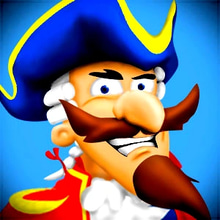
Baron Liar Cannonball Ride is the kind of game that doesn’t ask if you’re ready for physics, it just lights the fuse and watches you commit. You’re not riding a horse, you’re not marching an army, you’re not giving inspiring speeches to the kingdom. You’re launching yourself out of a cannon like it’s the most reasonable military strategy ever invented. And the weird part? After your first decent flight, you’ll start believing it too.
The whole fantasy is simple and wonderfully ridiculous: the Baron wants conquest, trophies, glory… and apparently the fastest way to prove bravery is to become a flying projectile. You press the launch, you explode forward, and the world turns into a scrolling runway of chaos where every bounce, bump, and mid-air correction decides whether you’re a legend or a short-distance joke. It’s an arcade distance game with that classic “just one more attempt” loop, because every run ends with you thinking you were one tiny decision away from greatness. One more boost. One less bad angle. One smarter bounce off the ground instead of that sad little faceplant into nothing.
The first launch feels like learning a new language 🌬️💥
At the beginning, you’re basically guessing. You’ll fire the cannon, watch the Baron fly, and immediately realize that the sky has rules you can’t bully. Angle matters. Momentum matters. When you dip too early, you slam into the ground and lose all your speed. When you stay too high without purpose, you float, stall, and waste distance like you’re sightseeing. The funniest part is how quickly your brain starts doing tiny calculations without admitting it. “If I stay higher for a second, I’ll clear that obstacle.” “If I aim down slightly, I can get a stronger bounce.” “If I touch the ground at the right time, I can convert flight into speed.” You’re not doing math on paper, you’re doing it in your nerves.
And once it clicks, the game becomes addictive in a clean, honest way. You stop feeling random. You start feeling deliberate. Not perfect, not always, but deliberate enough that your misses sting because you understand them. You didn’t lose to mystery. You lost to your own impatience. That’s the kind of loss that makes you instantly restart.
Mid-air control feels like steering a bad idea 🪂😅
The core joy here is that you’re not a passive projectile. You’re constantly nudging the Baron’s flight, guiding the arc, trying to keep speed alive. There’s a sweet spot where you’re gliding low enough to stay fast but high enough to avoid smashing into the ground too harshly. When you find that sweet spot, your run looks smooth, almost elegant in a ridiculous way, like a royal cannonball ballet.
But the game loves breaking that elegance. You’ll be doing great and then you’ll clip something, bounce weird, lose your angle, and suddenly you’re wobbling through the air like a paper airplane in a storm. That’s when the real skill shows up: recovery. Can you correct the flight without overcorrecting? Can you turn a messy bounce into a new rhythm instead of a full collapse? The best runs aren’t the ones with zero mistakes. They’re the ones where you make a mistake and fix it fast.
Bounces are the secret engine of distance 🏜️🌀
Launch games live and die on how they handle impact. In Baron Liar Cannonball Ride, the ground isn’t just a failure state. It’s a tool. A bad landing kills momentum. A good landing turns into a slingshot. The difference is angle and timing. If you hit the ground too steep, you stop. If you skim it with the right angle, you keep moving. If you bounce at the right moment, you can chain speed in a way that feels like cheating, the fun kind of cheating where you earned it.
You’ll start to chase “clean bounces” the same way players chase perfect drifts in racing games. Not too high, not too low, not too heavy, not too soft. When you nail it, it feels amazing because the Baron rockets forward and the scenery blurs like you just found a hidden gear. When you miss it, you feel it instantly because everything slows down and the run starts to die in real time.
Upgrades turn bravery into a strategy 🧰⚙️
The upgrade loop is the quiet backbone that makes each attempt feel meaningful. You’re not only trying to go far for pride, you’re trying to earn enough to make the next run stronger. Better launch power, better control, better durability, smoother momentum… every upgrade turns the Baron from “lucky cannon passenger” into a more reliable flying machine.
And upgrades change your personality in a dangerous way. The stronger you get, the greedier you play. You start aiming for riskier angles because you think you can recover. You start pushing the limits because you’ve tasted a longer run and now your brain refuses to settle for “okay.” That’s the cycle: upgrade, improve, get confident, do something reckless, crash, laugh, upgrade again.
What makes it satisfying is that progress is obvious. You can feel the difference when your launch hits harder. You can feel it when your flight stays stable longer. You can feel it when a run that used to end early now stretches into a real distance attempt. It’s the kind of progression that doesn’t need complicated menus to feel rewarding. Your reward is the road scrolling further than it did before.
The trophy chase and the “almost” curse 🏆😵💫
If the game gives you stars, trophies, or little goals, they’re not just decoration. They’re motivation disguised as shiny nonsense. You’ll finish a run and think, I can complete that objective if I just do one thing better. Then you try again. And again. And suddenly you’re deep in a loop that’s equal parts skill and stubbornness.
The most dangerous emotion in Baron Liar Cannonball Ride is “almost.” Almost hit that boost. Almost held the angle. Almost landed the bounce. Almost is why you don’t quit. Almost convinces you the next run will be the one. Sometimes it is, and you feel like a genius. Sometimes it isn’t, and you still feel like a genius for trying, which is honestly impressive.
Tiny habits that make huge distance 🧠🎯
The game rewards calm control more than frantic inputs. Small corrections beat big swings. Chasing every risky opportunity usually kills a run. The longer attempts come from reading the flow: keep a stable arc, aim for controlled bounces, and only take risky boosts when the angle is already safe. It sounds simple, but in the moment your hands want speed and your brain wants safety, and they don’t always agree.
A smart way to play is to treat the early part as setup. Don’t waste your run in the first seconds by slamming into the ground like a rock. Build rhythm first, then push it. Once you’re moving fast and stable, then you can start gambling. That’s how you turn a chaotic launch into a real distance run.
Why it fits Kiz10.com so well 🚀✨
Baron Liar Cannonball Ride is pure arcade energy: fast starts, quick restarts, visible improvement, and a goofy premise that somehow becomes serious the moment you care about distance. It’s easy to understand, hard to master, and it has that perfect “I can do better” itch that keeps you coming back. One more launch. One more upgrade. One more run wheres you don’t ruin the perfect bounce with a tiny panic dip. It’s always one more. That’s the deal.










 Share
Share
 Embed
Embed