🍔 A hungry cat with zero patience
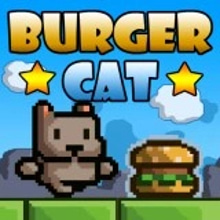
Burger Cat has the kind of premise that instantly makes sense in the best possible way. Kiz10 describes it very clearly: help the cat reach the tasty burgers, aim and click to change the level structure, add or remove terrain blocks, create trampolines, avoid traps, and do it fast because the cat never stops walking toward the goal. That one sentence already gives the game a much stronger personality than a normal platform puzzle. You are not controlling the cat directly like some careful hero with a plan. You are the invisible problem-solver trying to keep an extremely committed burger maniac alive while it marches forward with full confidence and absolutely no survival instinct.
That is exactly why Burger Cat works so well. The cat’s constant movement creates pressure immediately. You do not get to sit there forever admiring the level and casually considering your options like a philosopher of sandwiches. The cat is already moving. The burger is already waiting. The traps are already in place. That means every level becomes a live puzzle, not a static one. You are reacting, preparing, and reshaping the path while a furry little disaster keeps walking straight toward whatever looks edible. Great setup. Very browser-game. Very hard to stop once it starts clicking.
And honestly, that nonstop movement changes the whole mood of the game. A normal puzzle platformer can feel methodical. Burger Cat feels urgent. Not in a stressful, ugly way. In a playful, slightly chaotic way. The game does not just ask, “Can you solve this?” It asks, “Can you solve this before your cat makes one truly terrible life choice?” That is much funnier, and much more memorable.
🐱 The cat is not the hero, it’s the deadline
One of the smartest things about Burger Cat is that the cat itself acts like a timer with whiskers. Kiz10’s page explicitly says the cat will not stop walking toward its target, and that detail does all kinds of useful work. It gives the game pace. It gives the puzzle urgency. And it makes the player think differently. You are not planning a route for later. You are building safety in real time.
That is what gives Burger Cat its edge. The level is not just a level. It is an unstable plan in motion. Maybe the cat needs a trampoline here. Maybe a block must disappear there. Maybe the terrain should be extended before the little maniac walks off a cliff with full burger-related confidence. Every click matters because the cat keeps moving no matter what. That turns simple level editing into a kind of rescue operation disguised as a food quest.
And because the objective is so absurdly charming, help cat, get burger, the whole thing feels lighter and funnier than a normal pressure puzzle. The cat is not chasing treasure or saving the world. It wants lunch. Desperately. That silly motivation makes every level feel more playful, even when the timing gets tight.
🧩 You are not moving the character, you’re rewriting reality
This is the real hook. Burger Cat is not about direct movement. It is about changing the world around the cat. Kiz10’s page says you can add or remove terrain blocks, create trampolines, and avoid traps, which means the gameplay lives in the environment itself. That is a much stronger puzzle concept than simple left-right jumping because it shifts the player’s role entirely. You are not guiding footsteps. You are redesigning fate.
That makes the game feel clever even when the controls stay simple. A missing block is not just empty space. It is a future problem. A trampoline is not just a gimmick. It is a route correction. A trap is not just danger. It is a test of whether you noticed it early enough to do something smart before the cat reached it.
And that is why the levels likely become so addictive. You can see what went wrong almost instantly. The cat fell because you were too late. The jump failed because the shape was wrong. The burger was close, but your level edit created a route that looked good for half a second and then collapsed into cartoon sadness. Excellent puzzle feedback. Brutal, but fair.
⚡ Fast thinking looks way smarter with burgers involved
There is something very satisfying about games that ask for quick thinking without turning into pure panic. Burger Cat seems to land in exactly that sweet spot. The cat’s movement creates urgency, but the level-editing mechanic still rewards planning. So the player lives in that wonderful middle space between control and chaos.
You look at the screen, spot the burger, spot the danger, and start building the answer before the cat reaches the bad part. That process feels great because it mixes instinct and logic. Part of your brain is solving. The other part is just trying to keep the cat alive long enough for the solution to matter. Those two layers make the game much more alive than a static puzzle would be.
It also helps that the burger theme is inherently funny. There is no elegant mythical destiny here. Just a cat with tunnel vision and a snack at the end of the map. That kind of simple, silly motivation is perfect for browser games because it makes the whole challenge easier to enjoy. The player is not burdened by drama. The player is delighted by how much chaos one burger can cause.
🍟 Why every level probably ends in either genius or embarrassment
Games like Burger Cat are excellent at creating two emotional outcomes and almost nothing in between. Either you solve the route and feel like an absolute mechanical genius, or the cat launches itself into a hazard and the whole level becomes a tiny comedy of failure. Both outcomes are entertaining, which is one of the reasons the concept works so well.
And the failures are the good kind. They feel fixable. Kiz10’s own description gives you all the relevant tools, terrain changes, trampolines, trap avoidance, and the cat’s nonstop movement, so when something goes wrong, you usually know why. That makes retries feel natural. You do not restart because the game was unclear. You restart because you can already see the better version of your idea.
That is one of the strongest forms of replay value in puzzle games. The player is never too far from success. The solution is usually sitting there, one smarter click or one earlier terrain change away. Very dangerous design. Extremely effective.
🎮 A small, funny puzzle with real mechanical bite
Burger Cat works because it takes one great idea and commits to it fully. Hungry cat, moving constantly. Burger at the end. Player reshapes the level in time. Kiz10’s page confirms exactly that formula, and it is a strong one because it mixes timing, puzzle logic, and playful humor without wasting any energy on unnecessary systems.
On Kiz10, it fits naturally beside other animal games and light physics-puzzle titles, but its specific “edit the world while the character keeps moving” mechanic gives it a much stronger identity than a basic cat platformer. If you enjoy browser puzzles that feel active, funny, and just a little bit rude when your plan fails one second too late, Burger Cat is an easy fit.
By the time you finally line up the path properly, remove the right block, place the perfect bounce, and watch the cat reach the burger without turning the level into a furry accident report, the game has already done its jobs. It made one silly idea feel smart, urgent, and weirdly satisfying. Which is exactly what good browser puzzle games are supposed to do.



 2.5 (19 votes)
 Share
Share
 Embed
Embed


