🐱🌍 THE CAT IS HUNGRY AND THAT’S THE WHOLE PLOT
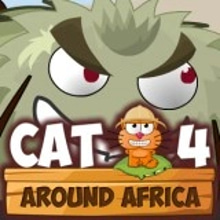
Cat Around Africa starts with the most honest motivation in gaming: your cat wants food and doesn’t care about your excuses. No epic speech, no tutorial that treats you like a baby, just a simple scene that looks innocent for two seconds… then physics shows up wearing clown shoes 🤡. You’re on Kiz10, staring at a hungry cat, a piece of food hanging somewhere in the level, and a bunch of blocks, platforms, and hazards placed like someone wanted to test how fast you can go from confident to panicked.
This is a physics puzzle game, but it plays like a tiny action movie where the main character is a snack. You don’t run around. You don’t fight enemies with combos. You click things. You remove things. You trigger things. Then you watch the chain reaction like you’re holding your breath in a silent theater. Will the food slide into the cat’s paws like a perfect delivery? Or will it bounce, roll, explode into a disaster, and disappear off-screen like it got hired by NASA? 🚀🥩
And the cat… oh, the cat. He’s not cheering you on. He’s not saying “good job.” He’s just there, waiting, judging, doing that calm stare that feels like a performance review. Feed him correctly or prepare for the emotional damage 😼.
🧊🖱️ CLICK, BREAK, PANIC, REPEAT
The controls are basically fate in mouse form. In most levels you’ll have breakable parts, usually ice blocks, that you can click to remove. That sounds easy until you realize every block you remove changes weight, slope, and momentum. One click too early and the food drops straight into danger. One click too late and the food gets stuck, trapped in a sad little corner while the cat stares like “so we’re starving today?” 😾
The game is sneaky, because it teaches you like a friend, not like a textbook. Early levels let you feel smart. You remove one block, the food rolls, the cat eats, you feel like a genius. Then the game starts adding twists: multiple layers, slopes, moving pieces, enemies, little traps that wait for you to get cocky. And suddenly your brain is doing math without permission. “Okay… if I remove that ice, the food should slide here… unless it bounces… unless the angle flips… unless I just created a snack missile.” 💥
Physics here has a personality. Sometimes it’s polite. Sometimes it’s chaotic. And that chaos is what makes it fun. You’re not solving the same puzzle pattern over and over. You’re improvising in a messy system and trying to make it behave for three seconds, just long enough to deliver dinner.
🦁🥩 AFRICA LOOKS BEAUTIFUL… AND ALSO LIKE IT WANTS YOUR FOOD
The “Africa” theme isn’t just decoration. The levels feel like little travel snapshots with wild energy. Different terrain vibes, different hazards, and sometimes the sense that the world is actively trying to steal the food before it reaches your cat. That’s where the puzzles start feeling like tiny survival scenes. You’re not only guiding the snack toward the cat. You’re protecting it. You’re making sure it doesn’t roll into a trap, get crushed, or end up in the wrong mouth. 🐊
And the best part is how the game keeps you on edge without feeling unfair. When you fail, it’s usually obvious why. You clicked too much. You clicked in the wrong order. You trusted a block that looked stable but was actually a liar. The game isn’t punishing you with randomness. It’s punishing you with consequences. There’s a difference, and your brain can feel it. That’s why you instantly want to retry.
You’ll get moments where a level looks impossible until you notice one weird detail: a tiny slope that can guide the food, a block that can act like a bridge if you leave it, a piece of ice that needs to be removed last, not first. Those moments hit like “OH… I SEE IT.” And suddenly you’re not just clicking, you’re directing a scene.
🎬😵💫 THE PUZZLE RHYTHM: CALM THINKING → SUDDEN EMERGENCY
Cat Around Africa has a very specific rhythm and it’s addictive. First, you study the setup. Everything is still. You’re calm. You plan. Then you make one click and the whole level comes alive. And now it’s live television. Things fall. Things roll. Something starts moving faster than it should. Your calm plan turns into real-time improvisation. “No no no… go left… PLEASE go left… why are you bouncing like that?” 🤯
This is why the game feels so human. It’s not a sterile logic test. It’s a messy little physics playground where you can create elegance or chaos with the same click. Sometimes you solve a level in one smooth chain and you feel cinematic. Other times you trigger a ridiculous sequence, the food ricochets, a hazard activates, and you’re watching your own mistake in slow motion like a tragic comedy. 🎭😂
The levels are short enough that failure doesn’t feel like a punishment. It feels like a dare. You’re always close. Always one smarter click away. That “almost” feeling is fuel.
🐾📱 QUICK SESSIONS, BIG OBSESSION
This is the kind of online puzzle game that fits any mood. Want a quick break? You can solve a couple levels and get that little brain spark. Want to get stubborn and refuse to stop until you beat “that one level” that keeps humiliating you? Congratulations, welcome to the loop 😅.
On Kiz10, it’s also the kind of game that runs smoothly and feels immediate. You don’t need to load a massive world, you don’t need to memorize complicated controls, you just need to look, click, and react. That simplicity is part of the charm. It makes the clever parts stand out more.
And yes, you’ll start doing that thing where you whisper “one more try” and then realize you’ve been playing longer than planned. The cat did that. The cat is controlling you. The cat is the final boss. 🐱👑
🧠🧊 LITTLE TRICKS YOUR BRAIN LEARNS WITHOUT TELLING YOU
After a few levels, you stop clicking randomly. You start reading the stage like a map. You notice which blocks hold weight. You notice how slopes guide movement. You begin to predict how the food will roll after each removal. It’s not complicated in a scary way, but it’s layered enough that you feel improvement.
You’ll learn that sometimes the best move is to not click. Leave support in place. Let the food settle. Watch the angle. Then remove a piece at the right moment. It’s weirdly satisfying when you finally stop rushing and start controlling the chaos. 😌🖱️
And when the level does turn chaotic, that’s where the game becomes hilarious. The food might bounce in a way you didn’t expect, and instead of feeling angry, you’ll probably laugh because it’s so physically dramatic. Like, why did that snack just do a triple jump? Who taught it parkour? 🥨🏃
🏁😼 WINNING FEELS SMALL, BUT IT HITS BIG
Every success is a tiny moment: food reaches cat, cat eats, level done. No fireworks, no speech. But it still feels good because you earned it. You didn’t grind stats. You didn’t rely on luck. You read the puzzle, timed the clicks, and guided the physics just enough to make dinner happen.
And that’s the heart of Cat Around Africa. It’s a fun, chaotic, clever physics puzzle game where the stakes are silly but the satisfaction is real. If you like click puzzles, chain reactions, and that feeling of “I’m smarter than this level… okay maybe not… okay YES,” you’ll fit right in on Kiz10. 🐾🌍🍖



 4.4 (9 votes)
 Share
Share
 Embed
Embed