🧩🏙️ A CITY MADE OF PIECES AND BAD LUCK
City Connect 2 begins with a simple promise: you’re going to build order out of a scattered little mess. Not with bulldozers, not with budgets, not with a dramatic mayor speech. Just you, a grid, and a bunch of street tiles that look harmless until you rotate one the wrong way and suddenly the entire neighborhood feels like it’s refusing to cooperate. You press play on Kiz10.com and the first thing you notice is how calm it looks… and how quickly it becomes a brain itch you can’t stop scratching.
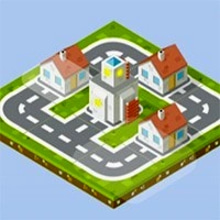
This is a road-connection puzzle, the kind where every piece wants to belong to something else. Streets need to meet streets. Buildings need to connect to the network. And somewhere in the middle of it all is the “big deal” piece, the power plant, the beating heart of the level that quietly asks: can you route everything to me without leaving anyone in the dark? It’s not loud about it. It doesn’t shout. It just sits there like a judge with a clipboard while you rotate tiles, squint at corners, and whisper “why won’t you connect” at your screen like the tiles can hear you. 😅
🔄🛣️ ROTATE, SNAP, REGRET, REPEAT
The core mechanic is wonderfully pure. You rotate street pieces until the paths line up. When it clicks, it’s the good kind of click, the kind your brain treats like a tiny reward. When it doesn’t, you feel it instantly because the grid starts looking like a map drawn by someone who hates navigation. City Connect 2 is one of those puzzle games where the moves are simple, but the consequences are sneaky. One rotation can solve three connections at once… or break two others you didn’t realize depended on it.
The fun comes from the way your thinking shifts as you play. Early levels teach your eyes what to look for: dead ends, corner pieces, straight streets, and those awkward intersections that always seem to be facing the wrong direction at the worst time. Later levels start asking for planning, not just reaction. You can’t just spin pieces randomly and hope the city magically organizes itself. Well… you can. It just tends to end with you staring at one final building that refuses to connect, like it’s protesting your leadership. 🏠🙃
There’s a rhythm to success here. Rotate. Check adjacency. Follow the line. Rotate again. Double-check. Then do the smug little mental victory lap when the roads finally form a clean route. It’s oddly satisfying because it feels mechanical and creative at the same time, like solving a tiny urban mystery with your fingertips.
⚡🏭 THE POWER PLANT IS YOUR DRAMA CENTER
A lot of puzzle games have a “goal tile” that’s basically a finish line. In City Connect 2, the power plant feels more like a magnet. Everything wants to lead there, and the level makes you feel that pull. You start tracing connections with your eyes like you’re planning emergency infrastructure. “Okay, this building needs a path. That path needs to turn here. That turn forces the next tile to face down, which means the street above must…” and suddenly you’re doing a full detective monologue about sidewalks. 🕵️♂️🧩
That central objective changes the vibe. You’re not just making a pretty road network, you’re making a functional one. If even one building is left disconnected, the level feels incomplete, like the city is missing a heartbeat. When you finally connect the whole layout, it’s not just “level cleared,” it’s “the town is alive.” That’s the little emotional trick City Connect 2 pulls, and it works because the satisfaction isn’t flashy, it’s earned.
🧠✨ THE MOMENT YOU STOP GUESSING, YOU START WINNING
There’s a phase every player goes through in this type of game. Phase one: spin tiles quickly, hoping for miracles. Phase two: slow down, actually look, and realize the puzzle has rules you can use. The second phase is where City Connect 2 becomes addictive. You start seeing the board differently. You stop rotating pieces like a slot machine. You rotate with purpose.
You begin asking better questions. Which building has only one possible path? Which tile is forced because it’s boxed in by edges? Which street must be straight because a corner would lead nowhere? These are small logic steps, but they build momentum. And once you build momentum, the puzzle feels less like struggle and more like flow. It’s the kind of flow where you catch yourself smiling because you just solved something cleanly without panic-spinning half the grid. 😄
And yes, sometimes you will still panic-spin. It happens. Especially when you’re one connection away and you can’t see it. Your brain goes “just rotate everything, surely that’s faster.” It’s not faster. It’s chaos. It’s beautiful chaos, but it’s chaos.
🗺️🏘️ TOWNS THAT LOOK FRIENDLY… UNTIL THEY GET CLEVER
City Connect 2 does a smart thing: it doesn’t rely on complicated controls to get difficult. It uses layout. It uses constraints. It uses the way pieces influence each other. A puzzle can feel easy when each tile is independent. This one becomes interesting when every tile is part of a chain reaction. You rotate one street and it fixes a neighborhood, but it also changes the direction a future connection must take. Suddenly you’re not solving a single tile, you’re solving a route.
That’s where the “city” theme really lands. It feels like infrastructure. One wrong turn creates a problem downstream. One well-placed rotation creates a clean highway of logic. The grid starts to feel like a living network rather than a static board. And that makes every solution feel like you built something, even though you’re just rotating pieces on a screen. That’s not a small achievement for a browser puzzle game. 🏙️👏
😵💫🔍 WHEN THE BOARD GETS BIG, YOUR PATIENCE BECOMES A SUPERPOWER
Later, when the levels become denser, the challenge is less “can you figure it out” and more “can you stay calm long enough to figure it out.” The board starts giving you multiple paths that almost work. Almost is dangerous. Almost is the enemy. Almost is that moment where you think you’ve solved it, then notice a tiny disconnected building in the corner like a sad little notification you can’t dismiss. 📍😩
This is where it helps to play like a human, not like a machine. Take a breath. Trace from the power plant outward. Identify the forced connections first. Edges and corners usually tell you what’s possible. Work from constraints, not from hope. And if you get stuck, do the most effective move in puzzle history: step back mentally and look for the one tile that has only one reasonable orientation. That one tile is often the key that unlocks the whole map.
🌟🧩 WHY IT FEELS SO GOOD ON Kiz10.com
City Connect 2 is perfect for quick sessions because it has that instant clarity. You always know what you’re trying to do. Connect streets. Link buildings. Power the town. And because the game is level-based, you can play one puzzle and feel satisfied, or play five and get that “I’m on a roll” momentum where your brain starts hunting solutions like it’s a sport.
It’s also a friendly kinds of challenge. It’s not the kind of puzzle that tries to embarrass you with obscure rules. It’s the kind that says: the solution is here, you can see it, you just need to rotate the world into place. That’s the joy. You’re not grinding stats. You’re not waiting for upgrades. You’re solving. You’re building. You’re turning a messy grid into a functioning little city network, and the final connection always feels like a small personal victory. 🏆🏙️
If you enjoy road puzzles, city-building logic, tile rotation challenges, and that satisfying “everything finally connects” moment, City Connect 2 on Kiz10.com will hit the sweet spot. Just be warned: once you clear one level, your brain will immediately want to clear the next one too. “One more puzzle.” Famous last words. 😈🧩





 4.4 (25 votes)
 Share
Share
 Embed
Embed


