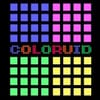
🎨🧠 The moment you realize colors can bully you
Coloruid starts off looking innocent. Just a grid, some colors, and that calm “this will be easy” confidence you get right before a puzzle game steals your evening. On Kiz10.com, this is the kind of color puzzle that feels simple for about thirty seconds… until you click once, watch the color spread, and suddenly understand you’re not painting. You’re negotiating. With a grid that has opinions 😅.
The goal sounds straightforward: unify the board into a single color using as few moves as possible. That’s the whole mission. No complicated story, no characters begging for help, no dramatic voiceover. It’s just you and the grid, and the grid quietly daring you to be smarter than it. Every move floods a region with a chosen color, expanding your control like spilled paint. But it’s not random. It’s logic. It’s pattern reading. It’s decision-making under that subtle pressure of “you’re wasting moves, buddy.”
The best part? The game makes you feel clever even when you’re failing. Because failing in Coloruid is still informative. You can see the consequences immediately. You can watch how one choice blocks another. You can feel the difference between a lucky click and a planned sequence. And then you do that classic puzzle-gamer thing: “Okay… restart. I have a new idea.” Famous last words.
🟦🟥 How it actually plays (and why it gets under your skin)
Coloruid is about flood-filling. You start with a region, usually from a corner, and your job is to grow that region by changing its color to match adjacent areas. When your color matches a neighboring block, it gets absorbed. Your controlled area expands. You repeat, aiming to eventually absorb the entire grid until everything is one color. Easy concept. Brutal execution.
Because you’re not picking colors randomly. You’re trying to pick the color that gives you the biggest expansion now, without ruining your best expansion later. That’s the mind game. One move might swallow a huge chunk immediately, which feels great… but leaves you with awkward islands that take forever to merge. Another move might grow less now, but sets up a chain reaction where your next three moves become giant expansions. The game teaches you to stop chasing the biggest immediate payoff. It rewards planning like a sneaky teacher who smiles when you finally “get it.”
And yes, you will have moments where you click the “obvious” color and instantly regret it. You’ll stare at the grid like it betrayed you, but deep down you’ll know: the grid didn’t betray you. You betrayed the grid’s geometry. There’s a difference 😭.
🔮🧩 Thinking two moves ahead feels like cheating (but it’s required)
The most satisfying runs in Coloruid happen when you start predicting. Not perfectly, but enough to feel in control. You look at the board and you don’t just see colors; you see borders. You see clusters. You see a future path, like a river of paint that could spread across the grid if you choose the right sequence.
At first, you’ll play reactively: “What color gives me the most right now?” Then the game forces you to evolve: “What color gives me the best setup?” That’s when you start noticing patterns, like how certain colors are scattered and could be merged efficiently if you time it right. Or how a particular color acts like a bridge between two big areas, and capturing it at the right moment is basically a shortcut through the whole puzzle.
And then you’ll do the weirdest thing: you’ll pause before clicking. Like, actually pause. You’ll hover, reconsider, breathe, and think, “If I choose blue now, I can merge that strip, but then I’ll need red to connect the corner… unless I go green first.” This is what Coloruid does. It turns your mouse into a decision engine.
🧨🎭 The chaos of “I was doing great until I wasn’t”
Coloruid has a special talent: making you feel like a genius and a clown in the same minute. You’ll have a run where everything aligns. Your region expands smoothly. You’re doing clean merges. You’re hitting the perfect colors at the perfect time. You’re already imagining your victory screenshot. And then you make one sloppy move. One. Suddenly your region expands in the wrong direction, leaving a chunk isolated behind a wall of colors that now requires extra moves to reach. The board doesn’t explode. It just quietly becomes less efficient. Which is somehow worse.
Because now you have to decide: do you keep going and accept a messy win? Or do you restart to chase perfection? And here’s the cruel truth: Coloruid makes perfection feel possible. That’s why it’s addictive. You know a better solution exists, and the game is daring you to find it. You’ll tell yourself you’re just “testing strategies.” Meanwhile, you’ve been playing for 25 minutes and you haven’t blinked.
🌈⚙️ Strategy that actually works (without turning it into math class)
There’s a rhythm to playing well. It starts with grabbing large neighboring areas, sure, but more importantly it’s about building bridges. You want to merge clusters in a way that reduces isolated islands. Islands are expensive. Islands are the reason your move count suddenly looks embarrassing.
A solid approach is to target colors that connect multiple borders of your current region at once. When one move absorbs two sides, you’re accelerating. When one move absorbs a thin strip that opens a new boundary, you’re unlocking options. That’s the hidden currency: options. The more boundary you control, the more colors you can merge next. The fewer boundary edges you have, the more the board can trap you in repetitive, low-value moves.
Also, don’t be afraid of smaller moves early if they create huge openings. That’s the puzzle-gamer glow-up. Choosing the “boring” move that makes the next move amazing. It feels counterintuitive at first. Then it feels like a superpower.
😵💫💡 The “one more try” loop is pure Kiz10 energy
Coloruid is a perfect Kiz10.com puzzle because it’s instant, it’s readable, and it doesn’t waste your time. Every move matters. Every attempt teaches you something. And the feedback is immediate, visual, and strangely satisfying. Watching colors flood the grid feels like popping bubble wrap for your eyes. Even when you’re messing up, it still looks cool. Which is unfair, because it encourages you to keep playing.
And the game quietly scales your obsession. Early boards let you win with basic instincts. Later boards demand better planning. The jump isn’t rude, but it’s enough to make you feel the puzzle tighten around you. You start needing efficiency. You start caring about move count. You start replaying not because you can’t win, but because you want to win cleaner. Faster. Sharper. Like a puzzle speedrunner who doesn’t even realize they’re becoming one.
🧊🧠 That weird feeling of “my brain is tired but I’m happy”
There’s something satisfying about games that don’t rely on reflexes. Coloruid is calm, but it’s not passive. It’s mentally active. You’re always making micro-decisions. You’re always evaluating. And when you finally solve a tricky board with a low move count, you get that quiet victory feeling. Not a loud explosion. More like a nod to yourself. “Yeah. That was good.” 😌
If you like color matching puzzles, logic games, flood-fill challenges, and anything that rewards planning without being complicated, Coloruid is a strong pick. It’s minimal, clever, and addictive in that sneaky way where the game seems small but somehow takes over your attention. Play it on Kiz10.com, pick your colors wisely, and remember: the grid is always watching. Not judging. Just watching. Waiting for your next mistakes 😈🎨.





 4 (12 votes)
 Share
Share
 Embed
Embed