🌈 A Board Full of Color… and One Tiny Rule That Ruins You 😅
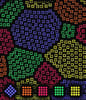
Coloruid 2 looks harmless for about three seconds. Bright jelly-like shapes, clean grid, friendly colors. Then you realize the real enemy isn’t the board, it’s your confidence. The goal is simple in a way that feels like a dare: turn the entire field into a single color. One color. One. That’s it. And somehow, that tiny rule turns every click into a decision you’ll either celebrate or immediately regret like you just texted the wrong person at 3 a.m. 📱💀
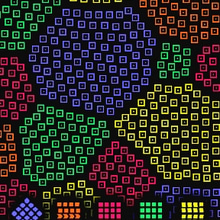
On Kiz10, Coloruid 2 lands perfectly as a logic puzzle game you can start fast and keep replaying because the “almost solved” feeling is viciously addictive. The board is divided into groups of colored pieces, and you’re basically negotiating with the grid. You pick a color, then pick a connected cluster, and the game floods that cluster into your chosen shade. Sounds like painting, right? Except it’s painting with consequences. You’re not decorating, you’re converting territory, and every move changes the future of the board in a way you can’t unsee.
It’s the kind of puzzle where you stare at the grid and whisper, okay, if I change this group to blue, it will merge with that blob… but then I lose access to the red bridge… unless I turn that green island first… wait, why is my brain sweating. 🧠🔥
🧃 Jelly Crosses, Sticky Choices, and the Art of Not Panicking 😵💫
There’s a specific texture to how Coloruid 2 feels. The pieces look soft, almost like candy or gummy tiles, and the transformation between colors feels smooth, satisfying, clean. That’s the trap. Because while your eyes are enjoying the nice visuals, your logic is quietly being tested. This isn’t a “click randomly and eventually win” situation. The board rewards planning, and it punishes impulsive moves with that cold silence only puzzles can deliver.
You’ll notice quickly that the game is not asking you to be fast. It’s asking you to be accurate. You can take your time, but you can’t take your mistakes back with a magic wand. Each move is a commitment. Each move is a tiny contract. And once you’ve signed it, the board reshapes itself around your decision like, great, thanks, now deal with the consequences. 😬
The early levels ease you in, letting you feel clever. You’ll merge a couple of groups, shrink the chaos, and think you’ve cracked the code. Then a later level drops you into a layout where every color is scattered in awkward pockets, and suddenly it’s not about making progress, it’s about choosing the “least bad” move. That’s where Coloruid 2 gets fun in a slightly mean way.
🧠 “Just One Color” Is a Lie That Takes Strategy 😈
The phrase “make everything one color” sounds peaceful. Zen. Minimalist. Coloruid 2 turns it into a tactical battle. Because the real problem isn’t the final color, it’s the order of merging. The grid is basically a map of social drama: these two groups want to connect but they need a mediator color first; those three islands could unite if you stop being stubborn; that one annoying little patch is going to be a problem later if you ignore it now.
You start thinking in merges instead of moves. You’re not just changing colors; you’re building alliances. When you convert a cluster, it can fuse with neighboring pieces of the same shade, creating a larger, more powerful region you can manipulate next. That’s the heart of the game. Your best moves usually aren’t the ones that “fix” the board immediately. They’re the moves that set up a bigger merge on the next step.
And that’s where the tension comes from. Sometimes the smartest move looks like it does nothing. You’ll change a mid-sized cluster into a color that doesn’t seem helpful… until you realize it created a bridge that lets you absorb half the board later. Those moments feel amazing, like you outsmarted the puzzle instead of simply solving it. 😏✨
🌀 The Moment You Realize You’re Managing Territory, Not Paint 🎨
At some point, Coloruid 2 flips in your head. You stop seeing “colors” and start seeing “zones.” You start noticing borders. You start reading the board like a weather map of chaos. Where are the isolated islands? Which color is overrepresented? Which cluster can become a super-cluster if you merge it correctly?
This is also when you start respecting space. Big clusters are powerful, but they can also become clumsy. If you turn the wrong region into the wrong color too early, you might accidentally swallow something you needed as a stepping-stone. It feels ridiculous to say out loud, but it’s true: sometimes you want to delay a merge. Sometimes you want to keep a color alive for one more move because it’s doing a job for you, like a temporary ladder you’ll kick away once you’ve climbed. 🪜🙂
And yes, occasionally you’ll do the opposite. You’ll merge something too early, feel proud, and then notice you’ve stranded a tiny island of a different color with no clean way to absorb it without exploding your move count. That’s the classic Coloruid 2 experience: a win is never guaranteed until the last stubborn tile surrenders.
🎯 Moves Matter, and “Close Enough” Doesn’t Exist 😭
The game’s move limit is the quiet villain. It doesn’t scream. It just sits there, counting down your choices. This is what makes the puzzle feel sharp instead of casual-fluffy. You can’t always brute force. You can’t just try every option unless you enjoy watching your move counter die slowly.
Instead, you learn to pause. You learn to scan. You learn to ask yourself questions that sound dramatic but are genuinely useful: If I make this cluster yellow, what does that unlock? Which color can I eliminate completely in two moves? Where is the board most fragmented, and can I unify it without creating a new problem?
You’ll also learn a painful truth: the “best” move isn’t always the one that reduces the number of colors right now. Sometimes reducing colors too quickly creates a monster blob that blocks future merges. Coloruid 2 is weirdly elegant that way. It wants you to think ahead, but it doesn’t require math formulas or spreadsheet energy. It’s more like… chess, if every piece were gummy candy and your opponent was your own impatience. 🍬♟️
😌 The Calm That Turns Into Obsession (In the Best Way) 🔁
There’s something soothing about watching the board slowly become unified. The color transitions are clean, and when a big merge happens, it’s genuinely satisfying, like popping bubble wrap but smarter. The game gives you tiny dopamine hits without feeling cheap. And because each level is short, you get stuck in the loop of “one more.”
One more because you barely missed the move limit. One more because you found a smarter path halfway through. One more because you’re convinced that if you start again with that one different move, everything will fall into place. And it usually does… eventually… after you’ve had a mild argument with yourself. 😅
That’s why Coloruid 2 works so well as an online browser puzzle on Kiz10. It’s easy to jump into, but it keeps rewarding thoughtful play. It respects your learning. You’ll feel yourself improve. You’ll start spotting merges faster. You’ll start predicting how the board will collapse into a single color. You’ll also still mess up sometimes, because the game loves punishing overconfidence. Fairly. Politely. Repeatedly. 😈
🏁 The Final Tile Is Always Dramatic 😤🌟
Every level has that final moment where the board is almost unified and there’s one awkward patch left, like a stubborn opinion at a family dinner. You can see the solution, but your move limit is tight, and you need one clean conversion to finish it. Your cursor hovers. You hesitate. You click. The board floods into one glorious color.
And for half a second, you feel like a genius. Then you hit the next level and the game introduces a layout that looks like it was designed by someone who hates you personally. Which is perfect, honestly. Because if it were easy, you’d stop playing. Coloruid 2 doesn’t let you stop. It convinces you there’s always a smarter move, a cleaner merge, a more elegant solution waiting for you to find it.
So if you love color puzzle games, logic challenges, and that satisfying “merge the mess into order” feeling, Coloruid 2 on Kiz10 is the kind of brain-teasing candy you’ll keep unwrapping. Just don’t trust the board when it looks friendly. It’s smiling because it knows you’re about to click too fast. 😄🎨🧠



 4 (40 votes)
 Share
Share
 Embed
Embed