🛣️🚗 THE CAR IS READY, THE ROAD IS NOT
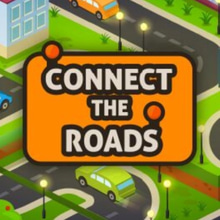
Connect The Roads starts with a very relatable crisis: a little car has places to be, and the city has decided to scramble reality into a broken jigsaw. The destination isn’t far, the problem is the path. You load the level and instantly see it, that awkward gap in the route, the pieces that almost fit, the one tile that looks innocent but is definitely the villain. It’s a classic logic puzzle idea, but with the satisfying feel of a sliding tile game: you don’t “solve” with words, you solve with motion, with nudges, with tiny corrections that slowly turn chaos into a clean road.
On Kiz10.com, it feels like the perfect short-session brain game. You can finish a level quickly, but the game keeps tempting you with that next one. “This one will be easy.” You say it every time. You’re wrong every time. And yet, when the road finally connects and the car glides forward like you planned it all along, you get that smug little dopamine spark that makes puzzle games dangerous. Not loud-dangerous. Quiet-dangerous. The kind where you look at the clock after “two levels” and realize you’ve been solving for way longer than you intended. 😅
🧠🧩 SLIDE, LOCK, REALIZE, RE-SLIDE
The core idea is clean: move the road tiles until a continuous path connects the start and the finish. But “clean” doesn’t mean “easy.” Sliding puzzles are sneaky because they turn small mistakes into big detours. One tile moved the wrong way can block the exact corridor you need. Another tile moved too early can trap a key piece in a corner like it’s refusing to cooperate out of spite.
Connect The Roads shines because it keeps the rules simple while making your brain do the heavy lifting. You’ll start each level with a plan that feels solid. Two moves later, the plan collapses, and you’re improvising. Then you backtrack. Then you try again. Then you see a route you didn’t notice before. This is the loop: a little confidence, a little doubt, a little “wait… what if I move that first?” and suddenly the whole board rearranges in your head like you just found a better angle on reality.
And the best part is how tactile it feels, even as an online puzzle. You’re not typing solutions. You’re physically reshaping the map. That makes the payoff stronger. The road isn’t connected because the game decided to be nice. It’s connected because you made the city behave.
🌟🏁 THREE STARS, ONE TINY MISTAKE AWAY
A lot of puzzle games are satisfied with “finish the level.” Connect The Roads adds that extra little twist of pressure: the star rating. Getting the car to the end is step one. Getting there efficiently is step two, and step two is where your pride starts sweating.
Because once you know a level is solvable, you immediately start thinking about solving it better. Fewer moves. Cleaner sequence. No wasted slides. You’ll complete a level and feel happy for about two seconds, then notice you got fewer stars than you wanted, and suddenly the level isn’t “done.” It’s unfinished business.
This is where the game becomes strangely competitive, but not against other players, against your past self. You replay the same board with a new mindset. You stop experimenting randomly. You begin to plan with intent. You try to predict how pieces will shift two moves ahead. You start doing that thing where you stare at the board without touching anything, like the solution might float up out of the tiles if you look hard enough. Sometimes it does. Sometimes it doesn’t. That’s the fun. 😈✨
🧭🛠️ THE GRID IS A FRIEND UNTIL IT ISN’T
There’s a satisfying clarity to a puzzle grid. Everything is visible. Everything is contained. Nothing is hidden behind luck. And yet, the grid can still feel like it’s messing with you, especially when you’re one tile away from perfection and the board layout refuses to give you the move you want.
Connect The Roads leans into that classic picture-slider energy: the board is a system, not a suggestion. If you want a tile to move somewhere, you need to create space for it. That means moving other tiles first. That means sometimes moving away from the goal to get closer later. It sounds logical, but emotionally it feels wrong, like you’re sabotaging yourself. Then you do it anyway, and it works, and you learn the most important sliding puzzle lesson: progress is often backwards for a moment.
And if you’re the kind of player who likes tidy solutions, the game becomes a gentle obsession. You’ll want routes that look elegant, not just functional. You’ll want the road to connect in a way that feels “right,” even if the car would technically drive on something uglier. Your brain starts caring about aesthetics. That’s how you know you’re fully trapped. 😂
🚗💨 THAT LITTLE MOMENT WHEN THE CAR MOVES
Puzzle games live and die by payoff. Connect The Roads has a simple payoff that hits surprisingly hard: the car driving on the path you built. It’s such a small animation, but it validates everything. Your thinking becomes motion. Your solution becomes a journey. It feels like turning a dead map into a living route.
And it changes your mentality. You stop thinking only in tiles and start thinking in flow. Where does the road want to go? Which curves need to align? Which segments are essential and which are distractions? The car becomes your “proof.” If it drives smoothly, your layout makes sense. If it can’t, you don’t just feel “wrong,” you feel visibly wrong, which is annoying, but also helpful.
This is why the game feels good even when you fail. Every failure shows you something. Every near-solution teaches you where the real blockage is. And because levels are compact, you don’t feel punished for trying. You feel nudged to try smarter.
🌀🕯️ THE PUZZLE MOOD: CALM HANDS, CHAOTIC BRAIN
Connect The Roads has that perfect puzzle atmosphere where your hands are calm but your mind is loud. You’re making simple moves, but your brain is narrating like it’s in a thriller. “If I move this tile, I lose the corner piece.” “If I don’t move it, I can’t open the lane.” “If I do this first, the whole middle unlocks.” Then you try it, and the middle does not unlock, and you stare at the screen like the grid betrayed you personally.
But that’s what makes it addictive. It’s not random. The solution exists. It’s a fair fight. You can feel it. And fairness is dangerous in a logic puzzle, because it removes your excuses. When you fail, you can’t blame luck. You can only blame the sequence. Which means you can fix it. Which means you will keep going. 😅🧠
🎯🧩 LITTLE TIPS THAT FEEL LIKE SECRET MAGIC
The fastest way to improve isn’t to move faster. It’s to pause more. Take a breath before you start sliding. Look for the “anchor” road pieces, the ones that clearly belong near the start or the finish. Identify the tile that must connect two critical lanes. Then work backwards from that tile, creating space and pathways like you’re setting up a stage for the final connection.
Also, watch for fake progress. Sliding puzzles love giving you the illusion of a working road that actually dead-ends one square later. The road looks good, but it’s missing a crucial turn. That’s where star-chasing becomes fun, because you start spotting those traps early. You stop celebrating too soon. You become suspicious of solutions that look too easy. You become, in the nicest way, a paranoid road engineer. 🤝🛣️
🏁🧠 WHY IT WORKS ON Kiz10
Connect The Roads is a tight, satisfying logic puzzle that mixes the charm of a picture slider with the clarity of a route-building challenge. It’s easy to understand in seconds, but it keeps your mind busy because every levels is a new shape, a new bottleneck, a new moment where you think you’ve got it… and the grid politely proves you don’t.
If you like road puzzle games, tile sliding puzzles, pipe-style connection logic, or any brain game where the solution feels earned, this one fits perfectly. Play it on Kiz10.com, chase those three stars, and accept the truth: your brain will keep replaying the board even after you close the tab. 🚗✨





 4.3 (46 votes)
 Share
Share
 Embed
Embed


