🧽🎨 The Wall Looks Dirty on Purpose
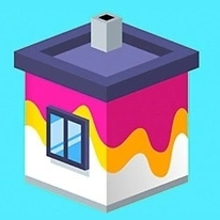
House Paint has that instantly satisfying vibe where the goal is obvious the second you see it. A wall is messy. Your tool is basically a magical eraser roller. Your job is to clean and paint the entire surface until it looks smooth, fresh, and weirdly perfect. It’s simple, it’s calming, and then it quietly gets tricky because the wall isn’t just a wall anymore. It’s a little puzzle made of lanes, gaps, corners, and those tiny moments where you think you covered everything… but one thin stripe is still laughing at you from the side. 😅
This is the kind of casual puzzle cleaning game that turns into a “one more level” situation fast. You swipe or steer the direction, the roller glides, and you watch the wall transform. It’s satisfying in the same way it’s satisfying to peel a sticker cleanly or wipe fog off a mirror. Your brain gets that tiny reward ping every time a section turns neat. And yes, the game knows that’s what you came for. It’s basically serving you neatness like a snack.
🧠🏠 A Puzzle That Feels Like Cleaning, Not Math
What makes House Paint work is that it doesn’t feel like homework. It feels like cleaning with style. The challenge isn’t numbers, it’s coverage. You have to think about how to move so you don’t leave missed spots behind, because once you pass a section the wrong way, you might not be able to come back easily. The wall becomes a grid of choices, and the roller becomes your little decision maker. Go this direction and you clear a long lane. Go the other way and you fix a corner. Hesitate and you start mentally mapping the wall like you’re planning a tiny heist. 🧽🗺️
And the game has this funny emotional swing. When you’re doing well, it feels peaceful. When you miss one small strip, it suddenly feels personal. Like the wall is judging your attention span. You’ll have that moment where you stop and stare at the screen thinking, where is the last bit. It’s always the last bit. It’s always a tiny stripe hiding in a place you swore you already cleaned. 😭
🎨🧽 The Roller Has One Rule: It Does Exactly What You Tell It
The control is straightforward, but it demands intention. You direct the roller, and it moves. That sounds easy, but “easy” becomes “oops” when the wall layout forces you into awkward angles. Some paths are long and satisfying, like cleaning a big section in one smooth move. Other paths are tight, making you slow down and aim carefully so you don’t trap yourself into leaving a gap you can’t reach.
This is where the game becomes sneaky in a good way. It teaches planning without announcing it. You start thinking ahead. If I go down first, I can clear this side, but then I might block access to that little rectangle. If I go across first, I’ll get the top, but the bottom corner might become annoying later. You’re basically doing strategy, but your brain frames it as “I just want the wall to look clean.” 😅✨
🧩🧼 The Best Levels Feel Like One Smooth Sweep
There’s a special joy in clearing a level with a clean rhythm. You guide the roller, it fills the space perfectly, and the wall becomes crisp with no leftover marks. Those are the levels where you feel like a genius even though the mechanic is simple. It’s not about complexity, it’s about flow.
The flow breaks when you rush. If you move too fast without thinking, you can create awkward leftovers that require extra moves, and extra moves are where mistakes happen. House Paint quietly rewards patience. Not slow playing, just patient decisions. Pick a line, commit, then fix the edges. The wall wants you to be thoughtful. It doesn’t want you to be chaotic. Which is funny because the moment you get bored and go chaotic, the wall wins. 🏠😈
😌🎨 The Relaxing Part: Watching Everything Turn Perfect
This is a genuinely relaxing game when you’re in the zone. The visual feedback is immediate. Dirty becomes clean. Blank becomes painted. Mess becomes order. And your brain loves order, even if you pretend you don’t. There’s a calming rhythm to it, like you’re doing a small task that always ends in a satisfying result.
It also has that “tiny accomplishment” feeling. Each level is a small win. You finish, you move on, you see a new wall, and your brain is ready to do it again. It’s like the game is giving you little bite sized puzzles that you can solve in quick sessions, but they still feel meaningful because the completion is so visible. 🧽✅
😅🧠 The Annoying Part: That Last Stripe You Didn’t See
Let’s be honest, the most dramatic moments in House Paint come from the smallest mistakes. You’ll clear almost everything, and then notice one thin line still unpainted. One. Tiny. Line. And suddenly you’re re planning the whole approach like you’re trying to fix a mistake on a real wall without repainting the entire room.
This is where you learn the real skill: scanning. You start checking corners before you move. You start thinking about coverage patterns. You start predicting where gaps are likely to hide. It’s a puzzle game that teaches attention to detail, but it does it with a smile. It never feels too serious, it just quietly dares you to be more careful next time.
And when you finally fix that last stripe and the wall turns fully clean, the satisfaction is ridiculous. Like, why does it feel that good. Why does my brain clap for a wall. And yet… it does. 😅🎉
🏠✨ The Clean House Fantasy, But Make It a Game
House Paint also hits that cozy fantasy of making a space look better. You’re not decorating with furniture or designing rooms, but you are improving something visually. That “before and after” feeling is powerful. It’s why cleaning videos are addictive, and it’s why this game works. You’re basically doing the most satisfying part of tidying up, with none of the real life effort.
It’s also super accessible. You don’t need perfect reflexes. You don’t need to memorize combos. You just need a steady hand and a bit of planning. That makes it great for all kinds of players, from kids who want a simple challenge to adults who want a calm puzzle that still keeps the brain engaged. 🧠🧽
🎯🧼 Tips Without Calling Them Tips
If you want the game to feel smoother, the trick is to treat each wall like a path puzzle. Look first, move second. Clear long lanes early when you can, then use those clean lines to reach awkward corners. When a level looks complicated, don’t panic. It’s usually just asking you to pick the right order.
And yes, order matters. The moment you accept that, you start winning levels more cleanly. You stop doing random swipes. You start doing purposeful sweeps. The roller becomes less like a toy and more like a tool, and suddenly you’re clearing walls in fewer moves and feeling weirdly proud of it. 😌
🏁🎨 Why It Belongs on Kiz10
House Paint is the perfect quick play puzzle game because it gives you instant satisfaction, simple controls, and levels that gently get more challenging without turning stressful. It’s relaxing, but not boring. Easy to start, surprisingly hard to perfect. And it’s the kind of game where finishing a level feels like finishing a tiny project, clean and complete.
If you want a casual painting and cleaning puzzle that’s all about smooth movement, smart coverage, and that addictive “make it perfect” energy, House Paint is a great pick on Kiz10. Now go clean that wall. And don’t miss the last stripe. 🧽🎨🏠
















 2.5 (390 votes)
 Share
Share
 Embed
Embed


