💡🌆 A tiny bulb, a giant city, and the worst commute imaginable
Lampada Street starts with an idea that sounds like a joke… and then immediately becomes a personal challenge. You’re not a soldier, not a racer, not a sword-wielding hero with dramatic hair. You’re a lightbulb. A fragile, bright little thing with exactly one job: make it to Lampada City by crossing streets that look like they were designed by someone who hates pedestrians. And somehow, it works. It really works.
The first seconds feel deceptively calm. The road is there. The traffic is moving. You think, “Okay, I can handle this.” Then you tap to run, you jump, you land, and suddenly you realize the spacing is tight, the timing is mean, and your bulb body has the durability of a soap bubble in a boxing ring. On Kiz10, Lampada Street hits that sweet spot where it’s easy to understand instantly but hard to master for real. It’s a 3D reaction game with the energy of a near-miss compilation, except you’re the one causing the near misses. 😅
🚦🦵 Run, jump, breathe, repeat (and try not to shatter)
The controls are clean and direct: you move forward, and you jump when you absolutely must. That sounds simple until you’re staring at a lane where cars are sliding past like angry clock hands, and you’re trying to decide whether you’re brave or just… impatient. The running is automatic-feeling in the best way, because it keeps pressure on you. No long pauses, no slow walking. The game is always nudging your nerves, always asking, “So… you crossing now or what?”
Jumping becomes your language. A short hop over danger. A leap to clear a bad moment. A desperate “please please please” jump when you realize you started too late. And when you land safely, there’s a tiny burst of relief that feels weirdly satisfying, like you just threaded a needle while someone honked at you.
The rhythm grows on you fast. Wait. Commit. Hop. Land. Tiny pause. Another hop. Then sprint again before your courage cools off. You’ll start feeling the cadence in your hands, even when you’re not looking at the whole screen, like your brain is counting traffic beats without telling you.
🛣️🚗 Traffic has personalities and they’re all rude
Lampada Street doesn’t just throw random vehicles at you. It throws patterns. Streams. Clusters that look passable until they’re suddenly not. A car you thought was slow turns out to be faster. A bike appears at the worst time, like it was hiding behind your confidence. And sometimes the lane looks open, totally harmless… until you step into it and realize you misread the distance by a single heartbeat.
That’s where the game becomes addictive. It isn’t about raw speed. It’s about reading motion. Learning to trust the gaps. Learning when to move early, when to hesitate, when to stop thinking and just go. If you treat it like a panic sprint, you’ll explode into pieces constantly. If you treat it like a timing puzzle with wheels, you’ll start seeing safe routes that weren’t obvious at first.
And yes, you will have those moments where you die and immediately whisper something dramatic like, “I can’t believe the road did that to me.” Meanwhile the road is just… being a road. You’re the one insisting a lightbulb should be crossing it. 🙃
🧠🧷 Checkpoints, three chances, and the slow rise of confidence
One of the smartest things Lampada Street does is give you just enough forgiveness to keep you trying. You’re not punished with endless restarts every time you make a mistake. You’ve got multiple bulbs to work with, which turns failure into strategy. You start thinking, “Okay, I can risk this jump, I still have another chance.” And then, funny thing, you get better faster because you’re willing to attempt bolder lines.
Checkpoints are the quiet heroes here. They break the journey into chunks, so progress feels real. Every checkpoint is a small victory that says, “Yes, you survived that nonsense. Here, take a breath.” But the game doesn’t let you relax for long, because the next section always looks slightly more complicated, slightly more crowded, slightly more “are you sure you want to do this?” It’s a perfect loop: confidence rises, chaos rises, you rise with it… or you shatter gloriously trying.
And when you finally clear a rough segment cleanly, without losing a bulb, you feel unstoppable for about five seconds. Then you see the next lanes. Then you laugh. Then you step forward anyway.
🎥🌧️ A weirdly cinematic world for something this silly
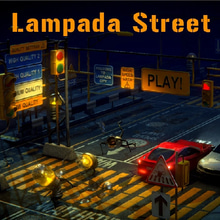
Here’s the surprise: Lampada Street can look moody. Not in a “horror game” way, more like a rainy-night city vibe where headlights streak past and everything feels a little post-apocalyptic, a little lonely, a little cool. It’s that contrast that makes the game memorable. The main character is a lightbulb, which should be pure comedy… but the environment sometimes feels almost serious, like you’re a tiny spark trying to survive a world that forgot how to slow down.
That mood makes the near misses feel bigger. A clean jump isn’t just a jump; it’s a scene. A car blasts by, your bulb lands with millimeters to spare, and for a moment it feels like you’re in an action montage made for a hero who weighs two grams and glows softly. The soundtrack and atmosphere push you forward, and suddenly you’re not just crossing roads, you’re “making the run.” Dramatic? Absolutely. Accurate? Also yes. 😄
⚡🧡 The “one more try” curse (and why it’s kind of perfect)
Lampada Street is short-session friendly, but it’s dangerous in that casual-game way where you keep restarting because the improvement curve is obvious. You can feel yourself learning. You can feel your timing tightening up. You can feel your decision-making getting sharper. And because each attempt is quick, your brain does that thing where it rewrites history instantly: “If I had waited half a second… If I had jumped earlier… If I hadn’t gotten greedy…”
Greed is the funniest villain in this game. You’ll see a gap, then you’ll see another gap, and you’ll convince yourself you can chain them back-to-back like a pro. Sometimes you can. When it works, it feels smooth, almost stylish. When it fails, it fails in the most comedic way possible: you step forward with confidence and immediately get erased by traffic. The lesson is always the same. The road doesn’t care abouts your vibe.
On Kiz10, this is exactly the kind of skill game that fits a fast, replayable slot in your day. It’s simple enough to jump into, tense enough to keep your focus, and weirdly satisfying when you nail a clean run. You’ll end up rooting for a lightbulb like it’s your last brain cell trying to get home safely. And honestly? Respect. 💡🏁





 Share
Share
 Embed
Embed