🕹️🌙 A Small Ball, A Big Problem
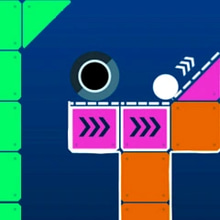
Launchball has that “looks simple, ruins your confidence” vibe. You see a clean board, a white ball, a goal, and your brain goes, alright, I just need to get it there. Easy. Then you try once and realize the level isn’t asking you to move a ball, it’s asking you to think like a slightly unhinged engineer who also happens to be allergic to gravity. On Kiz10.com, this puzzle game feels like planning, tinkering, and those tiny moments where you whisper “no no no” while the ball rolls toward disaster anyway 😅
The twist is that you’re not only reacting. You’re shaping the level. You place pieces, tweak the layout, and turn a flat setup into a real route. Then you launch the ball and watch your own choices come back like boomerangs. It’s funny in a painful way. You build something you believe is clever, press go, and the ball instantly proves you were overconfident. Then you fix it. Then it fails in a different way. That loop is the whole charm.
🧩🧱 Build the Maze Like You Mean It
Most ball puzzle games are about aiming and hoping. Launchball feels more like staging a controlled accident. You look at the board and start arranging parts: blockers, corridors, redirectors, little setups that either guide the ball cleanly or turn it into a ping-pong tragedy. One tiny mistake can convert “smooth route to the goal” into “ball trapped forever in the world’s saddest corner” 😭
This is where your brain shifts into real puzzle mode. You stop thinking about a single move and start thinking in sequences. If the ball hits this side first, it slides down there. If it bounces wrong, it loses speed. If it enters that corridor too fast, it might skip the turn and crash into something dumb. It’s not just direction, it’s timing and momentum. Suddenly you respect little slopes and angles like they’re living creatures with opinions.
And because the levels feel like mini construction projects, your solutions start to feel personal. It’s your maze. Your plan. Your disaster. Your redemption.
🎯🌀 The Launch Moment Is Always a Drama Scene
There’s a special tension right before you launch. You’ve placed your pieces, stared at the board, and replayed the route in your head like a montage. Now you commit. You launch the ball and become a spectator to your own design. It rolls… it turns… it slows… it wobbles on an edge like it’s considering betrayal… and your whole body leans forward like you can telepathically guide it. You can’t, but you’ll try anyway 😅
Sometimes the ball follows your route perfectly and you feel like a genius for five seconds. Sometimes it does something unexpected, and you realize your “perfect” plan had a hole the size of your ego. The good part is that failure here is useful. You can see exactly where the route breaks. You learn what angles are too sharp, what corridors are too narrow, where you need to slow the ball down, where you need to protect it from your own chaos.
You’re not just solving puzzles, you’re debugging your layout. It’s level design in miniature, and the ball is your brutally honest tester.
🛠️🧠 When the Levels Stop Being Nice
Launchball doesn’t stay gentle. Early stages teach you the language of the game: how pieces guide movement, how the board “wants” the ball to travel, how a small adjustment changes everything. Later, the layouts become trickier, the goal is placed in nastier positions, and your route needs to stay stable from start to finish instead of working “most of the time.”
And here’s the weird lesson: sometimes the best solution isn’t more complicated. Sometimes you overbuild, add too many turns, create too many chances for the ball to misbehave, and the fix is to simplify. Straighten a path. Remove a risky bounce. Give the ball a calmer line. It feels like life advice, then you launch again and the ball still finds a new way to embarrass you. Lovely 😭⚪
😈⚙️ The Fun Lives in Tiny Adjustments
Launchball is a game of micro-edits. Move one piece and the whole level behaves differently. You tweak an angle, widen a corridor, add a stopper to prevent overshoot, and suddenly the run looks clean. It’s like tuning an instrument, except the music is a ball rolling to the goal without ruining your mood.
This is why it stays addictive on Kiz10.com. Attempts are short, but every attempt teaches you something. You start recognizing common problems: the ball is moving too fast, so you need a soft slowdown. The ball is drifting off-route, so you add a guide wall. The ball keeps bouncing out of a lane, so you give it room to settle. Your intuition improves, and it feels earned.
Also, there’s quiet joy in watching a plan finally work. The ball glides through your path like it’s following invisible rails, and you get that internal “yes” that’s half pride, half relief.
🌟🧿 Why Launchball Hooks You
Launchball fits perfectly on Kiz10.com because it’s quick to start, easy to understand, but genuinely satisfying to master. It’s a brain game that doesn’t drown you in instructions. It gives you a board, a ball, a goal, and just enough freedom to make your own logic win against stubborn physics.
If you like physics puzzles, maze games, and that calm-but-chaotic feeling of crafting a solution with your own hands, Launchball hits the spot. You’ll laugh at your mistakes, celebrate the clean runs, and do the classic thing: beat a levels, swear you’ll stop… then immediately hit the next one because you want to prove it wasn’t luck 😅🎮
Launch the ball. Watch it roll. Adjust the board. Try again. Somewhere between your third redesign and your tenth “this time it’s perfect” moment, you’ll realize the ritual is simple: the ball doesn’t move until you commit, and once you commit, the level becomes your mirror. Good luck in there ⚪🧩✨



 4.3 (40 votes)
 Share
Share
 Embed
Embed