🗡️ A sad little monkey in a village full of secrets
Monkey Go Happy Samurai is exactly the kind of game that looks simple until you click one thing, then another, and suddenly the whole village starts feeling like a puzzle box built by someone who really enjoys hiding answers in plain sight. Kiz10’s page makes the setup clear: you must search for mini ninjas, summon the samurai, and help the monkey solve puzzles in a mysterious samurai village. There are coins hidden near old buildings, farms, and mountain areas, which already tells you a lot about the tone. This is not a loud action game. It is a quiet little logic adventure wrapped in charm, curiosity, and just enough weirdness to keep your brain fully awake.
That is one of the reasons the Monkey Go Happy series works so well. The goal is always emotionally simple. There is a sad monkey. You need to fix the situation. But the way you do it is where the magic happens. In Monkey Go Happy Samurai, the mood shifts into feudal Japan fantasy, with a village full of hidden items, odd clues, and tiny details that look decorative until you realize one of them is probably the exact reason you are stuck. That is the whole flavor of the game. It is calm on the surface, but underneath, every screen is quietly daring you to notice more.
And honestly, that is why it becomes addictive so quickly. You never feel far from the answer, which is much more dangerous than feeling completely lost. The solution is always close enough to taste. One missed coin. One hidden object. One clue you looked at but did not really see. That is the kind of pressure that makes point-and-click puzzle games so hard to leave alone.
🏯 The village is small, but the puzzle logic is not
What makes Monkey Go Happy Samurai stand out from more generic hidden-object games is how much personality the setting gives the puzzle chain. A samurai village already feels full of possibilities. Gates, rooftops, lanterns, farms, mountain paths, old wooden structures, and tiny tucked-away corners where something important can easily disappear. That gives the whole game stronger atmosphere than a plain room puzzle ever could.
The best thing about a setting like this is how it changes the way you look at objects. A door is never just a door. It might need the right item. A structure in the distance might be more than scenery. A small token or coin near a building might not only be collectible, but part of the larger route toward making the monkey happy. The environment becomes a conversation with the player. You click, the scene reacts, and slowly the whole level begins to open.
That is where the game feels most satisfying. Not when you randomly guess something, but when the village starts making sense. You begin noticing how one solved piece reveals another. One item leads to one action. One action opens a clue. Then suddenly the whole place stops feeling mysterious and starts feeling readable. That shift from confusion to control is one of the best feelings in puzzle games, and Monkey Go Happy Samurai seems built exactly around that rhythm.
🐵 The monkey is the emotional engine, and somehow that still works perfectly
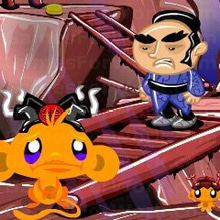
There is something deeply funny about how effective this series is with such a simple emotional hook. The monkey looks miserable, and for some reason that immediately becomes your responsibility. It should not work as well as it does, but it absolutely does. That tiny face gives the whole game a purpose beyond solving abstract logic. You are not just completing a puzzle scene. You are fixing a mood. Turning a sad little monkey happy again is a small reward, but it lands every time because the game keeps the objective so clear.
In Monkey Go Happy Samurai, that emotional hook blends nicely with the village setting. The mystery is playful, not grim. The logic is clever, not exhausting. The game invites curiosity rather than overwhelming you with complexity. That makes it perfect for players who enjoy short, satisfying puzzle sessions where observation matters more than speed. You do not need fast reflexes. You need attention. Patience. The willingness to click around and trust that the answer is probably right there hiding in some tiny, annoying corner.
And yes, some of those corners will absolutely feel annoying when you miss them the first time. That is part of the fun too.
🔍 Every missing item feels personal after a while
Point-and-click puzzle games always become emotional in one very specific way: the last missing piece starts feeling like a personal attack. Monkey Go Happy Samurai is exactly the kind of game that would do that beautifully. You find almost everything. The village starts opening up. The logic chain mostly makes sense. But then one mini ninja or one coin or one tiny object remains missing, and suddenly the entire screen feels like it is quietly mocking you.
That is a good sign.
Because good puzzle games should create that tension without becoming unfair. They should make you feel like the answer is hidden, not impossible. Kiz10’s description mentioning hidden coins near old buildings, mountains, and farms supports that style perfectly. This is a game about careful looking. About revisiting areas with fresh eyes. About understanding that the environment is full of small meaningful details. Once you accept that, the whole village becomes more interesting. Every screen starts carrying possibility.
And that is why retrying or replaying these little puzzle scenes can still feel rewarding. Once you know the solution, you start noticing how neatly the clues were placed. How the item chain flows. How the scene guided you more than you realized at first.
🎎 A perfect fit for players who love soft, clever puzzle adventures
Monkey Go Happy Samurai on Kiz10 is a strong match for players who enjoy point-and-click games, hidden object puzzles, light escape-room logic, and small self-contained adventures with lots of charm. The Kiz10 page places it naturally inside the puzzle and adventure categories, and that feels exactly right. It is not a giant complicated mystery. It is a compact, satisfying one. The kind of game you start casually and then refuse to leave because one missing clue is still bothering you.
That is a very good lane for Kiz10. Easy to open, easy to understand, but with enough puzzle bite to keep players engaged. The samurai setting gives it more identity than a standard Monkey Go Happy level, and the hidden mini ninjas and coins add just enough collection energy to make the whole thing feel more playful.
So yes, Monkey Go Happy Samurai is small, clever, and full of quiet little secrets. A sad monkey, a mysterious village, hidden ninjas, and one long chain of satisfying clicks that slowly turns confusion into a smile. That is exactly the kind of puzzle game that stays in your heads longer than expected.





 Share
Share
 Embed
Embed