🤖🔗 Tiny Robots, Big Brain Pressure
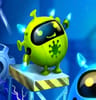
Nanobots has that deceptively calm look that always means trouble. Blue little robots. A clean board. A simple goal that sounds friendly: connect them all. And then you place your first bot and realize the game is quietly judging your efficiency. This isn’t a “match colors and relax” kind of puzzle. It’s a logic placement game where every move matters because you’re trying to build one complete network with as few bots as possible. On Kiz10, Nanobots feels like a compact brain workout that turns into a personal challenge fast, because the moment you solve one level, your brain immediately goes, yeah… but I could solve it cleaner.
The rules are easy to grasp in seconds, which is exactly why it becomes addictive. You’re given a layout with connection points and space to work with. Your job is to position the blue nanobots in the right spots so the entire system links together. That’s it. No long tutorial speeches. No complicated menus. Just the quiet, satisfying click of logic falling into place. And when it doesn’t fall into place? The level sits there like a smug little circuit board daring you to try again.
🧠⚡ Placement Is the Spell, Not the Click
The most interesting thing about Nanobots is that it rewards thinking before acting, but it doesn’t punish experimentation either. You can test an idea quickly, see what it connects, and adjust. That means the game is constantly tugging you between two mental modes. One mode is planner mode: you stare at the board, map routes in your head, try to predict where a single bot placement will create the maximum connection value. The other mode is chaos mode: you start dropping bots just to see what happens, hoping the network will magically solve itself. Chaos mode feels fun for a moment. Planner mode is what actually wins.
But even planner mode has a twist. The “best” solution usually isn’t the one that connects something immediately, it’s the one that connects everything later. A placement that looks strong can actually trap you, because it consumes space you need for a more efficient chain. Nanobots loves that. It makes you learn the difference between an obvious connection and a useful connection. You’ll catch yourself thinking, okay, yes, this links two parts… but does it help the whole network, or did I just waste a bot on a local win? That question is the entire game in one sentence.
🔬🛰️ The Board Becomes a City Map in Your Head
After a few levels, something weird happens: you stop seeing robots and start seeing traffic. You start seeing lanes. You start seeing “bridges” and “bottlenecks.” Some areas are open and flexible, perfect for routing connections. Other areas are tight and fragile, where one wrong placement blocks the best pathway. The level becomes a little city planning problem, except the citizens are robots and your mayoral term ends the moment you run out of clean options.
This is why Nanobots feels so satisfying when it clicks. You’re not just guessing; you’re constructing. A strong solution usually has a shape to it. A spine. A central route that everything else can connect into. Once you build that backbone, the rest of the board suddenly feels easier, like the problem finally agreed to be solved. The best levels don’t feel like you forced the answer. They feel like you discovered it, like the layout always had a hidden “intended flow” and you finally saw it.
😵💫🔗 When One Bot Feels Like a Commitment
Because you’re trying to use the minimum number of nanobots, every placement has emotional weight. That sounds dramatic, but you’ll feel it. You’ll hesitate before placing the next one because you know every extra bot is basically you admitting the level outsmarted your first plan. And that’s the brilliant tension: the game doesn’t just ask you to connect things, it asks you to do it elegantly.
This is where your internal monologue becomes funny. You’ll start bargaining with yourself. “Okay, I’ll place one here… and then surely the rest will work.” It doesn’t. “Fine, one more bot, but that’s it.” Then you place the extra bot and the network still isn’t complete and you stare at the board like it’s doing this on purpose. It is. And you love it for that, because the problem feels fair. If you look long enough, there is a smarter route.
🧩🧠 The “Minimum Bots” Flex
Nanobots has an invisible scoreboard that lives in your pride. You can finish a level with a messy solution and still pass, but you won’t feel done. Not really. Because you’ll see the board after winning and immediately notice where you wasted a placement. You’ll realize two bots could’ve been one if you routed differently. You’ll realize you built two separate chains when you should’ve built one backbone and fed everything into it.
That’s the genius of “minimum resource” puzzle design: it creates replay value without needing random generation. The same level becomes a new challenge when your goal changes from “solve” to “optimize.” And optimization feels incredible because it’s pure skill. No luck. No reaction time. Just you getting sharper.
🧠🛠️ Small Habits That Make You Solve Faster
A strong habit is to look for the farthest separated parts of the network first. Those distant clusters often define your main routes, because you’ll need efficient bridges between them. Another habit is to avoid placing bots too early in the most open central areas unless you’re sure they’re part of your backbone, because central space is valuable. It’s where you can pivot routes and connect multiple sides. Waste it and you’ll feel it later.
Also, don’t lock yourself into one plan. Nanobots rewards re-framing. If you’re stuck, it usually means your backbone is wrong, not that you need a pile of extra bots. Try pulling the spine one tile over. Try connecting through a different corridor. Sometimes a tiny change turns a nearly-solved mess into a clean solution, and that moment feels like magic. Not loud magic, more like quiet satisfaction: oh… that was it.
✨🤖 Why Nanobots Works So Well on Kiz10
It’s quick to start, quick to understand, and still deep enough to keep your brain engaged. You can play one level as a short break and feel that satisfying “I solved something” reward. Or you can spiral into optimization mode and spend way longer than planned because now it’s personal and you refuse to use an extra bot. Nanobots is the kind of puzzle game that doesn’t need flashy animations to be compelling. The board itself is the story. The solution is the payoff. The efficiency is the bragging right.
If you like logic puzzles, connection games, routing challenges, and brainy levels where the cleanest solution is the real victory, Nanobots is a perfect fit. It’s minimal on the surface, sharps underneath, and it will absolutely make you replay a level just to save one bot and prove you’re smarter than a grid. 🤖🔗😈





 4.5 (12 votes)
 Share
Share
 Embed
Embed