😶🌫️🔫 Quiet First, Then Your Heart Starts Sprinting
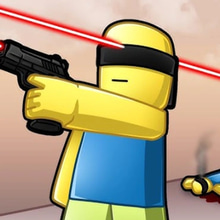
Obby: Blind Shot Online has the kind of tension that shows up before anything even happens. You spawn into an arena that looks clean and simple, almost innocent, and for a second your brain relaxes. Then you remember the twist. Your rivals are here too. You just cannot see them. So the calm immediately turns into that paranoid focus where you’re staring at corners like they’re suspicious and listening for meaning in every tiny movement sound. It’s a tactical shooter, but not the usual kind where you peek and spray. This one is about deduction, patience, and the weird confidence it takes to shoot at empty space and believe you’re right. 😬
The match has a rhythm that feels like a secret handshake. First comes preparation, where you move fast and quietly, trying to find the best spot without making obvious choices. Then the shooting starts, and suddenly the whole arena becomes a puzzle. You are aiming at possibilities, not at players. You are trying to think like your opponent while also trying to avoid thinking too loudly, because that’s when you panic and start firing at shadows like a startled cat. 🐱💥
And the funniest part is how quickly the game makes you feel clever. You find a good angle, tuck yourself behind cover, line up your view, and you feel like a genius strategist. Then someone’s shot lands near you, and that confident feeling collapses into “okay okay okay, they might have guessed me” and you’re instantly re-planning your life. That swing from calm to chaos is the entire charm.
🧭🧠 The Prep Phase Is Basically You Writing Your Own Destiny
Before the shooting begins, you get that precious moment to position yourself. It sounds simple, but it’s the real game inside the game. Where do you hide so you can take a shot without being obvious. Where do you stand so you can escape if your spot gets “read.” Where do you aim so your first guess has a chance of being correct. You start scanning lines of sight, imagining how someone else might move, and it turns into this quiet mental map-building session.
You’ll notice quickly that “the best hiding place” isn’t always the deepest corner. Deep corners feel safe, but they also make you predictable. A spot with multiple exits can be safer than a spot that feels protected, because if you get guessed, you need to move before the next shot comes. The strongest players don’t just hide. They hide with a plan, like they’re already picturing their escape route while they’re still sitting still. 😶🌫️🧠
And yes, sometimes you’ll choose a ridiculous spot, not because it’s optimal, but because it’s funny. Like hiding in a place that looks too obvious, hoping your opponent overthinks it. The game rewards that kind of mind game energy, because half the battle is controlling what your opponent expects.
🎧👣 Sound, Instinct, and the Art of Being Slightly Wrong
Once shooting starts, everything becomes a game of clues. You’re trying to read movement patterns, guess where someone could be based on timing, and decide where to spend your shot. It feels like a stealth duel with a blindfold on, where every sound is either vital information or pure bait. The arena stops being a place and becomes a set of probabilities.
You’ll have moments where you’re convinced you know exactly where the enemy is. You fire with full confidence. Nothing happens. That silence afterward is brutal, because you immediately realize you just revealed your own timing, your own rhythm, your own existence. And then you’re sitting there thinking, did I just give them the advantage. 😭
But when you land a shot, it feels unreal. Not in a flashy way, in a satisfying “I actually predicted a human” way. The hit confirms your thinking, your patience, your read on the map. It’s a tiny victory that feels bigger than it should, because you didn’t just aim well. You guessed well. 🎯✨
🕶️🎯 Shooting at Nothing Is Weirdly Intense
Most shooter games give you a target. This game gives you doubt. You’re aiming at corners, gaps, lanes, and cover spots, trying to picture an invisible opponent like you’re doing a magic trick with bullets. It’s tense because your brain is doing two jobs at once. You’re playing offense, trying to catch someone. You’re playing defense, trying not to be caught. And both jobs require calm, which is… hard, because the moment you feel threatened, your instincts scream “shoot now” even if it’s the worst moment.
You start learning the value of waiting. Waiting is powerful here. If you fire too early, you waste your chance and give away your presence. If you wait too long, you give your opponent time to reposition and set up a better guess. So you’re always balancing. Not rushing, not freezing, just hovering in that uncomfortable middle where you’re alert but not frantic. 😮💨
There’s also a delicious little fear that builds as the round continues. The longer you go without hearing anything, the more you suspect someone is lining you up. You might be safe. Or you might be perfectly framed in someone else’s imaginary crosshair. That uncertainty is the whole flavor.
🌀🏃 Movement Choices That Look Small, Feel Huge
Because visibility is limited, movement becomes a statement. If you reposition, you might save yourself. Or you might reveal your route. If you stay still, you might remain hidden. Or you might become predictable. The smartest movement is subtle. Small shifts, short relocations, changing angle without making noise, resetting your posture so you’re not locked into one idea.
You’ll also learn to think about what your opponent is likely to do after they miss. A miss creates panic, and panic creates patterns. Players often shoot again at the same spot, or swing to a nearby corner, or chase the idea that they were “almost right.” If you can predict that emotional reaction, you can outplay them without ever seeing them. That sounds dramatic, but it’s true. This game is as much psychology as it is aim. 😈🧠
And when you get into that flow, it feels clean. You’re not randomly firing. You’re testing areas. You’re controlling your risk. You’re making each shot mean something, even if it misses.
🤏🧤 The Finale Is Not a Gunfight, It’s a Slap Off
Just when you settle into the stealth shooter mindset, the game pulls the funniest switch. The last players standing don’t just keep sniping in silence. They face off in a one on one slap battle. It’s ridiculous, but it works. After all that quiet tension, the finale turns into raw, close-range chaos where positioning and timing still matter, but now it’s personal.
It’s also the kind of ending that makes you laugh even if you lose. You spend the whole match playing like a calm tactician, then suddenly you’re in a slap duel swinging like you’re trying to swat a mosquito that owes you money. 🫲😵💫 The contrast is perfect. It keeps the game from feeling too serious, while still rewarding players who stayed sharp to reach the end.
🏁✨ Why You Keep Clicking “Play Again”
Obby: Blind Shot Online has that classic quick-match addiction, but with a twist that makes every round feel fresh. Because you’re guessing humans, not memorizing patterns, matches keep their edge. You can improve, but you can’t fully control everything, and that balance makes it fun. You’ll learn better hiding habits, better timing, better reads on common spots, but you’ll still get surprised by someone doing something weird and brilliant.
And when you finally land that perfect blind shot, the one that feels impossible, you’ll sit there for a second like… yeah. That was me. Then you’ll queue again, because now you want two in a row. And that’s the trap, the good kind. 😶🌫️🔫🏆





 Share
Share
 Embed
Embed