🔐🧠 The lock is smiling. That’s how you know it’s dangerous
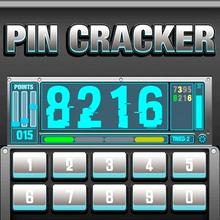
PIN Cracker is the kind of puzzle that looks polite until you touch it. A keypad. Four digits. A timer that pretends to be calm while it quietly measures your confidence and prepares to embarrass you. You’re not solving a maze, you’re not matching candies, you’re cracking a code like your brain is a crowbar and the door is laughing at you. On Kiz10.com, this becomes a fast, tense logic game where every guess is information and every sloppy guess is wasted oxygen.
The premise is simple in the way a trap is simple. A secret 4 digit PIN exists. You type a guess. The game responds with feedback that feels like a judge’s raised eyebrow. Some digits are correct and perfectly placed. Some digits are correct but sitting in the wrong position, smugly refusing to cooperate. Others are completely useless, like they never belonged in the code at all. That feedback is the whole game. It’s the difference between random guessing and actual deduction, and once you start deducing, it’s over. You’re in it now 😅.
🟩🟨⬛ Color clues that turn you into a detective with a calculator soul
The feedback system is what makes PIN Cracker addictive. It’s not just telling you “wrong.” It’s telling you why you’re wrong, in tiny, sharp fragments. You start building a mental map immediately. This digit exists. That digit doesn’t. This position is correct. That position is a lie. You begin treating your own guesses like evidence, and suddenly you’re not playing a casual browser game, you’re running an investigation.
And the weird part is how fast your mind shifts. Your first guess is usually chaotic, like throwing four numbers at the wall just to see what sticks. Then you get your first clue and your brain goes quiet. You start doing that slow, careful thinking where you stare at the keypad like it’s going to confess. If one digit is confirmed but misplaced, you start shuffling it around in your head, trying to find its true home. If a digit is confirmed in the correct spot, you lock it in emotionally, like a tiny victory flag planted on a square inch of truth 🏳️.
⏱️😬 The timer isn’t there to help. It’s there to make you doubt yourself
Without time pressure, a code puzzle becomes cozy. With time pressure, it becomes a personality test. PIN Cracker lives in that pressure. The timer forces you to choose between careful logic and fast action, and that conflict is deliciously stressful. You’ll have moments where you know the correct move is to slow down and reason it out, but your eyes flick to the clock and suddenly you’re typing faster, hoping instinct will carry you. Sometimes it does. Sometimes it throws you into a spiral of “why did I do that?” that feels way too real for a four-digit code 😭.
The best runs happen when you use the timer as fuel instead of fear. You don’t panic, you focus. You take the clue, you make one clean adjustment, and you push forward with intent. The worst runs happen when you start chasing the answer instead of building it. Chasing feels fast, but it’s expensive. Building feels slower, but it saves you because every guess has a job, every guess removes uncertainty, every guess tightens the net around the real code.
🧩🧨 The “one digit at a time” trap and the chaos of misplaced truth
There’s a sneaky difficulty in having digits that are correct but in the wrong position. That kind of clue is both helpful and annoying, like a friend who tells you “you’re close” but refuses to say how close. You’ll know a number belongs in the PIN, yet it keeps slipping away from the position you try. That’s where the puzzle becomes alive. You start permuting, testing, isolating. You stop thinking like a guesser and start thinking like a solver.
A great approach in PIN Cracker is to isolate information instead of piling guesses. If you already know a digit is invalid, don’t keep dragging it along out of habit. If you know one digit is correct but misplaced, test it in new positions with minimal other changes so you can actually interpret the next clue. The game rewards clean experiments. It punishes messy ones. A messy guess gives messy information, and messy information is how the timer eats you.
And yes, you will have that moment where you think you’ve cracked it and the lock says, nope. Not yet. Wrong order. That moment hurts, but it’s also the moment you learn the core truth of this game: the digits are only half the battle. Placement is the war.
🕵️♂️⚡ The satisfying feeling of narrowing the universe
The best part of PIN Cracker is the way the world shrinks. Early on, the code could be anything. It feels infinite. After a few smart guesses, the universe collapses into a small set of possibilities you can actually hold in your head. That’s the magic of logic puzzles, and PIN Cracker nails it. You’ll feel yourself getting sharper. You’ll notice patterns. You’ll stop making “hopeful” guesses and start making “inevitable” ones.
That inevitability is addictive. There’s a very specific dopamine hit when you realize, wait… it can only be these two digits, and this one can only go here. You’re not lucky. You’re correct. You built the answer out of evidence. When the final guess clicks and the lock opens, it feels clean. Like snapping the last piece into place. Like the puzzle finally stopped arguing.
🎭🧠 Your inner monologue is half the soundtrack
PIN Cracker is quiet, but your head won’t be. You’ll talk to yourself. Not loudly at first. Then a little louder. Okay, that digit is dead, never use it again. This one is alive but homeless. That position is sacred. Don’t touch it. Wait, what if I swap these two? No, that’s stupid. Unless it isn’t. You’ll do micro math, micro logic, micro panic, and you’ll feel silly doing it until you realize… you’re locked in. You’re fully engaged. The game did its job.
And because it’s on Kiz10.com, it’s dangerously easy to replay. You fail, you restart. You succeed, you restart because you want a cleaner win. Faster. Fewer wasted guesses. Less hesitation. It turns into a personal challenge fast, the kind where you measure yourself against your last run instead of the game itself.
🧠🔓 Why it works as a “quick puzzle” that turns into a mission
PIN Cracker is perfect for players who like brain games, logic puzzles, code-breaking challenges, and that Mastermind-style deduction loop where the clues are everything. It’s simple to understand, but it stays sharp because it doesn’t let you brute force without consequences. You have to think. You have to adapt. You have to treat each attempt like an experiment, not a hail mary.
If you want a logic game that feels tense without being complicated, PIN Cracker is a great pick. It’s a small puzzle with big mental bite, where your best weapon is patience and your biggest enemy is rushing because the timer looked at you funny. Crack the code, open the lock, and enjoy that smug little moment where you realize the puzzle didn’t beat you. You beat the puzzle 😄🔐.



 4.3 (45 votes)
 Share
Share
 Embed
Embed


