🌓🧠 A Quiet Board With Loud Consequences
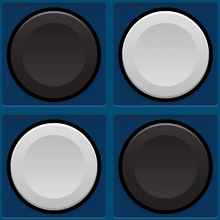
Reversi Mania looks innocent for about three seconds. A clean grid. Two colors. A simple rule that sounds like a bedtime story: place a piece, surround the enemy, flip them. Then you play one match and realize this isn’t a cozy board game at all, it’s a polite knife fight in a library. You don’t win by grabbing the most discs early. You win by setting traps that don’t look like traps, by making “good” moves feel irresistible, and by stealing the board when the opponent least expects it. That’s the heart of a classic Reversi game, and it’s exactly why it feels so addictive on Kiz10.
The first thing you notice is how fast the mood shifts. One turn you’re comfortably ahead, feeling clever, stacking flips like it’s free money. The next turn you discover you handed your rival a perfect angle, and suddenly half your color vanishes like it never belonged to you. Reversi Mania is a strategy game that teaches humility with a smile. The board doesn’t care how confident you are. The board only cares whether you left a corner open, whether you gave them mobility, whether you accidentally built them a ladder into your territory. 😬🧩
🎭🪙 The Flip Mechanic Feels Like Magic, Until It Feels Like Regret
Flipping discs is the dopamine. It’s the shiny thing. You place one piece and it’s like snapping your fingers: whole lines switch sides and your brain goes “YES.” But this is also the game’s favorite way to trick you. Big flips are often bait. They look powerful, they feel powerful, and sometimes they’re the exact move that ruins you five turns later.
Reversi Mania rewards the player who can hold back. Who can look at a 10-disc flip and say, quietly, “No. That’s a trap.” That moment is weirdly cinematic, because you’re fighting your own instincts. Your hand wants the big shiny swing. Your brain starts whispering about corners and edges and long-term control. You hesitate. You choose the smaller move. Then, later, when the opponent runs out of good options, you feel that slow, smug satisfaction of being right. 😈🧠
🧊🟩 Corners Are Royalty, Edges Are Politics
In this kind of Othello-style board game, corners aren’t just “good.” They’re terrifying. A corner is a piece that can’t be flipped, and that single fact changes everything. When you lock a corner, you start building stability outward like you’re planting a flag. Edges matter too, because they’re harder to break and they shape the lines the opponent can use.
But here’s the catch that separates casual play from confident play: you don’t just chase corners. You prepare them. Corners are often defended by poison squares nearby, those tempting spots that let your opponent take the corner right after. Reversi Mania is full of those moments where a move is technically legal, technically strong right now, and strategically cursed. You’ll learn to recognize the vibe of a bad square. It’s not always obvious, but it feels wrong, like stepping onto thin ice because you wanted a shortcut. 🧊😅
So the game becomes a conversation with the edge. Sometimes you push toward it. Sometimes you avoid it like it’s radioactive. Sometimes you sacrifice a few discs to prevent the opponent from anchoring a corner. It’s not glamorous. It’s not loud. It’s effective.
🧠⚡ Mobility: The Hidden Scoreboard Nobody Watches (But Everyone Loses To)
If you only count pieces, you’ll get lied to. Reversi Mania loves letting you “win” the midgame on points while secretly losing the match on options. Mobility is the real heartbeat: how many legal moves you have, and how many legal moves you’re allowing the opponent. A player with more choices can steer the game, dodge danger, and force bad replies. A player with fewer choices starts making desperate moves, and desperate moves usually open doors they can’t close.
That’s why strong Reversi play feels like choking the board. You don’t just take territory, you limit. You make the opponent’s next turn awkward. You present them with moves that look harmless but lead into worse positions. And when you finally trap them into a near-pass situation where their choices collapse, you’ll feel it: the board gets quiet, their options shrink, and you start placing discs with that calm “I’m driving now” energy. 🚗🧠✨
🎬🌀 Midgame Chaos: When Every Move Is a Little Story
The middle of a match is where Reversi Mania becomes personal. The board is crowded enough to create long flipping lines, but still open enough to create sudden reversals. You’ll have turns where the “best” move is a weird one that flips almost nothing. You’ll have turns where the best move is defensive, like placing a piece not to gain discs, but to block a future disaster.
This is also where you start thinking in rhythms. If you always take the biggest flip, you become predictable. If you always avoid flips, you become passive. The sweet spot is mixing intent: one turn you stabilize, next turn you pressure, next turn you quietly steal mobility, next turn you set up an edge fight. It’s like playing chess with a paint roller. Everything changes color, but the consequences stick. 🎨♟️
And the funniest part? You will absolutely lie to yourself midgame. You’ll say, “This move is safe.” Then you’ll realize it gave the opponent a perfect line into the edge. You’ll say, “They can’t take that corner.” Then they take it. You’ll stare at the board like it betrayed you, when really you betrayed yourself. Classic. 😭🌓
⏳🧨 Endgame: The Moment Your Early Greed Gets Judged
When the board starts filling up, Reversi turns into a different beast. Less room to maneuver means every legal move matters more. Sometimes the endgame feels like you’re being funneled through a narrow hallway and the last person to blink loses. That’s when the earlier decisions about corners, edges, and mobility get counted in a brutal, final way.
You can also get that delicious late-game sweep where everything flips in your favor and it feels like a cinematic reveal. Those moments usually aren’t luck. They’re the payoff for maintaining stable regions and forcing the opponent into weak placements. Reversi Mania is surprisingly good at making that payoff feel dramatic, because the board can swing hard in the final turns. One move can flip multiple lines, and suddenly the whole match reads differently.
And yes, you’ll have matches where you’re behind until the last few turns, then win. That’s the genre’s signature cruelty and beauty. It teaches patience. It punishes vanity. It rewards planning. 🏁🧠
🎮✨ Why Reversi Mania on Kiz10 Stays Replayable
It’s simple enough to start instantly, but deep enough to keep learning. Every match feels like a different puzzle because the opponent’s choices reshape the board. You don’t memorize a route like a platformer. You improvise. You adapt. You fall for the same trap twice, then finally stop falling for it, and you feel like you upgraded as a human being for a second. That’s what makes it a great brain game to play online.
If you want a strategy board game that’s fast, clean, and quietly intense, Reversi Mania fits perfectly. It’s not about flashy combos. It’s about reading the grid, controlling space, and making moves that look boring until they win you the whole board. And when you pull it off on Kiz10, it feels unfair in the most satisfying way. 😌🌓🔥





 Share
Share
 Embed
Embed


