🧠 Platforms that listen only when you panic
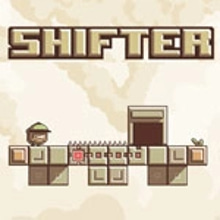
Shifter is the kind of puzzle platform game that looks almost calm from a distance. A few platforms. A small character. An exit waiting somewhere on the other side like it has all day. Then you touch the controls, tap the space bar, and realize the entire game is built around one nasty little truth: the platforms do not belong to you until you choose them, and choosing them at the wrong time can make a simple level feel like a tiny mechanical betrayal. Kiz10’s page describes Shifter as a puzzle platformer where you select platforms with the space bar and move with the arrow keys or WASD to reach the exit of each level. That one rule is the whole storm.
What makes that so good is how quickly the game stops being about movement in the normal sense. You are not just jumping across a level. You are editing your route in real time. You are deciding what can move, what stays still, what becomes useful, and what turns into a problem five seconds later. That creates a completely different kind of platform tension. In a standard platformer, the danger is usually outside you. Spikes, gaps, enemies, gravity acting dramatic. In Shifter, the danger is often your own optimism. You see a route, believe in it too early, shift the wrong platform, and now the level is staring back at you like it knew this would happen.
And honestly, that is exactly why the game sticks in your head. It is not loud. It is not overloaded with nonsense. It is one strong mechanic, cleanly presented, and just cruel enough to keep you interested.
🕹️ One button changes the whole level
The space bar is doing far more work here than it has any right to. Kiz10’s own description makes it clear that selecting the platforms is the core trick, which means every level is really two puzzles at once. First, where do you need to go? Second, what do you need to control in order to make that route possible? That double layer is what gives Shifter its bite. You are not reacting. You are planning under awkward conditions.
That feels great in practice because it turns every platform into a choice instead of just scenery. A ledge is not merely a ledge anymore. It is an object with timing, consequence, and the potential to ruin your afternoon if handled badly. You start seeing the whole screen differently. The level becomes less of a place and more of a system. Which platform should move first? Which one needs to stay exactly where it is? Can you build a route in stages, or are you about to lock yourself out of the obvious solution because your confidence arrived early and your logic took the next train?
That is where the real fun starts. Puzzle games are strongest when they make you feel smart and foolish in alternating waves, and Shifter absolutely has that energy. One moment you solve a route cleanly and feel brilliant. The next moment you realize the exit is technically reachable, just not by the version of reality you created.
⚙️ Puzzle platforming without wasted motion
There is something very satisfying about games that keep their ideas small and their consequences big. Shifter does not need ten mechanics stacked on top of each other. It has one good idea and trusts it. That confidence helps. The levels feel purposeful because everything on screen is there to test your understanding of the shifting mechanic. That is a great sign in a browser puzzle platformer. It means the game is not wasting your time with filler. It gets straight to the hard part.
And the hard part is lovely. Because unlike pure reflex platformers, this one gives your brain the starring role. Movement still matters, of course. You still need to navigate cleanly. But the real challenge is spatial thinking. Order of operations. Seeing how the level changes when one platform becomes active and another one does not. This is less “run and hope” and more “think, commit, regret, rethink, finally solve.” Beautiful structure.
It also creates those wonderful little moments where the answer feels impossible until it suddenly feels obvious. That shift is one of the best feelings in puzzle design. You stare at the same layout, confused for a while, and then your brain catches the pattern. Oh. Right. That platform first. Then that one. Then move. Then exit. And now the whole thing looks so clear you almost get offended at your earlier self for missing it.
🚪 The exit is simple, the route is the joke
The goal in Shifter is wonderfully direct: reach the exit. Kiz10 says exactly that, and it is part of why the game works so well. The objective never gets muddy. The complexity lives in the path. That is the ideal setup for a game like this. Give the player a clean target, then make the journey there a little labyrinth of bad assumptions and delayed understanding.
That also makes each level feel like a conversation with the designer. Not a long conversation. More like a smirk. You can almost feel the structure asking, are you sure that is the platform you want? Are you sure this is the order? Are you sure you have not just made the whole level harder for no reason? And because the mechanic is so readable, the game can ask those questions without ever feeling unfair. If you fail, you usually know why. Maybe not instantly, but soon enough. The answer is in the level. Your route was just messier than you wanted to admit.
There is a lot of replay pull in that. Fixable failure is the most addictive kind. You do not walk away blaming the game. You walk away thinking, no, no, I almost had that. Dangerous phrase. Famous last words before ten more attempts.
🧩 Why Shifter feels tougher than it first looks
Because platform movement tricks your brain into expecting physical difficulty, while the shifting mechanic quietly introduces logical difficulty at the same time. That combination is sneaky. You are solving with your hands and your head together. One without the other does not get you far. If your platforming is clean but your sequence is wrong, the level collapses into nonsense. If your logic is solid but your movement is sloppy, the exit still wins.
That blend is a big part of the appeal. It makes Shifter feel more alive than a static logic puzzle and more thoughtful than a pure skill platformer. You are constantly balancing action and structure. When do I move? What do I shift first? What am I accidentally making impossible? These questions keep the game from becoming repetitive even though the core mechanic stays simple.
And there is something especially satisfying about puzzle platformers that make the environment feel cooperative only if you deserve it. The level is not helping you. It is waiting for the correct instruction. Once you give it that, the whole thing opens up. When you do not, it becomes a monument to your overconfidence. Very elegant. Mildly mean.
🏁 Small game, sharp brain, surprisingly hard to leave
Shifter succeeds because it understands how powerful one clever mechanic can be. Kiz10 lists it as a Flash browser game in both the Puzzle and Platform categories, and that fit makes perfect sense. It is a puzzle platformer through and through: direct objective, spatial thinking, careful movement, and levels built around manipulating the path instead of simply running through it.
If you enjoy platform games that slow you down just enough to make you think, and puzzle games that still require a bit of nerve once the answer appears, Shifter is a great fit. It feels compact, mechanical, and sneakily brilliant. You start with a few platforms and a visible exit. A little later, you are mentally rearranging the level, wondering how one tiny space-bar decision managed to turn your route into abstracts suffering. That is usually the sign of a very good puzzle game. It means the mechanic is doing real work. And in Shifter, it absolutely is.



 4.2 (14 votes)
 Share
Share
 Embed
Embed


